


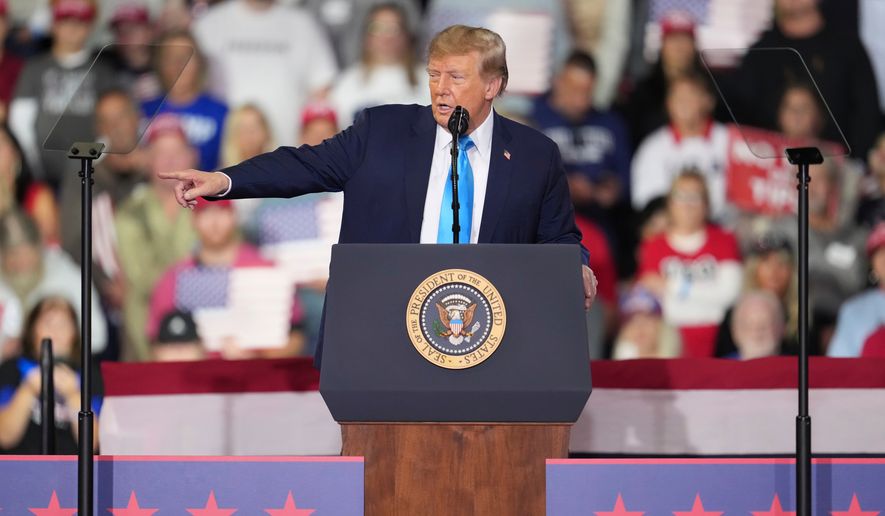

PALM BEACH, Fla. — President Trump, as he prepared for the next leg of his campaigning blitz across the U.S., boasted that his rallies are the best weapon against predictions of a blue wave in fast-approaching Nov. 3 elections.
He is also painfully aware that he’s not only battling low poll numbers but also history as he fights to keep Republicans in control of Congress for the final two years of his term.
Indeed, the president’s party has lost power in Congress in all but three midterm elections since 1894, including when Democrats took control of the House in the 2018 midterms and then twice impeached Mr. Trump.
People were interested in these podcasts
That’s why he is doing something different this time — campaigning like it is a presidential election. And he says it is working.
“You know what’s happening? These big monster rallies — everybody’s watching them in Alaska, Texas, Montana. … It’s infectious,” he said at a rally Saturday in rural Kentucky.
Mr. Trump’s rally schedule is jam-packed this week with rallies in Park City, Kansas; Greenville, North Carolina; Pendleton, South Carolina; Sioux City, Iowa; Fort Myers, Florida; Macon, Georgia, and Port Huron, Michigan.
“There’s never been any president [who] has campaigned like this for the midterms.” Mr. Trump told the Kentucky rally crowd.
He said he was “putting it all out on the line.”
“And if I don’t make it … they’ll say, ‘He was terrible, he campaigned terribly.’ If I do make it, if we win, I will get absolutely no credit,” he said. “They’ll say the candidates were spectacular, but what the hell? I have to do it anyway.”
Republican National Committee Chair Joe Gruters pitched the Trump-led turnout strategy to GOP donors at a Friday dinner fundraiser at Mr. Trump’s Mar-a-Lago estate, saying the president has “delivered these low propensity voters three times.”
“This race is all about turnout, and he is absolutely crushing out there,” Mr. Gruters said when introducing Mr. Trump at the dinner. “Nobody could do what he’s done.”
Applause erupted in the Mar-a-Lago ballroom when Mr. Trump entered the room after Mr. Gruters’ introduction.
It is a heavy lift for Mr. Trump and his Republican candidates. Polls show roughly 60% of voters disapprove of Mr. Trump’s performance as president, and Democrats top Republicans by about 8 points on a generic congressional ballot.
At the same time, the party in the White House historically is at a disadvantage in midterm elections.
Since 1934, the president’s party has averaged a 27-seat loss in the House and 3.4 seats in the Senate in the midterms, according to an analysis by the Ripon Society’s Andrew E. Busch.
The largest losses were 72 seats in 1938 under Franklin D. Roosevelt, 63 in 2010 under Barack Obama, 56 in 1946 under Harry Truman and 54 in 1994 under Bill Clinton.
“The three exceptional years, when the president’s party actually gained a tassel of seats, were 1934 (FDR), 1998 (Clinton), and 2002 (George W. Bush),” Mr. Busch wrote.
What those years had in common were uniquely popular presidents during specific extraordinary circumstances: the Great Depression, Mr. Clinton’s unpopular impeachment attempt and the of the 9-11 attacks.
On the Senate side, the president’s party gained seats or maintained control of the upper chamber in only 8 of the 23 midterm elections since 1934.
Still, Mr. Trump is fighting to beat the odds.
“What’s happening is, two weeks ago, they were talking about the blue wave. And in all fairness, we’re at a disadvantage,” he said in Kentucky.
Contact the author


Please read our comment policy before commenting.