


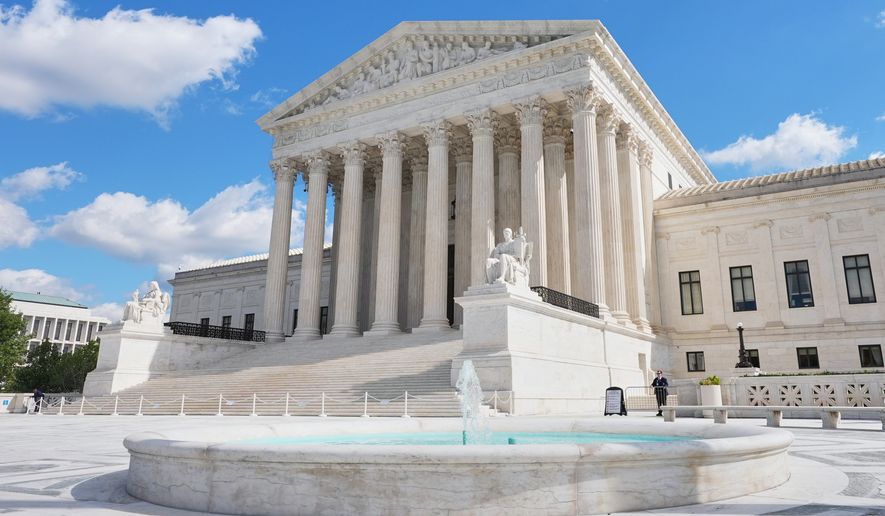

The Supreme Court said Monday it will hear a case involving the school admissions policy in Montgomery County, as the justices look to settle what standard lower courts use when deciding whether plaintiffs can sue schools over affirmative action schemes.
Lower courts have divided on that issue, with some refusing lawsuits when the plaintiffs can’t show a general maltreatment of broad racial demographics.
The justices signaled they want to settle that issue, asking the sides to focus on “whether a plaintiff challenging a facially neutral admissions policy as racially discriminatory must establish that the targeted racial group suffered an aggregate disparate impact relative to its share of the applicant pool.”
People were interested in these podcasts
Montgomery County has been trying to boost Black and Hispanic enrollment at its middle school magnet programs for years.
But opponents say the rebalancing has come at the expense of Asian American students.
The county, after several tweaks, settled on a geography-based lottery system during the pandemic. The county argues its policy is race-neutral, but Asian American families say the result has been a deep cut in their ability to get seats.
The Association for Education Fairness is leading the challenge to the county policy and the Pacific Legal Foundation is handling the case for them.
Chris Kieser, a lawyer at the foundation, said individuals’ complaints that they were blocked because of a policy should be enough to get in the courtroom. He said students shouldn’t have to prove a broader discrimination.
“A school district should not be able to defeat a discrimination claim by showing that its policy did not harm enough Asian American children. Every family deserves admissions rules that judge their child on their own merit,” Mr. Kieser said.
The case comes to the justices three years after the court’s landmark ruling finding race-based admissions policies at Harvard University and the University of North Carolina were illegal and unconstitutional.
The justices said assigning weight to a student’s application because of race cannot stand.
Schools have searched for other ways to boost minority enrollment, with geography-based plans emerging as options for public school systems with selective schools.
The Supreme Court had previously declined to hear a case challenging a geography-based policy for Thomas Jefferson High School for Science and Technology in Alexandria.
The justices also declined a case involving selective schools in Boston.
The Harvard case in particular pitting claims of Asian American students against admissions policies favoring Black and Hispanic students.
Justice Samuel A. Alito Jr. earlier this month told The Washington Times that lower courts hadn’t “gotten the message” the high court was sending in the Harvard and North Carolina cases.
“In both the Thomas Jefferson case, the TJ case, and the Boston case, the rules were changed, and it was incredibly obvious, absolutely plain, well, there was very strong evidence this was done to bring down the percentage of Asian American students at that school,” Justice Alito told The Times.
Liberal groups that support racial preferences expressed worry over the Supreme Court’s decision to hear the case, and defended the county’s policy as a critical improvement for children “who too often have been left out of opportunities.”
“Universal screening, local norming, the use of a lottery, and other reforms help ensure that students across Montgomery County have a meaningful chance to demonstrate their abilities and pursue advanced educational opportunities,” a coalition of groups said in a statement.
Among those groups were the Montgomery County branches of the National Association for the Advancement of Colored People, the Progressive Asian American Network and We Are Casa, which has advocated for Hispanic immigrants.
The county’s current policy — which opponents said was developed in secret — allows students who score high enough on an assessment to be part of a lottery. But the test scores were “locally normed,” so students at schools with higher poverty rates could score lower and still get in, the challengers said.
The challengers said students at the highest-poverty schools only had to achieve a 60th percentile score, while those at the lowest-poverty schools had to reach 93rd percentile.
Montgomery County is one of the nation’s larger school systems, though it has seen a dramatic drop in enrollment since before the pandemic.
It has fallen from about 165,000 students in the 2019-2020 term to fewer than 152,000 students now, according to preliminary figures from the new school year.
Officials expect the drop to continue through the end of the decade.
Contact the author


Please read our comment policy before commenting.