



Artificial intelligence apparently is helping reverse decades of bureaucratic bloat at universities, whose nonteaching staff have increased faster than their faculty and student bodies, analysts say.
The College and University Professional Association for Human Resources, a nonprofit group of human resources officers, surveys roughly 1,000 public and nonprofit private schools each year. The association found that colleges reported 6.6% fewer full-time staff and 23.9% fewer part-time staff in 2025 than the year before.
That reverses several years of increases. Administrative employment in 2024 jumped annually by 6.5% for full-time staff and 21.1% for part-time workers, according to the voluntary survey, which covers 30% of the nation’s nonprofit and public campuses.
People were interested in these podcasts
The association did not explain the changes.
Several academics told The Washington Times that colleges struggling with reduced enrollment and Trump administration funding cuts are eyeing smaller nonteaching workforces as AI automates research, event planning and donor relations tasks.
“I definitely see AI systems making it easier to let people go and not replace them,” said economist Siri Terjesen, an associate business dean at Florida Atlantic University who studies the topic. “People are important, but not at every stage, and there are hundreds of AI companies targeting the higher education sector.”
Ms. Terjesen reported getting at least one email a day from an AI company selling services to automate university systems.
Joy Kutaka-Kennedy, an education professor at private National University in San Diego who helps train colleagues in AI programs, noted that the technology has already reduced labor demand for college degrees and graduates.
“You can have one person running a whole bunch of AI programs on a campus,” Ms. Kutaka-Kennedy said. “There are some new jobs created, but there are also a lot of others that are eliminated.”
The American Council of Trustees and Alumni, a liberal arts advocacy group, analyzed federal data on higher education spending at four-year public and nonprofit campuses. It found administrative expenditures jumped 13.9% from 2015 to 2024, while instructional spending rose by 2.5%. Full-time enrollment inched up by 1.32%.
“AI is now at the point where many of the data management jobs done by mid- and higher-level administrators may also be threatened,” said Kyle Beltramini, a senior research fellow at the council.
However, he noted that the technology still requires “human review,” and predicted that mid-level bureaucrats will be skillful at shifting job cuts to other areas in annual budget proposals.
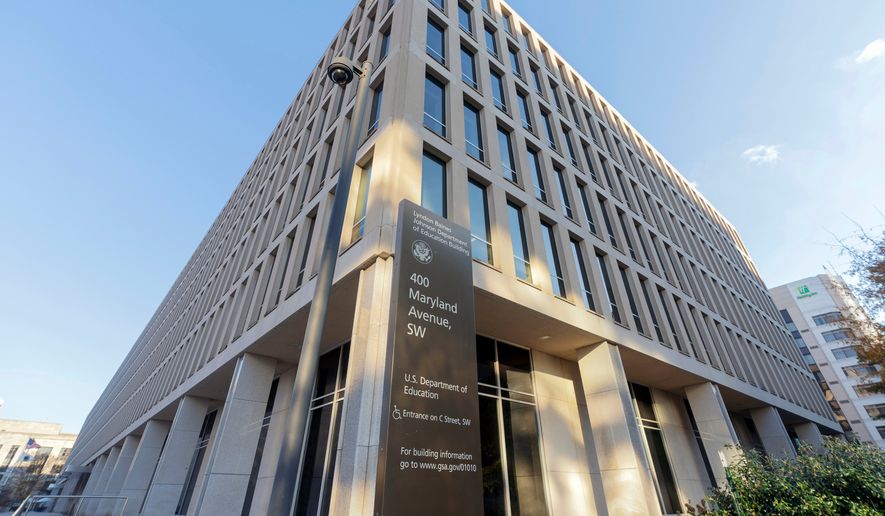
The most recent data from the Education Department shows that the number of nonteaching staff working full-time at colleges accepting federal aid grew from 1.8 million in 2013 to 1.9 million in 2023. In that period, the ratio of full-time students to full-time administrators dropped from 8.7 to 7.7.
“For decades, institutions of higher education increased tuition and administrative staffing while failing to improve academic outcomes or career opportunities for students,” department spokeswoman Ellen Keast said Monday in a statement.
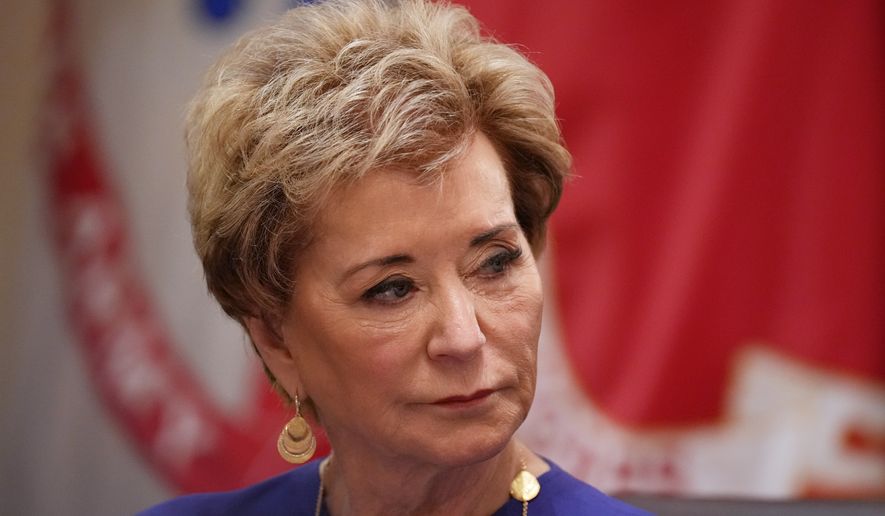
“Thanks to the leadership of President Trump and Secretary [Linda] McMahon, institutions are now being forced to live within their means, streamline operations, cut unnecessary spending, and refocus on their core educational mission,” she said.
Dick Startz, an education economist at the University of California, Santa Barbara, said more research is needed to confirm the human resources association’s survey.
“There’s been a huge drop in the new hire market for software-related jobs, and lots of schools are having financial problems,” Mr. Startz said. “But I would be surprised if many layoffs are directly related to AI at this point.”
Recent public opinion surveys have tracked a surge in Americans questioning the value of a college degree, as AI threatens white-collar jobs and graduates struggle to pay off their federal student loans.
A Gallup poll reported this month that a record low 31% of surveyed adults described a college education as “very important,” down from a previous low of 35% last year.
Campus leaders met a “demographic cliff” this spring, as a decline in U.S. births since 2008 drove a 15% drop in potential college applicants. The Western Interstate Commission for Higher Education projects the number of high school graduates will fall steadily from a record 3.9 million in 2025 to less than 3.4 million in 2041.
Jed Macosko, who teaches AI in physics and finance courses at private Wake Forest University, noted that federal higher education spending rose during the 1940s. He said most universities still hired more nonteachers after it dipped again starting in the 1970s.
“As government spending on higher education increased, universities developed a taste for becoming ever larger and more expensive,” Mr. Macosko said. “They will likely continue finding new revenue sources to sustain administrative bloat.”
A recent study of the Massachusetts Institute of Technology found that its student body has grown by 8% and its faculty by 9% since the mid-1980s. By comparison, the tally of administrators jumped by 189%.
Today there are more nonteaching staff members than students at Yale, Harvard and Stanford. In recent months, Yale leaders have embraced a push to “streamline bureaucracy” at the Ivy League institution.
University of California, Riverside philosophy professor Barry Lam said such bloat has increasingly overwhelmed faculty as administrators push them to learn AI software systems.
“There is no way universities can sustain such trends financially,” Mr. Lam said. “I understand why some felt like they needed to have a real estate and business office, but when such offices are larger than entire academic departments, the university has lost sight of its mission.”
Christiane Schroeter, a behavioral economist at California Polytechnic State University, said schools that wait for falling birth rates to force layoffs under pressure will struggle as bloated staffing keeps education costs elevated.
She called on campus leaders to publish their spending by function, tie positions to measurable student outcomes and make cuts from there.
“I would ask which roles directly serve students and which exist because no one has reviewed them,” Ms. Schroeter added. “Most campuses have never run that audit.”
Contact the author


Please read our comment policy before commenting.