


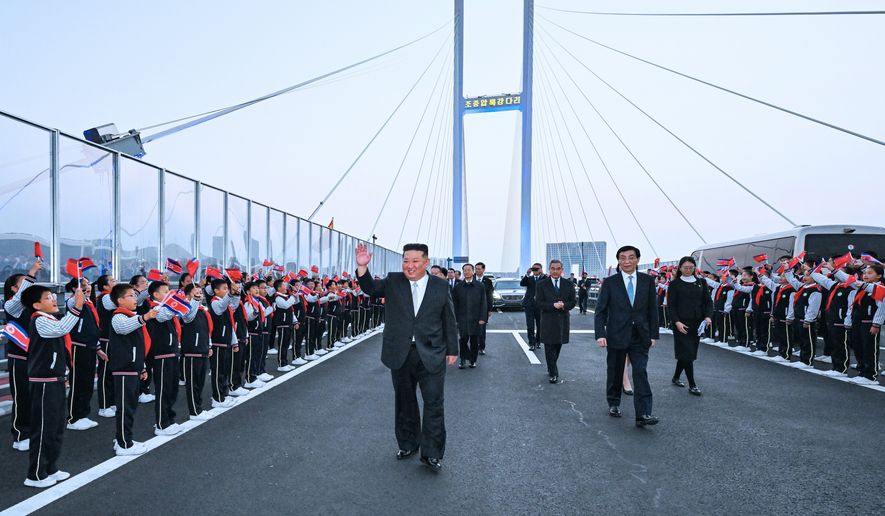

SEOUL, South Korea — North Korean leader Kim Jong Un took a day trip Saturday over the Yalu River to Dandong, the Chinese city that has traditionally been the gateway to the Korean Peninsula and which played a key role during the 1950-53 Korean War.
Images released by state media showed a beaming, besuited Mr. Kim leaving his motorcade and walking over a newly opened cross-border bridge over the Yalu River, waving at lines of children waving Chinese and North Korean flags.
The fanfare refuted unverified rumors last week on social media that Mr. Kim had died.
People were interested in these podcasts
According to Chinese media, Mr. Kim met Chairman of the Political Consultative Conference Wang Huning — widely reported as China’s fourth highest-ranking official — and Foreign Minister Wang Yi.
His own delegation included Foreign Minister Choe Son-hui and his younger sister Kim Yo-jong, a close confidante.
In addition to official talks and a visit to a bus factory, Mr. Kim paid respects at a memorial to the Chinese troops who fought in the Korean War.
“We will always remember the history when the excellent sons and daughters of the Chinese people helped our revolution at the cost of their blood and steadily and firmly carry forward the history of the [North Korea]-China friendship,” Kim said, according to state media.
China’s intervention in the Korean War in October 1950 saved the North Korean state, which was at the time on the brink of falling to U.S.-led multinational forces.
The first Chinese units covertly crossed the Yalu into North Korea on Oct. 19, 1950, where they were joined by a secret buildup of hundreds of thousands of comrades — the so-called “human wave.”
In deep ambush, these forces awaited the arrival of free-world spearheads advancing from the south. Those forces were defeated in battles in October and November.
The world was astonished. China, seen for 150 years as a third-rate military power, had overcome a mechanized modern force, saved North Korea — led by Kim Il Sung, Mr. Kim’s grandfather — and secured China’s northeastern flank.
The war dragged on until July 1953, when an armistice was signed. China suffered almost 200,000 men killed or lost.
As is typical for China-North Korea talks, little information about what was discussed between the two delegations on Saturday has leaked out.
However, President Trump has made clear his hopes of restarting dialog with Mr. Kim — the pair held two unprecedented summits in 2018 and 2019 — and pundits have raised the possibility that the two could meet next month.
China will be hosting on Nov. 17-18 the Asia Pacific Economic Cooperation summit in Shenzhen, which Mr. Trump is expected to attend.
North Korea is not one of APEC’s 21 member states, and Mr. Kim does not, customarily, attend multilateral events. However, there is speculation that he might travel to Shenzhen, in southern China, for a tête-à-tête with Mr. Trump on APEC’s sidelines.
Mr. Kim last traveled to China in September 2025, when Chinese President Xi Jinping oversaw a huge parade commemorating the 80th anniversary of the end of World War II in the Pacific. There, Mr. Kim shared the limelight with Mr. Xi and Russian President Vladimir Putin.
The Yalu River — “Amnok Gang” in Korean — is the de facto border between China and North Korea on the western flank of the peninsula.
The western side, due to its low elevation, is the customary area for north-south transport and communications: The capitals of both Koreas, Pyongyang and Seoul, lie in the west.
Mountainous terrain in the east makes land communications more difficult.
The bridge that Mr. Kim was photographed on is the “new” road bridge that was finished in 2014 on the Chinese side, complete with a huge customs hall.
An older bridge over the Yalu continues to operate alongside the smashed remains of an even older bridge, bombed by U.S. forces during the Korean War, that functions as a tourist attraction and war memorial.
Western journalists who visited Dandong in 2015 and 2016 found local Chinese — many of whom are members of the Korean-Chinese ethnic minority and keen to trade across the frontier — nonplussed by the failure or refusal of the North Korean side to connect the bridge.
It was finally connected and opened in mid-October — albeit with far less fanfare than Mr. Kim’s visit provided on Saturday.
Weeks prior, a new road bridge connecting North Korea to the Russian Far East opened in September.
North Korea closed virtually all communications routes to the outside world during the COVID pandemic, but in 2024, Mr. Kim and Mr. Putin signed a mutual-defense treaty in Pyongyang.
North Korea has supplied huge numbers of munitions to the Kremlin, and in late 2024 North Korean troops joined Russia’s fight against Ukraine in Kursk Oblast — the first and only foreign ally to officially join Mr. Putin’s invasion.
Though Pyongyang does not publish economic figures, Russian aid, payment and military technology transfers are believed to have provided a massive boost to North Korea’s economy.
These factors could explain Mr. Kim’s current confidence in his two key allies, Beijing and Moscow, and the newly opened transport corridors.
Correction: A previous version of this report misstated when the Korean War armistice was signed.
Contact the author


Please read our comment policy before commenting.