


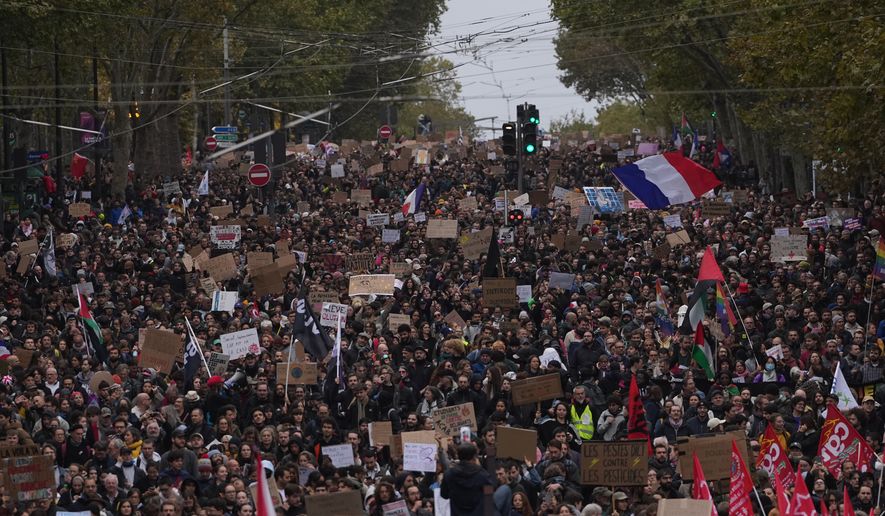

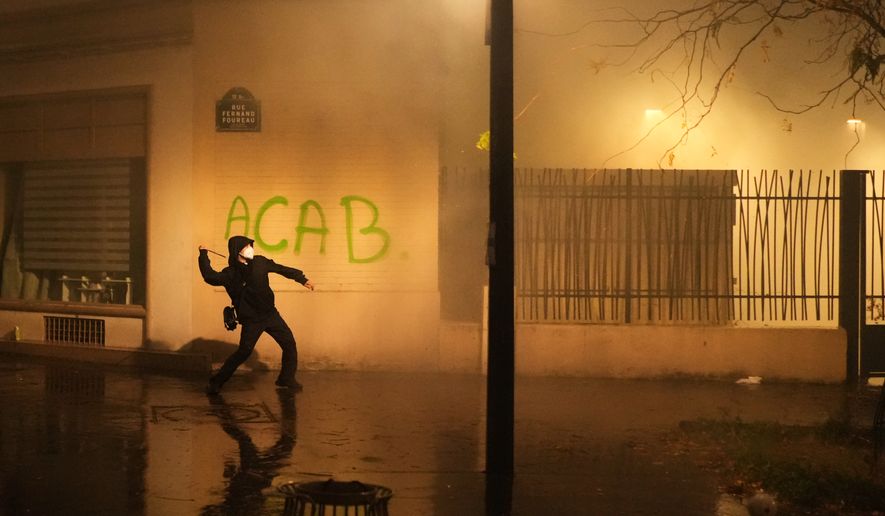
PARIS — Protesters waving Palestinian flags stormed the Colosseum in Rome, demonstrators looted shops in Barcelona and masked rioters hurled rocks, bottles and fireworks at police in Paris as another weekend of unrest unfolded across Europe.
French officials reported at least 1,300 arrests as police used heavy tear gas, stun grenades and water cannons to disperse crowds when violence erupted after a day of largely peaceful protests across the nation.
Interior Minister Laurent Nunez said authorities cracked down on demonstrations Saturday after facing “an extremely elevated level of violence” from black-clad “ultra-left” extremists. Riot police squads fired tear gas at protesters in Paris, Marseille, Lyon, Bordeaux, Lille, Toulouse, Montpellier and Nantes.
People were interested in these podcasts
Still, Mr. Nunez described the government’s response to the ongoing protests as more “positive” than a week earlier, when riots led to an estimated $1.3 billion in damages affecting as many as 3,000 businesses across France.
Officials responded last week with curfews, restrictions and, on Satursday, a massive deployment of 70,000 police on city streets to handle the demonstrations, which organizers have said are being driven by anger over rising prices and poor schools.
Critics of President Emmanuel Macron’s administration, including right-wing leader Marine Le Pen and U.S. President Trump, have blamed the unrest on Macron policies and on France’s migrant communities, while other analysts have cited the subversive influence of international communist groups.
Mr. Macron is also being slammed from the left. The Yellow Vests, the loosely organized protest group behind disruptive anti-Macron demonstrations in 2018 and 2019, called for supporters to return to the streets again on Saturday.
According to the France 24 news site, far-left presidential candidate Jean-Luc Melenchon vowed that Mr. Macron “is going to understand that this is going to repeat itself every week.”
Most marches proceeded peacefully. Authorities counted 410,000 demonstrators nationwide, including 110,000 in Paris, down from 550,000 across France a week earlier. The Confederation Generale du Travail, one of France’s largest trade unions, estimated turnout at nearly 800,000.
Riot police in body armor, officers on motorcycles and van after van filled with police patrolled the main arteries of Bordeaux, Paris and other major cities.
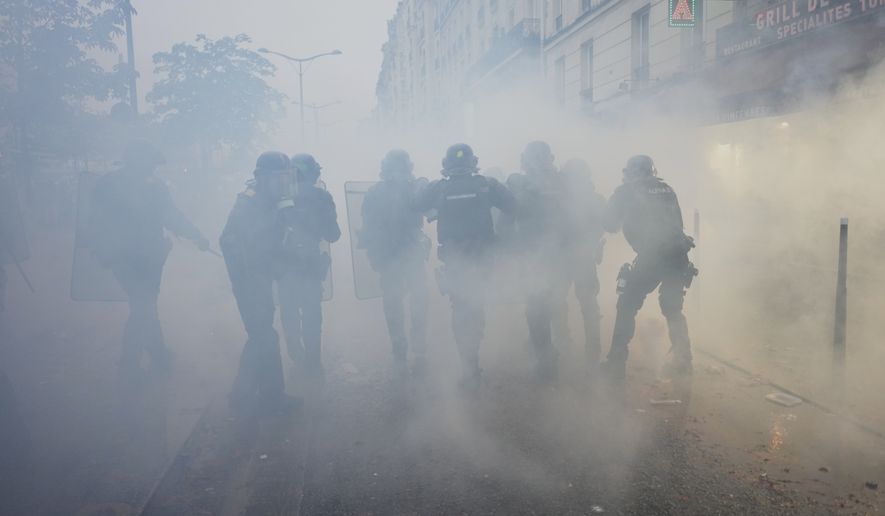
Shops boarded up their windows, while major Paris museums closed as a precaution.
The Interior Ministry reported Sunday that 1,314 people had been detained nationwide, and 53 officers injured, compared with 2,628 detentions and 1,144 injured officers the previous Saturday.
The ministry reported 24 shops looted and 75 fire-response interventions.
Americans in Paris for Sunday’s Pittsburgh Steelers-New Orleans Saints game were upbeat despite the NFL’s decision to scale back festivities for the contest, part of the league’s series of international showcases.
The French government had acknowledged failures in intelligence and preparation after the Oct. 17 violence. Its revised approach combined the deployment of additional personnel with searches at railway stations and major roads, restrictions around commercial districts and units positioned to respond rapidly to groups breaking away from marches.
In Paris, authorities moved the main procession to the capital’s southeastern edge, away from central shopping streets. Several subway stations were closed, and the Louvre and Musée d’Orsay shut their doors.
Opponents accused the government of using the violence to restrict the right to peaceful protest. The leader of the Greens party Marine Tondelier said Friday: “They are taking security measures to respond to a social crisis.”
“What changed was anticipation,” Mr. Nunez countered Saturday.
He credited greater police visibility and mobility with preventing most attempted attacks on people and property.
Clashes nevertheless erupted near the Paris march’s endpoint at Porte de Vincennes, where masked demonstrators threw projectiles and fireworks. Police responded with tear gas and water cannons.
In Marseille, groups burned garbage bins, hurled rocks and bottles at officers and ransacked stores, including two jewelry shops, according to police cited by Reuters.
Bordeaux’s initially peaceful procession also gave way to confrontations. The prefecture’s Saturday evening assessment, reported by Bordeaux Gazette, counted 44 detentions, two injured officers, one injured demonstrator and eight businesses damaged or looted.
Windows were broken at the Palais de la Bourse.
Serious civilian injuries once more fueled criticism of heavy-handed police tactics.
A 20-year-old man suffered a severe hand wound in Toulouse. In Clermont-Ferrand, prosecutors opened an investigation into another demonstrator’s serious hand injury, saying Sunday it could have been caused by a police grenade. The circumstances of the Toulouse injury remained under investigation.
National authorities did not release a consolidated count of injured protesters.
The movement began weeks ago with high school protests over staffing shortages, crumbling infrastructure and poor teaching conditions, before broadening to encompass wages, fuel prices and declining purchasing power.
Students are demanding more teachers, repairs to schools and changes to the university admissions system.
Aurelien Boudon, a national secretary of the left-wing Solidaires union federation, said students’ concerns also reflected their families’ financial difficulties.
“They were also talking about their parents, who can no longer afford to fill the gas tank or stock the fridge,” he told The Washington Times ahead of Saturday’s protests.
He repeatedly emphasized that Solidaires opposed rioting and looting and seeks to build pressure instead through workplace strikes and large demonstrations. But he also acknowledged that many protesters believe their earlier, peaceful efforts have been ignored.
Mr. Boudon criticized the pace of security measures compared with the government’s sluggish response to social demands.
“On social and educational questions, it tells us there will be answers later, in a few weeks,” he said. Protesters also clashed with police in Italy, Spain and Belgium over the weekend.
In Rome, activists, many waving Palestinian flags, forced their way through the gates of the Colosseum were eventually dispersed by police using water cannons and tear gas.
In Barcelona, hooded youths set over 30 street fires, clashed with riot police, and looted or vandalized at least 14 downtown shops.
Students in Brussels also clashed with police, though officials indicated the intensity of the protests had diminished compared to a week earlier.

Please read our comment policy before commenting.