



NEWS AND ANALYSIS:
China’s military is developing directed-energy weapons to attack U.S. military satellites in a future conflict, according to a new Defense Intelligence Agency report on space security threats.
The report made public this week states that the People’s Liberation Army views laser and other beam weapons as “ideal counterspace weapons” based on their ability to cause both reversible and nonreversible damage to orbiting enemy satellites.
“China has multiple ground-based laser weapons with varying power levels to disrupt, degrade, or damage satellites in [low earth orbit],” the report said. “By the late-2020s, China may field space-based directed energy systems and higher-powered ground-based directed energy systems capable of threatening satellites in higher orbits.”
People were interested in these podcasts
According to the DIA, the PLA announced in January that laser weapons had entered a “golden age.” The PLA said China’s new weapons will include dazzlers that temporarily disable sensors.
The DIA’s disclosure of China’s space laser plans was included in an unclassified report on Chinese, Iranian, North Korean and Russian space threats.
Publication of the report follows the announcement last month that the U.S. has deployed an anti-satellite weapon in space. Air Force Secretary Troy Meink made the disclosure but provided no details on the type of weapon now in orbit. It was the first time the U.S. military acknowledged having orbital weapons.
Defense analysts suspect the secret U.S. space weapon is some type of electronic warfare system that, similar ot the DIA’s description of an orbiting Chinese directed energy weapon, could also attack satellites using either reversible or irreversible effects.
The Pentagon is planning to deploy space-based interceptors as part of President Trump’s Golden Dome nationwide missile and aircraft defense systems.
In addition to directed-energy capabilities, China’s space weapons also include anti-satellite missiles, the DIA report said.
So-called direct ascent ASAT missiles are problematic for space combat because destroyed satellites create large debris fields — as evidenced by China’s 2007 ASAT missile test that left tens of thousands of dangerous, high-speed pieces of wreckage from a destroyed weather satellite orbiting in a large band of space.
Other orbital threats identified by DIA include maneuverable satellites with robotic arms that can grab and crush other satellites.
China also has satellites that have been maneuvered into position near other nations’ satellites in high geosynchronous orbits — close enough that the stalking satellites could be used to attack key military satellites in that orbit.
“Since at least 2006, government-affiliated academics have investigated aerospace engineering technologies associated with space-based kinetic weapons — a class of weapon used to attack ground, sea or air targets from orbit,” the report said.
“China’s space-based kinetic weapons research included methods of reentry, separation of payload, delivery vehicles and transfer orbits for targeting purposes,” the report said.
A Chinese scientist also revealed in a 2022 report that the military has studied using nuclear weapons in space as anti-satellite weapons, the DIA said. A space-based nuclear blast could neutralize multiple targets simultaneously.
China appears to have no plans to test or develop a space nuclear weapon, unlike Russia, which the DIA said is working on an orbiting nuclear weapon for use against satellites.
“A space-based capability such as this could cause rapid and sudden loss or degradation of thousands of satellites operated by countries and companies around the world, as well as to the vital communications, navigation, scientific, meteorological, commercial and national security services they provide,” the report said.
The report also noted China’s 2021 test of a “fractional orbital” long-range missile carrying a hypersonic glide vehicle — a maneuvering strike weapon designed to defeat missile defenses.
“This test demonstrated the greatest distance flown [~24,855 miles] and longest flight time (~100+ minutes) of any Chinese land attack weapons system to date,” the report said.
The report also included the first public image of China’s reusable space plane as it is orbiting near a satellite taken by a Maxar commercial imagery satellite.
The delta-wing space plane appears similar to the U.S. X-37B space plane that can spend long periods in orbit and which could be used for military missions.
Twenty-year mark for Chinese sub threat to Navy carrier
Twenty years ago this week the Navy experienced one of its worst security failures when a Chinese Song-class submarine surfaced undetected within torpedo range of the aircraft carrier USS Kitty Hawk in waters near Japan.
The submarine showed itself some five nautical miles from the carrier on Oct. 26, 2006, alarming and angering officers and sailors aboard, including Navy pilot Sam Paparo. The then-commander of Strike Fighter Squadron 195, now Adm. Paparo, went on to become the current commander of the Hawaii-Based Pacific Command.
The incident was kept secret by the Pentagon and the George W. Bush administration over concerns it would upset U.S.-China relations.
The Washington Times was the first to report on the Chinese submarine stalking on Nov. 13, 2006, in a major news exclusive.
The Times report noted that the encounter revealed China’s efforts to prepare for a conflict with the U.S. despite Pentagon exchanges aimed at building relations with China’s communist-ruled military.
Disclosure of the incident by this reporter coincided with the first visit to China by then-Chief of Naval Operations Adm. Gary Roughead as part of what critics said were feckless Pentagon efforts to develop cordial relations with the Chinese military.
Another officer familiar with the scandal, retired Navy Capt. James E. Fanell, was the senior intelligence officer for China at the Office of Naval Intelligence at the time and from 2003 to 2005 was the Kitty Hawk’s strike group intelligence officer.
Capt. Fanell said the carrier was conducting flight operations east of Okinawa, and he called the incident a turning point in China’s effort to transform the PLA navy into a dominant maritime power in the Pacific.
“This incident was an important inflection point in history, the results of which the U.S. Pacific Command and Pacific Fleet are now dealing with the PRC and PLA navy that is threatening the existing regional peace and security of the Western Pacific,” he said.
The incident was a watershed event for legitimizing the Chinese navy’s modernization efforts, the largest any nation had undertaken since World War II.
It also was the first PLA navy “break out” operation seeking to extend power past East Asia’s first island chain that is continuing to expand globally, Capt. Fanell said.
Military officials have said the PLA naval buildup is aimed at control over all waters hundreds of miles from the Chinese coast covering a chain of islands stretching from Japan south to the South China Sea.
Two years before the carrier-sub standoff, Chinese submarine forces experienced multiple damaging and embarrassing disasters, including deadly onboard fires on several vessels.
After the failures, submarine standdown was ordered by then PLA navy commander Adm. Wu Shengli, who denied to the visiting Adm. Roughead that the Song submarine carried out the provocative maritime stalking.
The standdown ended with the carrier incident, Capt. Fanell said.
Today, China’s navy is the largest in the world with an expanding number of newer, more capable submarines that operate with increasing stealth.
“We have not time to waste in restoring America’s naval power,” he said.
Air Force marks production of first hypersonic missile
A new air-launched hypersonic missile is entering the production phase as the first ultra-high speed weapon for the service, according to an Air Force statement.
The office of Air Force Secretary Troy Meink said in the statement made public Monday that a $694 million contract was awarded to the missile manufacturer Lockheed Martin for production and fielding of the Air Launched Rapid Response Weapon (ARRW), also known by its military designator as the AGM-183A.
“This is a turning point in our advanced weapons roadmap,” said Mr. Meink. “By moving ARRW from test to production, we’re providing our combatant commanders with a credible, high-speed strike weapon capable of penetrating the most advanced anti-access and area-denial systems.”
No details were provided on when the missile will be operationally deployed.
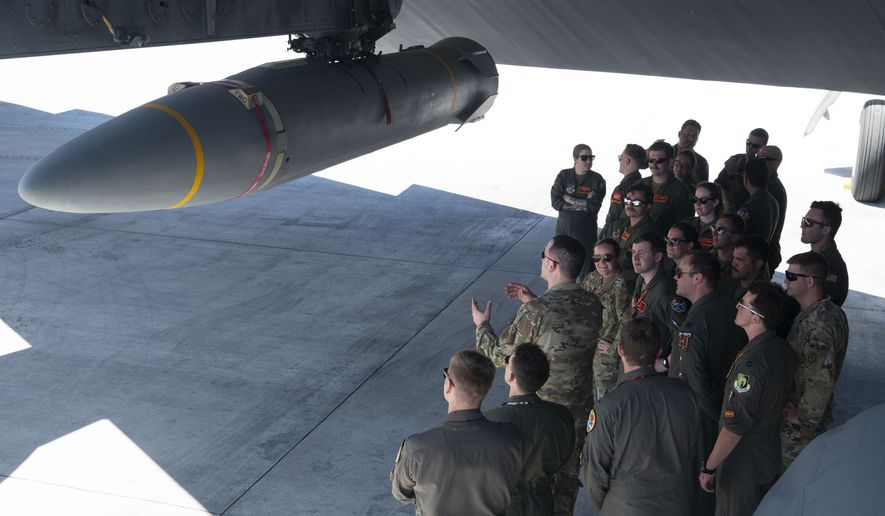
The missile will be carried by B-52 bombers and an Air Force photo published along with Monday’s announcement showed one of the new missiles deployed under the wing of a B-52 as crews from Minot Air Force Base, North Dakota, and Barksdale Air Force Base, Louisiana, looked on. The caption said the crews were practicing “hypersonic weapon familiarization training” at Andersen Air Force Base, Guam in 2024.
The announcement marked the transition of the unpowered, boost-glide hypersonic missile from prototyping and flight testing to production.
The Air Force said the new missile will strengthen the service’s “commitment to fielding standoff, high-speed strike options.”
Dropped from B-52s, the new missile ignites and accelerates to hypersonic speed — greater than 3,836 miles per hour or more than five times the speed of sound using a solid-fuel rocket booster.
The glide vehicle is then released for maneuverable flight, normally along the edge of Earth’s atmosphere to a target.
The missile will be used by the Air Force to attack time-sensitive, heavily defended and high-value targets from long ranges, the statement said.
“Fielding ARRW enhances our ability to hold targets at risk anywhere around the world,” said Chief of Staff of the Air Force Gen. Ken Wilsbach. “This hypersonic weapon provides the Joint Force a flexible and rapid response option for highly contested environments.”
The new Air Force missile joins the Army’s ground-launched Long-Range Hypersonic Weapon, called Dark Eagle, in production.
The Pentagon is rapidly building hypersonic missiles as part of a high-speed missile race with China.
China currently deploys two unique hypersonic missiles, the 1,500-mile range DF-17 medium-range missile and the 5,000-mile range DF-27, which the Pentagon has stated pose a threat to Guam and U.S. allies in Asia.
Defense Secretary Pete Hegseth warned in November 2024 that the Chinese military’s hypersonic missiles could sink all U.S. aircraft carriers, the military’s main power projection systems, in the first minutes of a conflict.
• Contact Bill Gertz on X @BillGertz.
Contact the author


Please read our comment policy before commenting.