


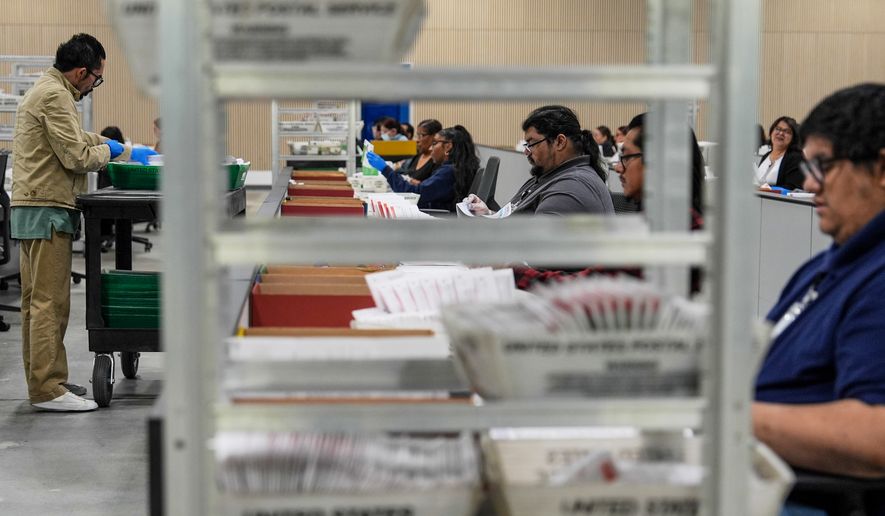

A federal judge rebuffed the Trump administration’s demand that California sequester 20,000 ballots from registered voters the feds say are likely noncitizens, calling the request unprecedented and a violation of the state’s ability to run its own election.
Judge David Carter, a Clinton appointee on the California bench, said the Justice Department can charge voters later but cannot stop them beforehand.
Besides, he said, the ballots have already been sent out and some may already have been returned, and there is no mechanism for carrying out the sequester and investigation the feds sought.
People were interested in these podcasts
“Constitutional rights and our democracy are at stake,” the judge wrote. “The public interest favors their protection. Individuals who have met the requirements of California’s voter registration laws must not be deprived of a core right merely because of unfounded allegations stemming from a procedure rife with uncertainty and errors.”
He denied the Justice Department’s request for a temporary restraining order.
That had been a long shot from the start.
Asking a court to intervene after ballots had been sent out, and to take the groundbreaking step of blocking ballots from being counted over suspicions that have yet to be fully explained publicly, was always going to be a tough sell.
Judge Carter said the administration’s position could have been stronger if it had brought the case earlier.
He said federal officials notified California in July that there were as many as 190,832 noncitizens on the state’s rolls. But it waited until Oct. 13 to send a final list of about 20,000 names, and then sued two days later, demanding urgency from the courts.
Judge Carter said the rush to block ballots violated a federal law that prohibits major interference with registration lists within 90 days of an election.
“Plaintiff’s theoretical risk of imminent harm is solely due to its own neglect,” he wrote.
He also questioned the process the administration used to identify the 20,000 names.
Government officials said Homeland Security came up with the list by running California’s registration list through third-party databases to try to gain more certainty on the names, then checked them against government files.
DHS’s citizenship agency looked for people who had immigration files associated with them, then looked for evidence that they achieved citizenship. Those who hadn’t were deemed good candidates to be noncitizens.
That list was then forwarded to Homeland Security Investigations, DHS’s detective force, which reviewed it and came up with the final list sent to the state earlier this month.
Judge Carter, though, said the government still hasn’t revealed the specific matching rules it used. And it still hasn’t explained how the vendor, LexisNexis, linked Social Security numbers to names on California’s lists.
The judge also said DHS’s attempts to identify noncitizens in other states have fallen flat. It claimed nearly 16,000 names were on Nevada’s rolls but later reduced that to 185 after a manual review. And Nevada later confirmed all 185 were actually citizens, the judge said.
“Given the vagueness of Plaintiff’s descriptions of its procedures and the unreliability of its similar claims in other states, the Court cannot conclude that Plaintiff’s process is credible,” Judge Carter ruled.
Left-leaning campaign groups hailed the decision.
“By denying this temporary restraining order, the court has affirmed what the Constitution has already made clear: The states and Congress oversee our elections, not the White House and not the Department of Justice,” said Anna Baldwin, director of voting rights litigation at Campaign Legal Center.
Contact the author

Please read our comment policy before commenting.