


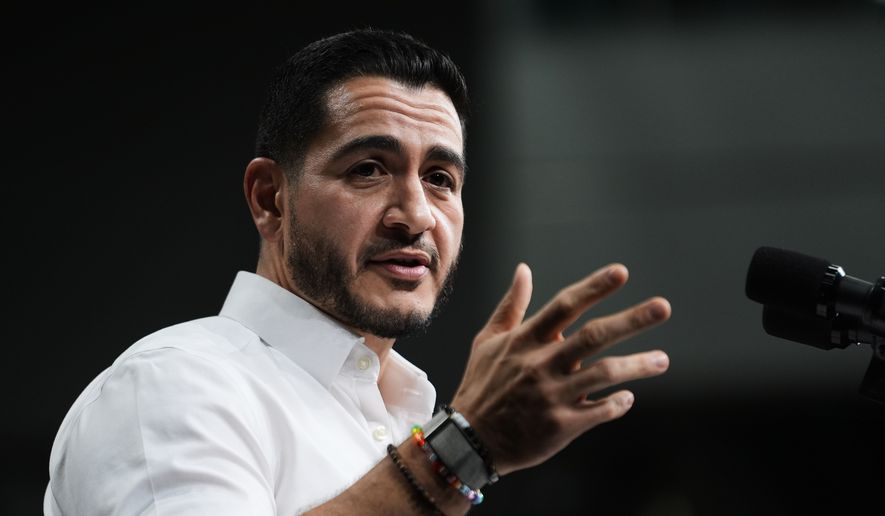

Five days before Election Day, Michigan Democratic Senate nominee Abdul El-Sayed is closing out the campaign with a simple argument: Republicans would rather talk about his name and Muslim faith than the issues he says are driving up costs for families.
“My name and my faith aren’t the reason you can’t afford your gas,” Mr. El-Sayed said Thursday in Jackson, Michigan, while campaigning alongside Sen. Elissa Slotkin. “Their war in Iran is the reason why our gas and groceries are so expensive. Their tariff war against Canada is the reason everything else is so expensive. Their big ugly bill is the reason why it’s become so hard to see a doctor. They don’t want to talk about those things, so instead they point to me.”
Mr. El-Sayed is betting that an aggressive closing stretch, which he says has included 700 public events across 120 cities, will help carry him across the finish line in a race where Republican Mike Rogers and his allies, including President Trump, have spent months casting him as a terrorist sympathizer.
People were interested in these podcasts
They have pointed to his family’s alleged connection to the Muslim Brotherhood, arguing it raises questions about his loyalty to the country and poses national security concerns.
Mr. El-Sayed, who has denounced the attacks as Islamophobic, is the son of Egyptian immigrants and is seeking to become the first Muslim elected to the U.S. Senate.
On Thursday, the National Republican Senatorial Committee, the Senate GOP’s campaign arm, circulated a Wall Street Journal article that outlined how senators are not subject to the same national security clearance process that could pose challenges for Mr. El-Sayed in other government positions.
The article revisited questions about his mother, Fatten Elkomy, who worked at the Islamic American Relief Agency from 1999 through at least 2004. The Treasury Department concluded that the organization was a branch office of the Sudan-based Islamic African Relief Agency, which, as a “specially designated global terrorist” and under anti-terrorism laws, had its assets blocked.
The Journal reported that court documents from a 2007 Justice Department case against the group’s U.S. operations mention Ms. Elkomy 14 times, including in connection with eight wire transfers to its Iraqi branch. She was not charged, and the organization ultimately pleaded guilty to sanctions violations in 2016.
The story also renewed scrutiny of Mr. El-Sayed’s father-in-law, Tayeb Jukaku, who led the Michigan chapter of the Council on American-Islamic Relations from 2005 to 2010 and has been associated with the Islamic Society of North America since at least 2007. Federal prosecutors in the Holy Land Foundation terror-financing case identified both organizations as unindicted co-conspirators.
The competing messages come as early voting is underway.
Mr. Rogers plans to campaign this weekend with Sen. John Barrasso, Wyoming Republican, as both Michigan campaigns make their final push toward Election Day.
The Detroit News reported that President Trump is expected to return to Michigan before Tuesday, a sign of the high stakes in a race that Republicans see as their best chance to flip a Democratic-held Senate seat.
The Michigan contest is unfolding as Democrats pursue a broader offensive map that includes Republican-held seats in Alaska, Iowa, Kansas, Maine, North Carolina and Texas. To reclaim control of the Senate for the final two years of Mr. Trump’s presidency, Democrats must net four seats.
Ms. Slotkin, who defeated Mr. Rogers in 2024 by fewer than 20,000 votes in a state carried by Mr. Trump, framed the election less as a battle between progressives and moderates than between people willing to fight and those content to stand aside.
There are “different kinds of Democrats,” she said, but the real divide is not “progressive versus moderate.” Instead, she said, it is “team fight” versus “team flight.”
Ms. Slotkin acknowledged that she and Mr. El-Sayed don’t agree on every issue, recalling a respectful policy debate they had while driving to an event earlier in the campaign. But, she added, the areas where they agree are “so much bigger.”
“I need a partner,” she said. “I don’t need someone who agrees with me all the time. I need a partner who’s willing to fight.”

Please read our comment policy before commenting.