


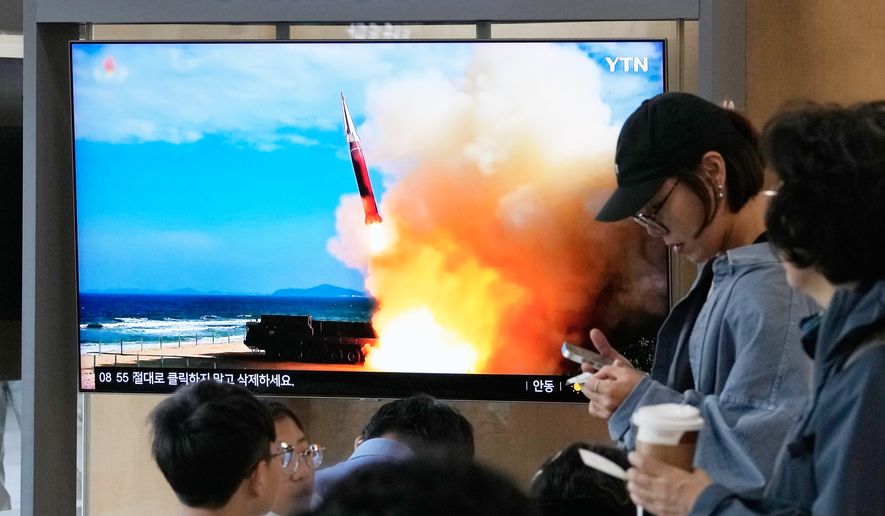

SEOUL, South Korea — North Korea test-fired its latest salvo of missiles Thursday, with around a dozen projectiles launched from the country’s west coast travelling around 155 miles before splashing in the Sea of Japan around midday.
The test firing comes at the midpoint of joint South Korean-U.S. aerial drills and amid cross-border tensions sparked by a September land-mine incident in the Demilitarized Zone.
In what is now a very routine practice, South Korea’s Joint Chiefs of Staff briefed the media on the launch, which Seoul and Tokyo subsequently condemned.
People were interested in these podcasts
Analysts say the North conducts missile test firings for two reasons: to stress-test its military technologies and/or to send political messages.
Regarding the former, Pyongyang has reduced its need to conduct tests locally, given that its military-industrial complex is generating plentiful real-world combat data from Russia, which is using North Korea’s short-range ballistic missiles, tactical multiple-launch missile systems, tube artillery and related munitions against Ukraine.
Ukrainian reports say North Korean missile guidance systems’ accuracy has massively improved since their first combat use, indicating Russian technological assistance.
Though North Korea’s light infantry shock troops have not engaged in combat since 2025, its artillery units were reported, by Ukrainian sources, to be in action in the Kursk region, firing over the border, early this year.
If Thursday’s launch was a political message to signal disapproval of South Korean or U.S. policy on and around the peninsula, it is likely aimed at ongoing joint aerial drills.
“Freedom Flag” exercises with both South Korean and U.S. assets in the air, began Tuesday in the skies over Gunsan, on Korea’s Yellow Sea coast south of Seoul. The drills run through Nov. 6.
But there are other disputatious issues in play.
Salvoes of angry cross-border rhetoric have been launched across the Demilitarized Zone since the wounding of three South Korean soldiers by a landmine on Sept. 21.
South Korea blamed the North for planting the mine, while North Korea has angrily refuted the South’s accusations.
South Korea’s pleas for bilateral talks to address the poorly marked status of the Military Demarcation Line, the actual border that runs through the center of the 2.5-mile-wide DMZ, have gone unanswered.
Similarly, a surprise last-minute reduction in the time frame and scope of August’s annual “Freedom Shield” drills, ordered by U.S. President Trump — who sought a summit with North Korean leader Kim Jong-un — generated no response from Pyongyang.
North Korea’s WMD have, for over two decades, been developed in defiance of U.S.-led pressure tactics.
Though it is forbidden from launching or exporting ballistic missiles by the U.N., Pyongyang has consistently ignored related resolutions, which are de facto unenforceable.
Sanctions adopted to give teeth to the resolutions have not prevented North Korea from developing nuclear warheads and a range of delivery systems, from intercontinental ballistic missiles to nuclear torpedoes.
Pyongyang benefits from the ambivalent stance adopted by treaty allies Beijing and Moscow, which both occupy permanent seats on the U.N. Security Council.
Contact the author


Please read our comment policy before commenting.