


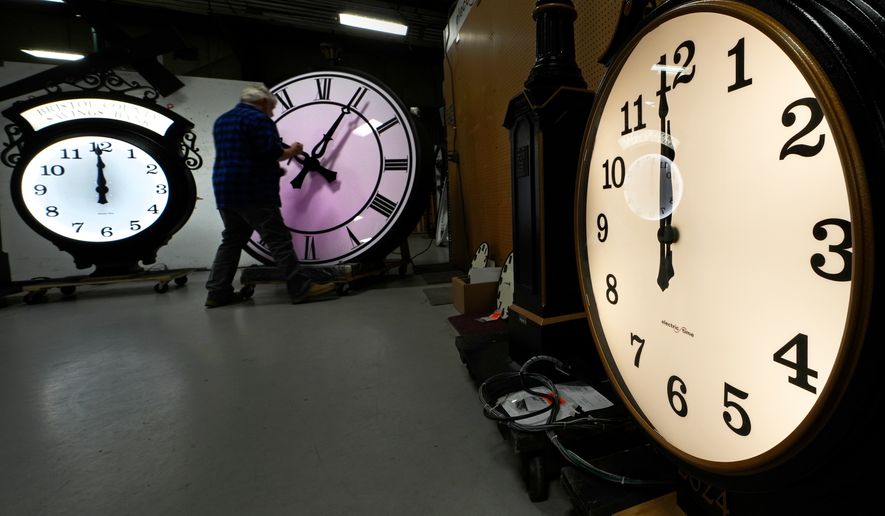

Legislative attempts to make daylight saving time the year-round standard in the U.S. were not fruitful, leading millions of Americans to change their clocks this weekend.
DST will officially end Sunday at 2 a.m. Eastern time, when clocks fall back to 1 a.m., giving most an extra hour of sleep.
DST will resume on March 14.
People were interested in these podcasts
The debate over ending Americans’ biannual clock reset is not new to Congress, but this attempt looked plausible due to White House support and one chamber’s historic passage of a bill to make daylight saving time permanent nationwide.
Congress debated the Sunshine Protection Act, which passed the House, though it has faced delays and pushback in the Senate.
The bill to cement DST as the year-round standard, spearheaded by Republican Rep. Vern Buchanan of Florida, passed the lower chamber for the first time in July.
No earlier version of the bill, which has been introduced in every Congress since 2018, had passed the House. The Senate approved a similar measure by unanimous consent in 2022, but the House never took it up.
Congress enacted permanent daylight saving time in 1974 and repealed it the same year after public backlash.
The Senate became the unmovable force that has struck down the bill’s chances of being signed into law.
Key senators, such as Republican Tom Cotton of Arkansas, have raised strong opposition, citing concerns over late winter sunrises for children and commuters.
President Trump has publicly urged the Senate to pass the bill and end the twice-yearly clock changes, though his push has not changed the stance of opposing senators.
Mr. Buchanan’s bill was one of six this session that attempted to make daylight saving time permanent.
Such legislation has multiplied in this session, with the key difference among bills being which time to lock in: standard time or daylight saving time.
Standard time, also known as “winter time,” closely matches the sun’s actual position, meaning earlier sunrises and earlier sunsets.
Medical groups such as the American Medical Association and the American Academy of Sleep Medicine favor permanent standard time because morning light better supports human circadian rhythms and sleep health.
On the other hand, daylight saving time, known as “Summer Time,” is one hour ahead of standard time, with later sunrises and later sunsets
Supporters favor it for after-work and school outdoor activities, recreation and evening commerce, though critics point out dark winter mornings and potential safety risks during transitions.
Of the bills addressing the time change, two pass daylight saving time decisions to the states without enacting a federal mandate.
One “split the difference” concession would move clocks forward a half hour from standard time and end the biannual changes.
The debate over permanent daylight saving time has historically split lawmakers and the public based on geography and time zones.
Daylight saving time is observed in 48 states, Washington, D.C. and some of Arizona. Hawaii, most of Arizona and U.S. territories, including Puerto Rico, Guam and American Samoa, do not observe it.
Contact the author


Please read our comment policy before commenting.