


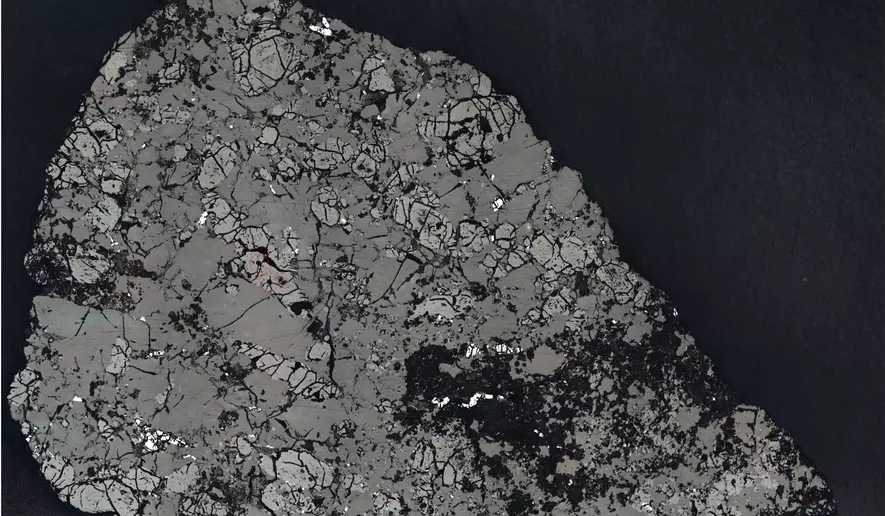

NASA-funded scientists have determined that a meteorite found in the Sahara Desert in Mali in 2022 is an ancient piece of the crust of Mars.
The rock, named Teghaza 001, is over 4.1 billion years old, NASA said in a release Thursday, making it one of the oldest Martian meteorites to be found on Earth. The scientists also published their findings Thursday in the journal Science.
Martian meteorites are rarely as old as Teghaza 001. Other Martian meteorites found on Earth that are classified as ancient include the meteorite ALH84001, which is about as old as Teghaza 001 and is made up predominantly of one mineral, and Black Beauty, which is about 2.1 billion years old and is made up of rock fragments.
People were interested in these podcasts
Yang Liu, who works for the NASA Jet Propulsion Laboratory and is an author of the study, told Ars Technica that “we don’t fully understand why old Martian rocks are so rare on Earth. If the impact hits into loose powder, it may not get cemented to become a rock and fly off Mars’ gravity. So the natural impact already acts as a filter. Weak rocks do not make it off Mars.”
As opposed to the two other aforementioned ancient meteorites, Teghaza 001 is made up of volcanic minerals and matches the landscape of the red planet’s southern highlands, NASA said.
“This is really our first piece of Martian crust from a part of Mars we’ve never had a sample of before. It records interactions of water and rock and maybe even an imprint of the Martian atmosphere as it was losing water,” NASA Ames Research Center scientist Lee Saper, one of the study’s authors, said in the release.
Teghaza 001 also has more oxygen-18, a heavier form of the element, than other Martian meteorites. This indicates that “there was active circulation of water through Martian crust,” Ms. Liu told Ars Technica, adding that “when this rock was forming, we do have a hydrosphere on Mars, and that hydrosphere is reacting with Martian crust intensely.”

Please read our comment policy before commenting.