


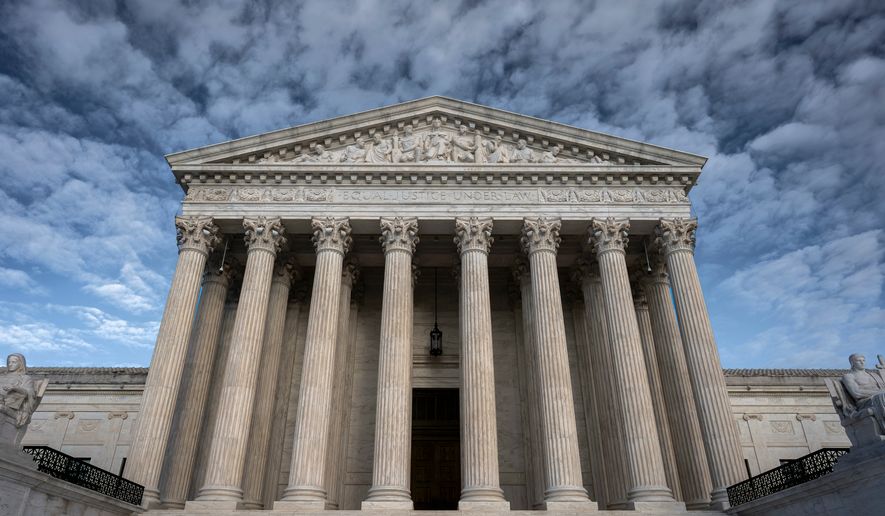

God, guns, global warming and immigration dominate the early cases as the Supreme Court kicks off its new term Monday.
The nine justices are poised to decide whether states can ban sales of AR-15s and other popular semiautomatic rifles, rule on the legality of some of the more aggressive tactics the Department of Homeland Security has adopted in its pursuit of mass deportations, test states’ ability to police climate change and refine the boundary between church and state.
What’s lacking from the docket, however, are blockbuster cases such as last term’s rulings on President Trump’s tariffs, his firings of top agency leaders and his attempt to restrict birthright citizenship.
People were interested in these podcasts
Mr. Trump has asked the justices to intervene in cases over his policies restricting medical care for transgender prisoners and the military, and his ability to deport illegal immigrants to countries other than their home nations.
The justices have so far agreed to hear oral arguments in 27 cases this term, leaving perhaps 30 more slots to be filled.
The term kicks off Monday with a major test of states’ ability to punish fossil fuel firms for the impacts of climate change.
The justices have been asked to decide whether a lawsuit brought by the city of Boulder, under Colorado’s tort laws, can move forward against Suncor Energy and ExxonMobil. The companies say allowing states to meddle in an area that’s deeply tied to global markets would trample on Congress’ power to control interstate and foreign commerce.
In November, they take up yet another case that explores how far states can go in denying religiously devout institutions — usually private schools — taxpayer benefits that are available to non-religious institutions.
Colorado has denied St. Mary Catholic Parish in Littleton access to the state’s universal preschool program because the parish won’t sign a nondiscrimination agreement promising to accept students regardless of their — or their families’ — gender orientation or sexual status.
The state says its law is neutral and applies to any school, not just religious ones — though it has made exceptions to its criteria for some non-religious schools.
Mark Rienzi, a professor at Columbus School of Law at Catholic University, speaking at a court preview hosted by the Federalist Society, said the issues should seem familiar because the court has repeatedly dealt with these sorts of cases and regularly has ruled against the states.
In 2020, the court ruled that Montana couldn’t bar religious schools from a tuition tax credit program. In 2022, the justices struck down Maine’s ban on parents using a tuition assistance program to pay for enrollment at religious schools.
Mr. Reinzi said it’s time states get the message.
“Some governments and courts have a very resistance mentality to the Supreme Court these days. They will not go along until you drag them, specifically, kicking and screaming,” he said.
The justices on Thursday added another religious liberty case to their docket, agreeing to hear a battle between a group of Catholic priests who want to build a shrine to the Virgin Mary and the Kentucky courts that said they didn’t deserve an exemption to zoning laws.
“Religion, and sort of the intersection between religion and public life, could wind up being a really big theme at the Supreme Court this term,” Amy Howe, co-founder of SCOTUSblog, said during a court preview at the National Constitution Center.
December will see a big gun-rights case, when the justices will hear arguments on whether governments can ban AR-15s and similar rifles — the most popular type of long gun sold.
The high court in recent years has looked at who can be limited from possessing a gun and locations where guns can be banned, but this is the first case in years to examine the types of weapons and how they fall under the Second Amendment.
Gun-rights advocates had been agitating for this fight, seeing a high court ready to slap down laws in more than 10 states that restrict sales of AR-15s.
“From the founding of this country, the rifle has been a paradigmatic American arm,” David Thompson, the lawyer for the challengers, told the court, calling the AR-15 the descendant of the weapons used to overthrow British rule and pioneer the West. “The question can be fairly asked: If the Second Amendment does not protect it, what could it possibly protect?”
But lower courts have resisted the idea, regularly upholding AR-15 bans.
Cook County in Illinois, whose law is being challenged, labeled AR-15s as “assault rifles” and called them “the weapon of choice for criminals and terrorists set on quickly massacring innocents.”
Also on the schedule in December is a case over whether Arizona can enforce a law requiring newly registering voters who want to participate in federal elections to prove their citizenship.
The justices also have several cases challenging the procedures the government has used to carry out deportations to so-called third countries when an illegal immigrant’s home nation won’t take them back and on Homeland Security’s ability to detain migrants awaiting deportation hearings.
Other cases on tap for the justices:
• Whether states can rely on less than 12-person juries for criminal cases.
• Parents’ ability to sue over a Washington state policy that allows shelters to skip notifying parents of runaway juveniles when those children seek medical treatments for gender transition.
• Whether federal agency tribunals can impose substantial fines on their own or whether such cases must be brought in federal court instead.
Contact the author


Please read our comment policy before commenting.