


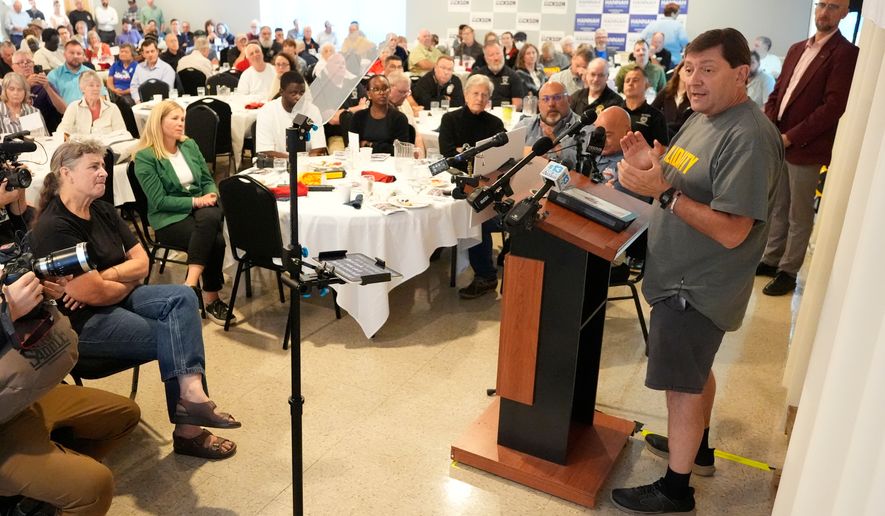

SCARBOROUGH, Maine — It’s a Monday night, and Troy Jackson has drawn about 250 people into a converted church to hear him talk about healthcare and labor in Maine.
The event is notably different from the rallies held earlier this year by Graham Platner, Jackson’s predecessor as Maine’s Democratic nominee for U.S. Senate. Platner sometimes drew more than 1,000 people to his events, and he wowed crowds with his booming voice and calls for working people to take on the nation’s billionaires.
Jackson sits with his legs folded, shares stories from his logging days and sometimes has to fight with the acoustics in the high-ceiling building.
People were interested in these podcasts
But the reaction from the crowd that fills the venue is similar.
“They try and make us feel powerless. But when we come together we do have power,” Jackson says as the audience cheers.
Jackson’s run against longtime Republican Sen. Susan Collins was always going to be an uphill fight because of the tiny window he has to sell himself to Maine voters. He became the Democratic nominee with just over 100 days to go when the party held an emergency nominating convention after Platner dropped out of the race while facing an allegation of sexual assault.
PHOTOS: Troy Jackson is scrambling to defeat Maine Sen. Susan Collins. Time is not on his side
Sometimes, it looks like it’s working. After a speech at a different church, outside Portland, 70-year-old voter Debbe Kelley of Windham said she appreciated Jackson’s “direct and genuine” approach. And she said many Maine voters are ready for Collins, first elected in 1996, to leave office.
“She’s just not a fighter for Maine,” Kelley said. “Troy is.”
Democrats have long viewed the race as crucial for determining control of the Senate, and Jackson, 58, will have to defeat a five-term incumbent who has strong support from the national Republican Party. Collins, 73, also has a fundraising advantage of millions of dollars over Jackson, a former state lawmaker who Collins says is too liberal for Maine.
On Tuesday, Jackson and Collins are scheduled to appear in the first of four debates this month.
“This short campaign is the best thing Troy has going for him,” said Blake Kernen, a Collins spokesperson. Referring to the state capital, Kernen said. “The more Mainers learn about his work in Augusta, the less impressed they’ll be.”
Jackson is holding town halls, a contrast with Collins
Since becoming the Democratic nominee in July, Jackson has been barnstorming the state, with stops at union halls, churches, bars and anywhere else he can hold rallies and speeches.
Jackson is spending some of his brief campaign time doing something Collins is well known for avoiding - hosting town hall-style speaking events. He had held four of the events by mid-September and encouraged Collins to join him, which she did not.
The aggressive campaigning makes for a crowded schedule. He held nearly 50 events between Aug. 1 and mid-September, his campaign said. They included meeting with 100 people in a Portland bar, attending a garden party hosted by a climate group and going to karaoke in Lewiston. On Labor Day weekend, he traveled more than 850 miles, attending Democratic office openings, a tailgate at a University of Maine football game and a town hall in Biddeford.
Collins regularly attends public events and meets with constituents in smaller groups, but she does not typically hold public question-and-answer style forums. Jackson has criticized her for that, and used it to characterize the senator as out of touch with the public. His campaign has called the question-and-answer events a way to hear “directly from voters on the way their lives have been impacted by the Trump administration’s broken economy.”
This weekend, Vermont independent Sen. Bernie Sanders, a progressive champion, will join Jackson in Maine for three get-out-the-vote rallies.
His campaign has come together on the fly
As a longstanding incumbent, Collins is essentially always campaigning and is well known to voters. Mark Brewer, a political scientist with the University of Maine, said that would have put Jackson in a tough position even under ideal circumstances. Jackson’s chance of winning hinges on capitalizing on dissatisfaction with Trump and the Republican Party, Brewer said.
“It’s reasonable to surmise that his organization is still not fully formed at this point, where Susan Collins’ is and probably has been for years,” Brewer said. “That national environment is what’s giving him a shot in this race.”
Initially, Jackson was among the crowded field for the Democratic nomination for governor in Maine this year, which he lost. Jackson had thrown his support behind Platner in the Senate race, but Platner dropped out in July. Maine Democrats convened a special nominating convention on July 25 that was won by Jackson.
Since, Jackson has worked to staff up a campaign that consists of about 40 employees and hundreds of volunteers. Some transitioned from other Democratic campaigns, though few came over from Platner’s campaign. One of Jackson’s advisers, David Farmer, joined the campaign after supporting the campaign of Hannah Pingree, now the Democratic nominee for governor. A handful are holdovers from Jackson’s run for governor.
Jackson has leaned on the kind of progressive issues he was known for championing in the Maine Senate, such as expansion of public healthcare. He has also come out strongly in favor of abolishing Immigration and Customs Enforcement.
Winning over Platner’s supporters is critical for Jackson to have a chance to win. One of those supporters, Mike Hein, 56, of Fairfield, attended a Jackson rally in Gorham in September wearing a shirt that said “Graham Platner for U.S. Senate” emblazoned with “I’m Here For Troy” stickers.
“I think there’s a lot of selling that needs to happen,” Hein said.
Others praised the candidate’s authenticity and commitment to working-class issues.
“He’s a working-class guy,” said Michael Ross, 64, of Westbrook. “There’s no silver spoon in his mouth.”
Jackson is at a big money disadvantage
Jackson’s ability to fundraise also has been constricted by time. Jackson has yet to file fundraising data with the Federal Election Commission, as the next filing deadline isn’t until Oct. 15 and his campaign hadn’t started by the previous deadline. His campaign said in mid-August that it had received $7 million in contributions since Jackson became the nominee.
Collins had raised more than $18 million by the end of June. Republicans had also spent more than $80 million on advertising in the race by mid-September when Democrats had spent less than $60 million.
The fundraising gap gives the Jackson campaign less flexibility to hold events and reach voters as Election Day nears, Brewer said.
“There’s never going to be a situation in this race where the Collins campaign wants to do something but can’t,” Brewer said. “I don’t know if that will be true for Jackson.”

Please read our comment policy before commenting.