



President Trump has become a victim of his own success when it comes to crime.
Under Mr. Trump’s watch, violent crime has plunged to some of its lowest levels in modern American history, causing it to fade from the national conversation. Voters and candidates have moved on to other problems, leaving Mr. Trump with little credit for pushing what was one of the country’s biggest concerns off the front page.
The numbers are striking. Murders, robberies and other violent offenses have fallen sharply, while arrests of violent offenders, gang members and fugitives have surged.
People were interested in these podcasts
FBI data shared with The Washington Times shows a dramatic shift during Mr. Trump’s first 20 months in office compared to the end of 2024, which was President Biden’s final year in the Oval Office:
• The homicide rate has dropped roughly 20%, to 4.1 per 100,000 from 4.9 per 100,000.
• Violent crime arrests are up 90% to 53,969, compared to 28,405.
• Law enforcement officers seized 3,258 kilos of fentanyl, an 8% increase.
• They located and identified 11,081 child victims, a 21% increase.
• Lawmen arrested 5,072 child predators and human traffickers, a 13% increase.
• They arrested 4,260 members of foreign terrorist organizations, a 38% increase.
• They stopped 1,038 individuals from carrying out a terrorist attack.
• All 10 individuals on the FBI’s Most Wanted list on the day Mr. Trump took office were captured.
An FBI report released in August showed that violent crime fell 9.3% in 2025, the largest one-year decline since the bureau began estimating national crime trends in 1936. Robberies fell 18.5%, and aggravated assaults declined 7.2%
Even in Chicago, a city Mr. Trump uses to paint Democrats as soft on crime, violence is down. Chicago recorded 416 murders last year, a 29% decrease from 2024 and its fewest since 1965, according to the data the city’s police department provides to the FBI.
Shootings in Chicago dropped to 1,471 incidents, a 35% decrease from 2024. Robberies are down 3.5%, carjackings declined 50% and aggravated assaults were down 19%. Preliminary data show that Chicago’s numbers have remained roughly flat through August of this year, compared to last year.
As the numbers recede, so does crime’s place in the political spotlight. When Pew Research Center asked voters to identify their most important issue for the midterms, less than 4% said crime, keeping it out of the top ten.
A Gallup poll found a similar shift: 49% of respondents described crime as an extremely or very serious problem, down from 63% just two years ago.
However, the same Pew poll found that Republicans still have a sizable advantage on crime policy, with 43% of respondents saying they agree with the GOP on stopping crime versus 29% who sided with Democrats.
Oklahoma City-based pollster Pat McFerron said he’s not even polling on the issue of crime because it has dropped from voters’ consciousness.
“Crime has been replaced with affordability,” he said. “Crime got solved, and we’re a society that worries more about what our problems are than applauding the good things that have happened. No politician ever gets credit for the issue they solve. A new issue just takes its place.”
Jeff Werniak, deputy police chief in Posen, Illinois, and a former Drug Enforcement Administration Task Force officer, said he sees the impact of Mr. Trump’s tough-on-crime approach on the streets.
He recalled that during Mr. Trump’s first term, it was costing his department $42,000 to buy a kilo of cocaine for an undercover investigation because it had become so scarce. That price plummeted to $14,000 per kilo during the Biden administration, but has again risen sharply since Mr. Trump returned to office.
“Law Enforcement understands what’s going on and gives Trump the credit because the administration has added so many tools for law enforcement to do their job,” he said. “If you are in law enforcement, you see the results. Democrats and the media know crime has taken a significant hit but will do everything in their power not to give Trump credit. It would look horrible on them, who caused the spike in crime during the last administration.”
Despite the good news, Mr. Trump doesn’t tout his own numbers, seemingly sensing that voters have moved on. The last time he gave substantive remarks on crime was roughly a month ago during a mid-September rally in North Carolina.
The White House sidestepped questions about the lack of credit, instead focusing on the results.
“He promised to make America safe again and the data proves he has done just that. Unlike defund-the-police Democrats, President Trump will always stand with our law enforcement officers and deliver safer American neighborhoods,” said White House spokeswoman Lauren Bis.
On the campaign, some Republicans in close races have started to warn that the gains fighting crime could be lost if Democrats win in the midterms.
Criminologists who spoke with The Times said the FBI’s numbers appear to be accurate but said it’s debatable how much credit Mr. Trump deserves.
They said crime was already falling before Mr. Trump returned to office and point to a host of societal factors, including a return to normalcy after the COVID-19 crime spike; a shift in policing to focus on more violent offenders; and police departments accessing better surveillance and digital tools to solve and deter crime.
“No one can take credit for the decrease, and there’s no single cause of it,” said Thaddeus Johnson, a senior fellow at the Council on Criminal Justice. “The Trump administration and its policies are not the primary reason for it, but you cannot also say they didn’t play a part at all. There’s just so many different things.”
Mr. Johnson said the Trump administration has pulled back on the federal government’s scrutiny of local police departments, abandoning the Biden administration’s heavy-handed oversight, which included consent decrees. He also noted that Trump officials increased funds for local law enforcement to purchase better equipment.
“Police were a bit more shy and hesitant about doing some of the nitty-gritty work. They set the stage for police to do fair policing and doing smart policing,” he said. “They supported it and other administrations did not. They also made a concerted effort to support local law enforcement through funding and investment, which has been great.”
The Trump administration also earmarked nearly $3 billion in federal grants and incentives for local and state law enforcement agencies. Local law enforcement can receive up to $100,000 for vehicles and equipment, as well as funds to cover overtime costs that would match 25% of an officer’s salary.
The funding enabled police departments to set up and support real-time crime data tracking centers, and bolster investigative units, Mr. Johnson said.
David Finkelhor, director of the Crimes Against Children Research Center at the University of New Hampshire, said when it comes to catching child predators and locating abused children, the Trump administration has not moved the needle.
He pointed to a 2024 law that expanded reporting requirements for internet companies in cases of suspected child sex exploitation.
“That’s been the main driver of these numbers,” he said.
Mr. Werniak sees it differently. He said the Trump administration has gone beyond traditional street policing, and it is having an impact.
Mr. Trump has dispatched troops to the southern border, sharply expanded immigration enforcement, directed authorities to prioritize migrants and human smugglers, designated cartels as foreign terrorist organizations and launched initiatives such as Operation Take Back America to target violent criminals and drug traffickers.
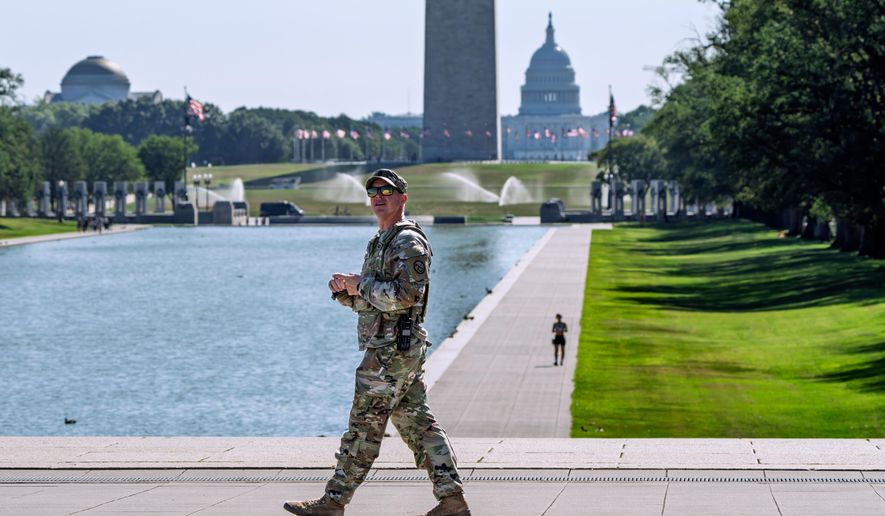
The Justice Department has mounted nationwide sweeps for gang members, while Mr. Trump has deployed National Guard troops to Washington and Memphis. In addition, the administration targeted the drug supply further from American streets, including military strikes on suspected drug smuggling vessels in the Caribbean.
“They’re actually going the extra mile to find [criminals],” Mr. Werniak said. “These guys are in hunting mode, and they’re in a preventive mode. They’re going and looking for crime. I would say maybe 99% of the crime reduction is because of the Trump administration.”
Mr. Trump’s support for police extends beyond funding, Mr. Werniak said, citing the president’s rhetoric on police and willingness to host law enforcement at White House that signal his support for police.
“Police love the fact that President Trump drops everything when a police officer is killed in the line of duty and calls the family, giving support and making sure they have everything they need,” he said. “No other president in my lifetime has done that.”

Please read our comment policy before commenting.