



The U.S. military has executed at least 135 of its own — a rogues’ gallery of notorious mutineers, deserters, rapists and killers — over the past 250 years. In a few weeks, former Army psychiatrist and mass shooter Nidal Malik Hasan’s name is likely to be added to that list.
Hasan is scheduled to face an Army firing squad Dec. 3 at Fort Hood, the massive Texas base north of Austin where he fatally shot 13 people in 2009.
Capital punishment, especially in the modern era, is exceedingly rare in the U.S. military — Hasan’s execution will be the first since Army Pvt. and convicted child rapist John A. Bennet was hanged in 1961. But the total number is almost surely higher than the 135 for which records exist.
People were interested in these podcasts
Military justice from the Revolutionary War through the Civil War was highly decentralized. Commanders conducted summary courts-martial and battlefield executions before the advent of any central archive system.
George Washington approved the execution of American soldiers during the Revolutionary War, including Thomas Hickey, a private in his bodyguard detachment who was convicted of mutiny and sedition for his role in a British conspiracy to assassinate American military leaders.
General Winfield Scott ordered the death by hanging of about 50 members of the mostly Irish immigrant Saint Patrick’s Battalion who were convicted of deserting their posts in combat and joining the other side during the Mexican-American War.
Hasan’s execution, approved by President Trump earlier this month, will be the first conducted by a military firing squad since Jan. 31, 1945, when Army Private Eddie Slovik was shot for desertion during World War II near Sainte-Marie-aux-Mines in France.
“I didn’t realize that was something that we still did in the military. The fact that they’re doing that, I think, speaks volumes,” said former Army Capt. Connor Crehan, who was at Fort Hood when Hasan opened fire on Nov.5, 2009, at the Soldier Readiness Processing Center.
The facility coordinated administrative clearances for troops before their deployment to Iraq or Afghanistan or upon their return from overseas.
Mr. Crehan was familiar with the processing center. It was just down the road from his artillery battalion in the 1st Cavalry Division. He had returned from a tour in Iraq that June.
“I knew people in that building that day,” he said. “We were locked down in our office for hours, as we didn’t know he was acting alone.”
A service member can be sentenced to death under the Uniform Code of Military Justice for 15 specific offenses. Military law strictly distinguishes between offenses that are capital at any time and those punishable only in times of war.
Wartime-specific cases include offenses like desertion, espionage, and refusing to obey a lawful order in times of war. Charges that can result in capital punishment during peacetime include conspiracy, sedition, and premeditated murder.
Hasan is one of four military service members on death row. Each was charged with murder.
Mr. Crehan said he recalled the uncertainty but also his anger at the time.
“We had just returned from a combat zone, and here we were on an American base in fear of an active shooter,” he said. “We were supposed to be safe [but] we weren’t. Finally getting closure all these years later is healing.”
Acting Army Secretary Adam R. Telle on Tuesday announced the date and location of Hasan’s execution following Defense Secretary Pete Hegseth’s recommendation and Mr. Trump’s formal approval of the death sentence.
Mr. Crehan wondered if the recent botched execution by lethal injection of death row inmate Christa Pike in Tennessee might have played a part in the Trump administration’s decision to authorize a firing squad for the Hasan execution.
“The chances that an execution is botched with a firing squad versus a lethal injection are drastically different,” Mr. Crehan told The Washington Times. “I would imagine that they’re trying to send a message that an individual who opens fire on our own service members while wearing the uniform of our military is not going to be tolerated in any way, shape, or form.”
While the date for his execution has been set, Hasan is entitled under the Constitution to pursue an appellate review of his death sentence in civilian federal courts. That could indefinitely delay the execution, according to the Death Penalty Information Center.
“President Trump has long sought an increase in the use of the death penalty, and authorized a record-breaking 13 federal executions in the waning days of his first term,” the DPIC said in a statement.
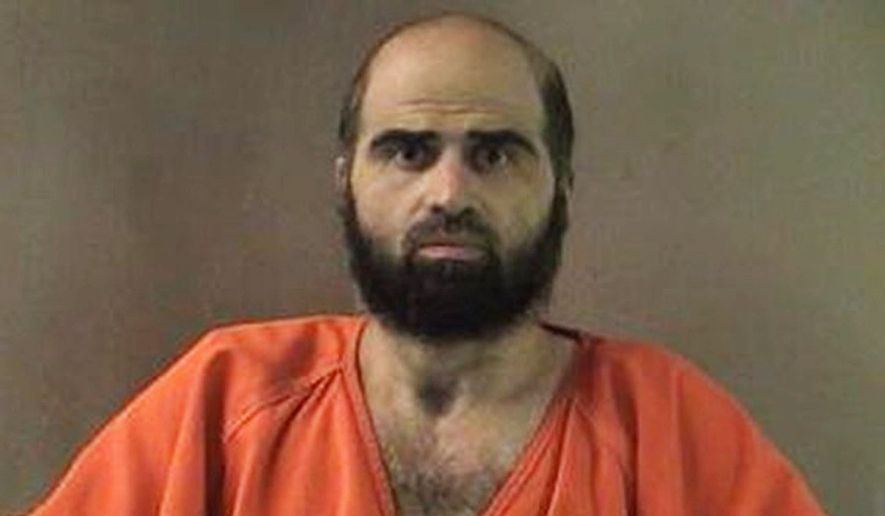
Hasan was a major in the Army’s medical corps and self-identified as an Islamic jihadist. He carried out the attack on the unarmed soldiers at Fort Hood under that ideology.
He was stripped of his rank and dishonorably discharged following his August 2013 court-martial.
Mr. Crehan was working at the battalion headquarters on Nov. 5 when his boss, the operations officer, suddenly rushed in and told the staff to “stand fast.”
“It was kind of startling because we had no idea what was going on. We were just going about our day,” he recalled.
Information was scarce even for those near the scene because instant messaging platforms like Twitter were still in their infancy, Mr. Crehan said.
“I can remember the rest of the day just sitting here, trying to refresh websites and getting information piecemeal from friends that were also stationed at Fort Hood,” he said. “It was really like trying to squeeze water out of a stone.”
Mr. Crehan was angry in the days after the mass shooting because Hasan had stripped away the feeling of safety and security for combat soldiers who had returned home.
“I had just survived a year and so many other people had survived deployments, and then to come back on American soil, on an American military base, and have that fear reinstated into our bodies,” he said. “It was anger-inducing, and it was anxiety-inducing because of the uncertainty.”
Mr. Crehan remained at Fort Hood until 2011.
“For the remainder of my time at Fort Hood, it was always sort of in the back of my mind,” he said. “I try not to hold grudges in my life, but there is resentment because ’peace of mind’ was taken away on that day.”
Modern executions by firing squad are rare for both the military and the civilian U.S. justice system, where only five firing squad executions have been carried out since 1977.
But the U.S. and the Allies executed hundreds of Nazi war criminals through tribunals and occupation courts after World War II. The International Military Tribunal at Nuremberg tried 24 top Nazi leaders. Of that number, 12 were sentenced to death, and 10 were actually hanged in October 1946.
Contact the author


Please read our comment policy before commenting.