



JOHNSTOWN, Pa. — It’s a story partly defined by cold, hard numbers and uncompromising precision.
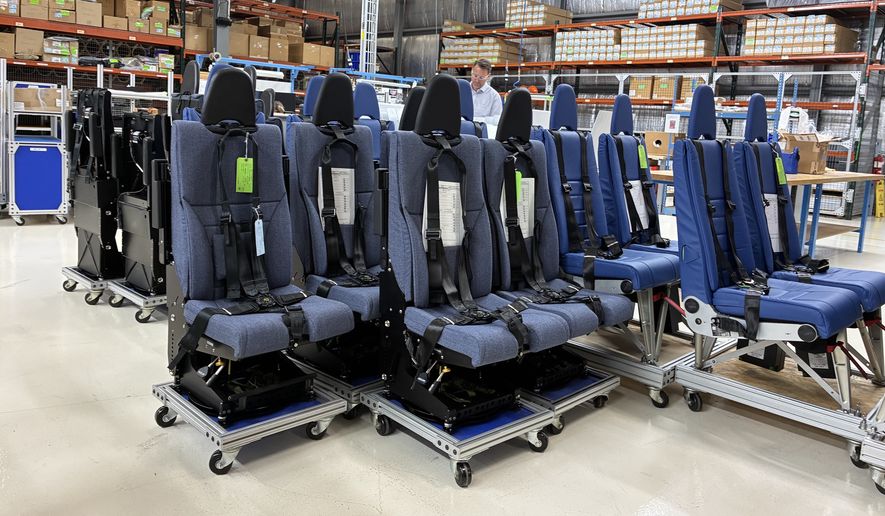
More than 1,000 separate components make up the F-35 fighter jet’s ejection seat. Seatbelts for some ejection and crashworthy seats contain more than 100 different pieces. Disassembling and rebuilding the F-35 seat, which weighs over 200 pounds, takes over 100 hours.
People were interested in these podcasts
It requires eight very careful folds, and another 18 pinpoint placements of canopy lines, to properly pack the seat’s parachute. Those parachutes must be unpacked and inspected every two years.

Ejection seat survival kits — which include blankets, flares, water, and other life-sustaining gear — are reviewed on a strict schedule every three years. Exact stitch-per-inch parameters govern the sewing of the seat material itself for both fighter jet ejection seats and the crashworthy versions inside helicopters, which are designed to withstand impact and save crew members’ lives in a hard landing.
Matt Johnson, the vice president and general manager of Martin-Baker America — the company that makes seats for the F-35 and a host of other U.S. military aircraft — can tick off those figures by heart. But a much more human element sits at the center of the work.
SEE ALSO: LISTEN: Here’s how F-35 ejection seats are made
“It’s the experience that you have when an ejectee visits. That really resonates with the workforce,” Mr. Johnson said in an exclusive interview, recounting the times when military personnel who survived an ejection visit the company’s headquarters to tell their stories.
“You can look a person in the eye and see that the work you’ve done has really brought them home to their families,” Mr. Johnson said in an interview that aired recently on The Washington Times’ Threat Status podcast.
“They make a point to visit every year, and they want to go talk to the people who packed the parachute or had a hand in creating that particular component,” he said. “They really want to meet every person here because they’re just so thankful, and that’s meaningful.”
The Times was granted exclusive access to Martin-Baker America’s sprawling production and maintenance facility in Johnstown, an old steel town about 60 miles east of Pittsburgh. Inside, more than 170 employees build and maintain ejection seats for the F/A-18, F-35, T-6, T-38, and T-45 fleets, along with crashworthy seats for Black Hawk helicopters and other military choppers.

The company says its ejection seats have saved more than 3,600 American lives, including a Marine Corps pilot who ejected from an F-35B stealth fighter before it crashed near Miramar air base in San Diego in July.
The complex, labor-intensive process of manufacturing those seats sits somewhere between an art and a science, a task that can’t be fully turned over to machines.
“When it comes to assembling those components, there is a lot of artistry that comes along with that,” Mr. Johnson said. “You can automate the squeezing of rivets and you can automate torquing down screws and things like that. But the very fine aspects of some of the fabric components that go along with it, and the placement of some of these rivets that are really particular, I don’t think you can quite automate just everything there. It takes a very special skill set.”
Martin-Baker America’s parent company, U.K.-based Martin-Baker, has been a global leader in ejection seats and aviation safety equipment for nearly a century. Martin-Baker America is one of two major suppliers of U.S. military ejection seats. The other is Collins Aerospace, a unit of defense industry giant RTX, which makes seats for F-15E fighter jets and other aircraft.
F-15E ejection seats have come into the spotlight during the U.S. war in Iran. Last March, three F-15s were shot down by friendly fire over Kuwait. All six crew members ejected and were recovered.
In April, another F-15E was taken down over Iran. Its two crew members ejected and were later rescued by U.S. forces in daring ground missions deep inside enemy territory.
No single, publicly available database clearly tracks all U.S. military ejections. There have been at least eight confirmed F-35 ejections since 2020, according to publicly available data and media reports.
Recently, there have been other high-profile ejection instances.

Late last month, for example, the Navy said it was investigating a landing “mishap” aboard the USS Dwight D. Eisenhower, when two aviators ejected from their aircraft off the coast of Virginia.
The Navy didn’t identify the type of plane lost, but it operates two types of two-seat aircraft: the F/A-18F Super Hornet strike fighter and the EA-18G Growler, a version of the Super Hornet used for electronic warfare missions.
Military pilots who have gone through the harrowing experience say they remain deeply thankful to those who maintain and inspect the ejection seats.
“I ejected out on an F-18 due to a cable breaking on the aircraft carrier I was landing on,” Air Force Lt. Col. Jon Vanbragt said in 2020, recounting his experience in an online news article released by the Air Force.
“I’m here today, 16 years later, now married with two children, and a legacy of teaching fighter pilots how to fly due to the diligence of the egress personnel who maintained my ejection seat, and made sure that when the system needed to perform, that it would do so flawlessly,” he said, referring to Air Force maintenance specialists. “I’m forever indebted to those airmen, and I continue to be thankful to egress and life support personnel for everything that they do to support the mission.”
At the entrance to the Martin-Baker America facility in Johnstown, a banner reads: “The only part of the aircraft that cannot fail.” And the company’s employees take that to heart.
“The whole seat itself is really the only part that’s a life-saving piece to that aircraft. The rest of it is on a mission to do what it needs to do, but the seat is there to save a life,” said Steve Brang, a calibration technician and Navy veteran who has worked at Martin-Baker America for 26 years.
• Mike Glenn contributed to this story.
Contact the author


Please read our comment policy before commenting.