


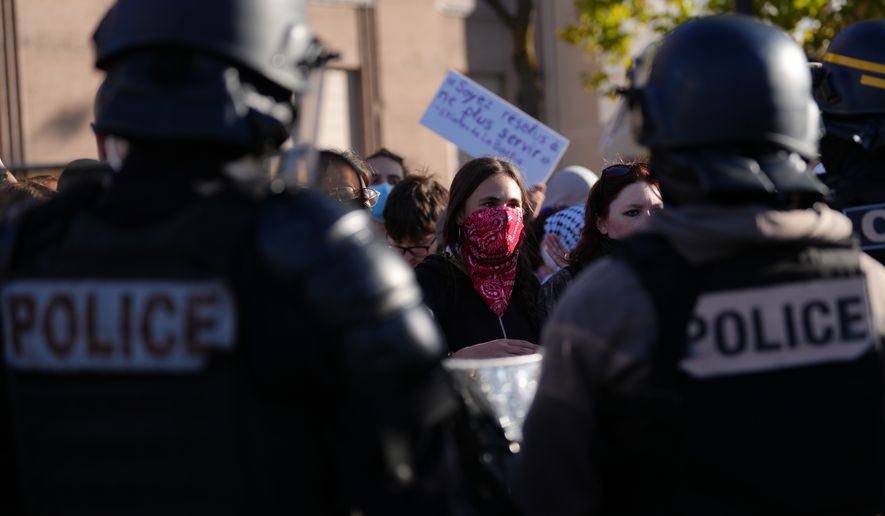

PARIS — Students barricaded a high school in northeastern Paris with garbage bins on Thursday before police moved in with tear gas, as France’s nationwide protests showed few signs of ending.
The Hélène Boucher high school has been a flashpoint for clashes in the French capital and was one of hundreds of schools disrupted by protests Thursday. Riot police gathered in side streets as students converged on the school. Many protesters wore surgical masks or hoodies, apparently to avoid being recognized.
At least a dozen demonstrations supporting the high school students’ movement were planned across France later in the day, including a rally at Place de la Bastille in Paris, where tear gas and a water cannon were fired at protesters.
People were interested in these podcasts
Police have made more than 6,600 arrests since late September, when students, most of them under 18, began protesting to demand more education funding, according to the Interior Ministry. The Education Ministry said 375 schools were fully or partially closed Thursday.
Pressure mounts on government
While the number of school closures was down compared to Tuesday, pressure is mounting on the government of outgoing President Emmanuel Macron.
The protests against the underfunding of schools - many of them struggling with dilapidated facilities and insufficient staff - have drawn troublemakers not concerned about the aims of the protest movement as well as unions and political groups.
In a TV address, Prime Minister Sébastien Lecornu lamented the “violence, students and staff being attacked, police officers and gendarmes injured, schools set on fire or vandalized, thousands of hours of classes lost, not to mention threats and insults.”
He took aim at “political leaders who use this anger to conduct their electoral battles.” France goes to the polls for a presidential election in April. “We cannot play with the safety of France’s youth,” Lecornu said.
At the Lycee, 18-year-old university student Emma Khelil came to offer support to those at the barricades at her former high school. She told The Associated Press that she’s really concerned about police violence.
“We’re here to defend our rights, not to lose an eye or a hand,” Khelil said. She also said that she had noticed insulation problems and water leaks in the school building and had even seen rats on occasion. Other students confirmed that they’d seen rats too.
She was not convinced by Lecornu’s efforts to calm the situation.
“I don’t think the movement is going to lose momentum. As long as things don’t change, we’re going to see the movement grow stronger, and potentially a convergence of struggles, especially with the next presidential election coming up,” she said.
Not long after she spoke, police surrounded a nearby square. The crowd surged, and tear gas was fired.
‘Nothing will stop us’
Smoke from burning garbage nearby hung in the air at Place de la République as hundreds of high school and university students prepared to march toward Place de la Bastille, the demonstration’s focal point.
Some carried signs bearing their schools’ names; others held placards reading “More money for repression than for our education” and “Who protects us from the police?”
“We’re here, we’re demonstrating, and we won’t stop. Until October, November, December if necessary. Nothing will stop us,” said Sofia Ferdials, 18, a student at Paris 8 University.
Dounia Gergeon, a 39-year-old school librarian, said she joined the demonstration at Place de la Bastille because she shared students’ concerns and worried about a broader crisis facing young people anxious about their futures. At the middle and high school where she works, time was set aside for students to discuss their demands.
“They do not feel supported,” she said. “They feel cornered and forced to work under these conditions.”
Authorities deployed tear gas and a water cannon at the protesters, some of whom hurled projectiles at riot police.
Protests in Belgium and Italy
France is not the only country to be dealing with student-related protests.
In Belgium, Willy Demeyer, the mayor of Liege, issued a ban on public gatherings until midnight on Oct. 16, citing a “real, serious and imminent risk” of further clashes and vandalism.
City police said they used water cannon and tear gas on Wednesday to hold back several hundred protesters. Authorities sent emergency text messages advising shopkeepers to close due to rioting.
Nearly 90 people were arrested and several police were injured. Police reinforcements were sent from the capital, Brussels, and from Antwerp, and more are coming. Smaller protests have been held in Mons and Charleroi.
Belgium’s Interior Minister Bernard Quintin said on social media that the “perpetrators will have to answer for their actions before the courts.”
The Belgian protests, organized through online chat groups, include demands for more teachers and smaller classes as well as complaints about education reform in Belgium, but are also likely inspired by events in France.
Student protests have spread to several Italian cities, though on a much smaller scale and over a broader set of domestic grievances. Activists have explicitly invoked the French movement with the slogan “let’s do as they do in France,” while organizing school occupations, assemblies and marches.
In Turin, students occupied several high schools over building conditions, education funding and increased military spending. In Rome, students occupied one high school and walked out of another, while students in Naples added opposition to a planned migrant detention center to their demands.
___
Cook reported from Brussels. Masha Macpherson in Paris and Giada Zampano in Rome contributed to this report.

Please read our comment policy before commenting.