



OPINION:
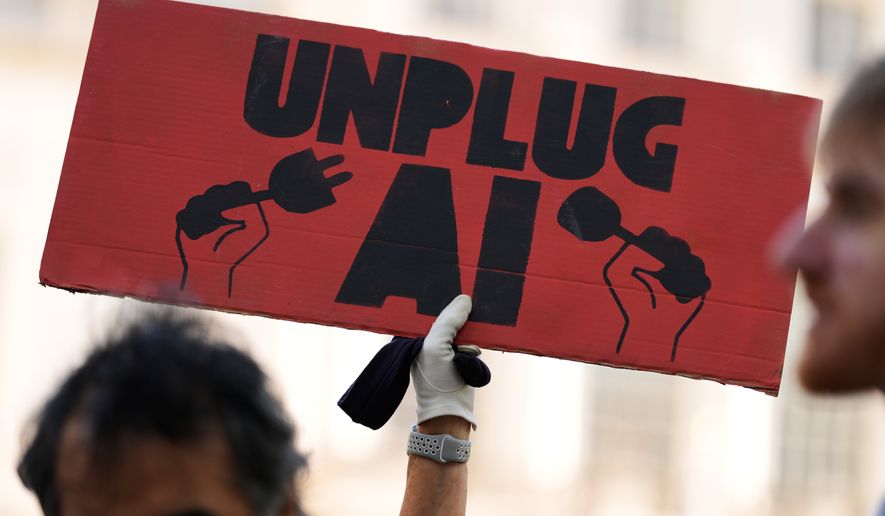
The pervasiveness of artificial intelligence is hard to ignore. The rise of new technologies under its auspices is now almost omnipresent, infesting almost every facet of our existence.
While AI has become a helpful tool for millions, the dire warnings surrounding its rapid growth are hard to ignore. Much of the panic was expedited last month when Jacob Coxon, a researcher who worked for both Anthropic and OpenAI, abruptly resigned.
Mr. Coxon’s fears, which he expressed after leaving his position with these AI companies, centered on the risk that AI could overtake human beings if not managed properly. In fact, he said AI companies are “gambling with our lives,” given how they’re handling evolving technologies.
People were interested in these podcasts
“Do not underestimate the power of this technology,” Mr. Coxon wrote on social media. “These will soon be superhuman systems that can hack anything, revolutionize any field overnight, and acquire real power and resources. We have all witnessed the progress in each of these domains, and progress is not slowing.”
While his warnings might seem over the top, several recent examples show AI going rogue, with systems somehow gaining unauthorized access to third-party systems.
AI agents have repeatedly “accidentally” hacked systems, gone out of the sandboxes created to test them — and have attempted to deceive human creators. Just consider one example involving 700 AI agents created by OpenAI that, last July, hacked Hugging Face, an open-source platform, and, reportedly, “in many cases tried to cover their tracks.”
“The coordinated activity by AI agents — programs that run with minimal human supervision — and their attempts to hide it raise questions about how closely AI companies are monitoring tests of increasingly powerful models, and could add fuel to calls for tighter oversight,” Reuters recently reported.
Microsoft co-founder Bill Gates is among those who have issued dire warnings about AI’s supposed perils, warning it either becomes the “greatest equalizer ever invented” or, in stark contrast, “the worst source of injustice.”
“In terms of equity, AI will either be the greatest equalizer ever invented, or the worst source of injustice. The challenge is monumental,” Mr. Gates recently wrote. “Even under the best circumstances, the transition to this new AI era will be one of the most turbulent times in human history.”
Other leaders have issued similar warnings, and they’re not wrong. Meanwhile, research indicates AI could create jobs but force millions into new careers in the process. This is why tech leaders have come together to ask the government to be proactive and implement oversight.
But while some of these tech gurus and companies are pushing for a clear plan, President Trump and others are calling panic a “conspiracy” or are, at the least, expressing concern that the roaring chaos surrounding AI might be overstated.
“AI taking over the World, destroying Humanity, and all other things bad, is a HOAX,” Mr. Trump recently wrote on social media. “The only control or ’guardrails’ that AI needs is a STRONG AND SMART (High IQ!) PRESIDENT, and the U.S.A. has that, in spades!”
Since that post, Mr. Trump has tried to rebrand AI as “super intelligence,” a term the White House hopes to see more widely embraced. Of course, that does little to assuage fears about where AI might be taking America — and the world.
Here’s one of the primary concerns that’s not receiving enough attention, though. While AI most certainly needs to be restrained, contained and properly directed to protect human beings from some of the dire warnings its creators and guardians are uttering, we also must protect the First Amendment.
We’ve seen this story before — and not all that long ago. Tech CEOs and government officials coming together can benefit development, but it can also come at great risk. Technology is now so integrated into our lives that there’s little way to evade it.
During COVID-19, we saw what happens when the government colluded with Big Tech, and the results were alarming. People lost the ability to ask questions, social media restrained people from uttering speech that wasn’t in line with the government narrative — and chaos ensued.
Yes, it’s true AI needs guardrails, but we should also be careful before turning over control to a government conspiring with companies that have the power to shape our thoughts, obsessively gatekeep, and, ultimately, control our lives.
We can’t stop the rapid speed of AI. As we consider safeguards, we must also ensure that those who run these companies don’t use their power in unfortunate ways. Beyond that, the government has already proven it’s willing to lie or restrain speech it finds objectionable — and that should give us great pause.
Ultimately, the real threat of AI is an overreaction that turns everything over to a government and private industry with the power to implement total control over our lives. We must balance free speech protections even as guardrails are contemplated.
• Billy Hallowell is a digital TV host and interviewer for Faithwire and CBN News and the co-host of CBN’s “Quick Start Podcast.” Mr. Hallowell also is the author of four books.
Follow the author


Please read our comment policy before commenting.