



With our national 250th birthday party coming to a close, now seems a good time to check in on how the American chess community marked the country’s first 100 years way back in 1876.
Paul Morphy had long retired after his brief, meteoric surge to the world title prior to the Civil War, but there was a rising generation of strong U.S. players and several commemorative events to mark the anniversary, including the 21-player “Clipper Free Centennial Tournament,” sponsored by a popular New York weekly newspaper of the day.
The two-month event earned a footnote in chess history by awarding what is believed to be the first “brilliancy prize” for the best played game of the event, a practice that came to be standard for major competitions.
People were interested in these podcasts
Claiming that very first honor as British master H.E. Bird for his victory over American James Mason, the tournament winner, in a game featuring a speculative queen sacrifice and a nice final mating attack. Today’s engines reveal some significant shortcomings in the play here, but it still rates as a rattling good battle.
In a French Exchange line, Bird as White systematically claims more and more space while limiting the scope of Black’s bishops, and the game opens up to White’s advantage on 22. Qc2 Ng5?! (the more patient 22…Qc7 23. f3 f6 looks better) 23. Bxe7 Rxe7 (and now 23…Bxd3 24. Qxd3 Rxe7 presented a tougher defense) 24. Bxg6 fxg6 26. Qxg6 Nxh3+ 26. Kh2 Nf4 27. Qf5, when 27…Qxf5? 28. Nxf5 Re6 29. Kg3 g5 30. Nxc6 Rxc6 31. Ne7+ wins material.
But the imaginative Bird goes off the rails in the bid to build on his advantage: 28. Ng2 Qc7 29. a5!? (perhaps already envisioning the sacrifices to come, but far more prudent was 29. Qd3) Bxa5?! (missing 29…Bxd4! 30. exd4 Nxd4 31. Qf4 Rxe5, when 32. Qxd4?? loses to 32…Re4+) 30. Rxa5 Rf8 (Qxa5? 31. Ng6 Qc7+ 32. N2f4 Ree8 33. Rxe6, with the advantage) 31. Ra6 — a move for which exclamation points and question marks seem beside the point.
White’s queen sacrifice is neither necessary nor sound, but does manage to radically unbalance the game and give White the initiative for the rest of the contest. Mason misses several opportunities to consolidate (35…Nxc6! and 37…Qc8! 38. Rxa7 Qxf5 39. Rf3 Qh5+ 40. Kg2 Ne6 41. Rff7 Kh7 leave White effectively busted), and White poses fresh problems for the defense with 39. f6! gxf6 40. Rxf6 Ne6, when 41. Rf7! — instead of Bird’s 41. Rg3? — would clawed White back to equality.
His accuracy may be questioned, but Bird’s audacity carries the day in the fiendishly complex finale: 42. Ng4 Kg7? (still winning for Black was the hard-to-find 42…Qa1! 43. 43. Nxh6+ Kg7 44. Rc6 Re1 45. Nf5+ Kf7 46. Rxg5 Rg1+) 43. Nf4 Qe4+ 44. Kf2 Nh7?? (the proverbial last mistake; a draw was still in hand with 44…Re6 45. Nxe6+ Nxe6 46. Rxh6! Kf8 47. Rh5, and the White queen and Black rooks cancel each other out) 45. Nh5+, and Bird conducts the final assault with brilliancy-level aplomb.
Thus: 45…Kh8 (Kg8 46.Nxh6+ Kh8 47. Nf7 mate) 46. Rxh6 Qc2 47. Nhf6 Re7 48. Kg2 d4 (Black is helpless as the White pieces zero in for the kill) 49. Ne5! Qc8 (Rxe5 50. Rg8 mate) 50. Ng6+, and Black resigned, facing the hopeless 50…Kg7 51. Nxe7+ Kf7 (Kxh6 52. Rg6 mate) 52. Nxc8 and wins.
—-
Chess problems — composing and solving them — played a much bigger role in the early modern era of the game, with newspaper columns of the late 19th century routinely featuring multiple “mate-in-X” problems for readers to solve. Two of America’s greatest composers were thriving in 1876, in the study and at the board.
We’ve written before of William Shinkman, the “Wizard of Grand Rapids,” who is said to have composed some 3,500 studies and problems over a six-decade career.
One of his few actual games that we have is an 1876 postal chess win over fellow problem composer Charles Henry Wheeler. Once again the accuracy of the play leaves a little to be desired, but Shinkman’s handling of the final assault is a model of how to punish an opponent’s failure to develop his pieces.
A sharp, double-edged position arises from this Open Ruy Lopez line after 9. Qc4+ d5 (neither problemist was likely to fall for the hoary Philidor’s Mate here: 9…Kh8?? 10. Nf7+ Kg8 11. Nxh6+ Kh8 12. Qg8+! Rxg8 13. Nf7 mate) 10. Qxc6 Rb8 11. Qa4 f4!? 12. Nc6?! (White is unable to resist the triple fork, but better was 12. f3 Rb4 13. Qxa7 Rb6 14. fxe4 dxe4 15. Qa4 Rb4 16. Nc6 Rxa4 17. Nxd8 Rxd8 18. Bxf4 Raxd4 19. Nc3, with chances for both sides in an unorthodox position) Qe8 (evading the fork by pinning the knight) 13. f3 Bh4!, giving up the piece for a very promising attack.
Both sides misfire as the tension mounts: 14. fxe4 Bd7?! (the engines say 14…f3! now is close to winning; e.g. 15. gxf3 Bh3 16. Rd1 Qg6+ 17. Bg5 Qxg5+ and mate next, or 15. g3 Qxe4 16. Nd2 [gxh4 Qg4+] f2+ 17. Rxf2 Qe1+ 18. Rf1 Rxf1+ 19. Nxf1 Bh3 20. Qa6 Rf8) 15. exd5? (still holding the defensive line was 15. Rxf4! Bxc6 16. Qxa7 Rxb2 17. Na3 Rxf4 18. Bxf4) f3! 16. Qc4 (gxf3 [g3 f2+ 17. Rxf2 Qe1+ 18. Kg2 Rxf2 mate] Rxf3! 17. Rxf3 Qe1+ 18. Kg2 Qe2+ 19. Kg1 Qxf3) Qg6? (missing the put-away volley with 16…Qe2! 17. Qxe2 fxe2 18. Bf4 Rxf4 19. Rc1 Bf2+ 20. Kh1 Be3) 17. g3? (one last misguided postcard proves fatal; with 17. Rxf3 Rxf3 18. Ne5! Bb5 19. Nxg6 Bf2+ 20. Kh1 Bxc4 21. gxf3 hxg6 22. Nd2, White could have reclaimed the advantage) Rbe8 — and Black’s fully deployed army proves unstoppable.
It’s over on 18. Ne5 Rxe5! (eliminating the only useful defender) 19. dxe5 Bxg3 20. Qd3, and as was the custom of the day, Shinkman announced a forced mate with 20…f2+ 21. Kg2 Qg4 22. Bf4 Bxf4+ 23. Kh1 Qh4 24. h3 Bf5 25. Qf3 Be4! 26. Qxe4 Qxh3.
—-
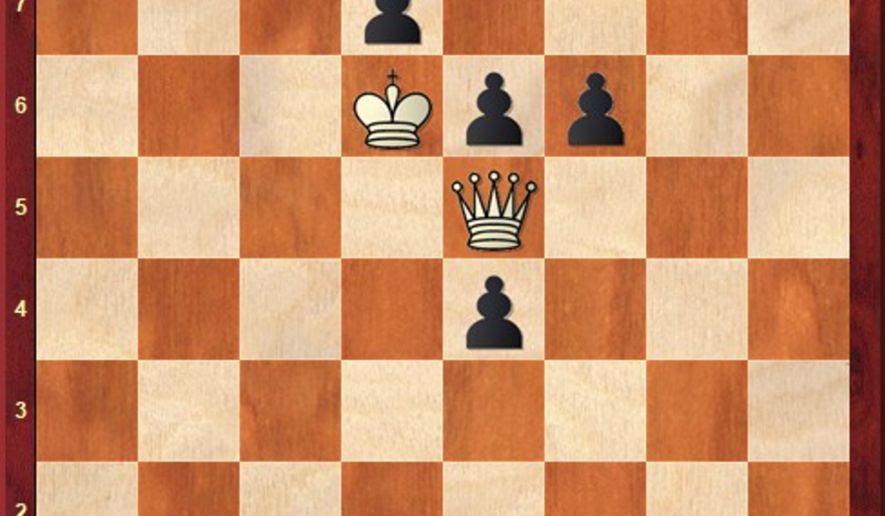
We close with today’s diagram, a study composed by Shinkman’s great contemporary, Sam Loyd. It’s taken from the inaugural June 1876 edition of the American Chess Journal, where Loyd headed the problem department.
White is to move first and mate Black in three moves, showing Loyd’s fondness for using the entire board for his compositions.
We’ll have the answer in next week’s column. Happy solving!
(Click on the image above for a larger view of the chessboard.)
Bird-Mason, Clipper Free Centennial Tournament, New York, September 1876
1.e4 e6 2.d4 d5 3.Nc3 Nf6 4.exd5 exd5 5.Nf3 Bd6 6.Bd3 O-O 7.O-O h6 8.Re1 Nc6 9.Nb5 Bb4 10.c3 Ba5 11.Na3 Bg4 12.Nc2 Qd7 13.b4 Bb6 14.h3 Bh5 15.Ne3 Rfe8 16.b5 Ne7 17.g4 Bg6 18.Ne5 Qc8 19.a4 c6 20.bxc6 bxc6 21.Ba3 Ne4 22.Qc2 Ng5 23.Bxe7 Rxe7 24.Bxg6 fxg6 25.Qxg6 Nxh3+ 26.Kh2 Nf4 27.Qf5 Ne6 28.Ng2 Qc7 29.a5 Bxa5 30.Rxa5 Rf8 31.Ra6 Rxf5 32.gxf5 Nd8 33.Nf4 Qc8 34.Nfg6 Re8 35.Nxc6 Qc7+ 36.Nce5 Qxc3 37.Re3 Qd2 38.Kg2 Qxd4 39.f6 gxf6 40.Rxf6 Ne6 41.Rg3 Ng5 42.Ng4 Kg7 43.Nf4 Qe4+ 44.Kh2 Nh7 45.Nh5+ Kh8 46.Rxh6 Qc2 47.Nhf6 Re7 48.Kg2 d4 49.Ne5 Qc8 50.Ng6+ Black resigns.
Wheeler-Shinkman, Correspondence Game, 1876
1. e4 e5 2. Nf3 Nc6 3. Bb5 Nf6 4. d4 Nxe4 5. O-O Be7 6. Qe2 f5 7. Bxc6 bxc6 8. Nxe5 O-O 9. Qc4+ d5 10. Qxc6 Rb8 11. Qa4 f4 12. Nc6 Qe8 13. f3 Bh4 14. fxe4 Bd7 15. exd5 f3 16. Qc4 Qg6 17. g3 Rbe8 18. Ne5 Rxe5 19. dxe5 Bxg3 20. Qd3 White resigns.
• Got a hot tip or a cool game to share? David R. Sands can be reached at davidrsands18@gmail.com.

Please read our comment policy before commenting.