



OPINION:
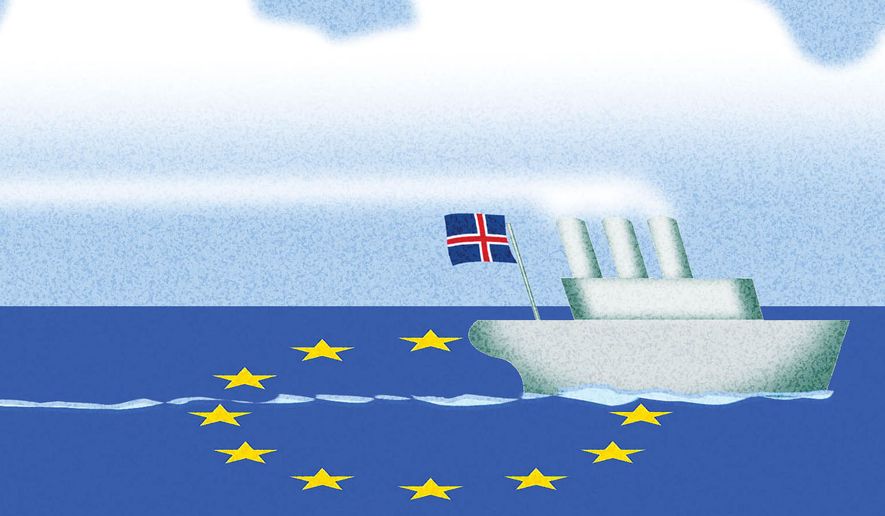
Icelanders have delivered a humiliating rebuke to Europe’s political elite: The continent does not belong to Brussels, and cooperation among free nations does not require surrendering sovereignty to the European Union.
On Saturday, by 52.8% to 47.2%, with an extraordinary 82.5% turnout, voters rejected reopening EU membership talks. This was not a vote against Europe, trade or the Western alliance. It was a vote against the assumption in Brussels that every successful European nation must eventually join the EU.
That is why the referendum matters far beyond Iceland’s population of roughly 400,000, a strategically placed North Atlantic democracy. Iceland’s message is simpler: Europe can cooperate, trade and defend itself without becoming a centralized political project run from Belgium.
People were interested in these podcasts
Iceland was supposed to be the EU’s model accession story. It is wealthy, democratic, already in Schengen (the passport-free travel arrangement that allows borderless movement without requiring full EU membership) and deeply integrated into the single market through the European Economic Area.
The EU hoped a “yes” vote would revive enlargement and extend the EU’s reach into the strategically vital Arctic. Instead, voters slammed the door.
Sovereignty — above all, over fisheries — stopped the EU cold. Fishing contributes roughly 15% of Icelandic gross domestic product, both directly and indirectly, and about 40% of export revenue. For Icelanders, control of their waters means jobs, food, national identity and economic independence.
Brussels’ Common Fisheries Policy would place decisions on quotas, access and regulation within a system in which Iceland would be one voice among 28 member states. Europhiles offered influence in Brussels. Icelanders chose accountability at home.
Prime Minister Kristrun Frostadottir’s left-wing government deployed the familiar Project Fear script, selling EU membership as protection from trade conflict, Arctic rivalry and uncertainty surrounding President Trump’s Greenland policy. The centralizers’ message: Small nations cannot be trusted to govern themselves in dangerous times.
Icelanders answered that a sense of insecurity is no excuse for absorption.
That answer matters because it cuts through one of Brussels’ favorite arguments: Outside the EU lies isolation.
Iceland already has access to the single market through the EEA’s four freedoms: free movement of goods, persons, services and capital. In addition to being a Schengen member state, it is a founding member of NATO, the alliance that guarantees European security, and it maintains a vital bilateral relationship with the United States.
Iceland chose another path: trade through the single market, security through NATO and close diplomacy with Europe and the U.S., without political absorption into the EU.
That is functional Europe in practice: nations working together where it serves their interests, while keeping political authority close to their own voters.
Iceland did not merely say no to one treaty; it unbundled Europe itself. Trade, mobility, defense and political authority need not reside in the same institution. That proposition terrifies Brussels federalists because it turns sovereignty into a practical governing model for the continent.
Iceland’s present model is not perfect. Through the EEA, it applies substantial single-market legislation without a formal vote in EU institutions. Still, the answer is not to surrender more authority to Brussels; it is to give sovereign EEA states a stronger voice and greater flexibility while resisting the EU’s relentless regulatory expansion.
Nor is sovereignty the only cost. EU membership would pull Iceland deeper into a rulemaking system designed for the bloc rather than for a nimble North Atlantic economy. For Iceland, that is not an incentive to join. It is a warning sign.
The result leaves the EU’s enlargement narrative in tatters. Brussels presents expansion toward Ukraine, Moldova and the Western Balkans as a geopolitical necessity. Yet if affluent, stable, institutionally compatible Iceland still judges the sovereignty and regulatory costs too high, EU leaders should ask whether their problem is messaging — or the product itself.
Washington should take note.
An “America First” foreign policy should deal with Europe as it exists: a continent of nations, not just an EU bureaucracy. The U.S. benefits when democratic allies control their resources, defend their interests and cooperate voluntarily through NATO.
A centralized EU is no guarantee of trans-Atlantic strength. Too often, it slows cooperation and makes it less accountable and less responsive to national interests.
The EU’s promise of “ever closer union” once masqueraded as Europe’s destiny. Today, it sounds like a threadbare slogan from an era when centralization could still be sold as progress and sovereignty dismissed as nostalgia.
Iceland’s voters have offered a better vision: independent nations, deeply connected and firmly allied, but still answerable to their own people. They did not turn their backs on Europe. They reminded Europe that democratic government still begins at home.
• Paul McCarthy is the senior research fellow for European affairs in the Margaret Thatcher Center for Freedom at The Heritage Foundation.

Please read our comment policy before commenting.