


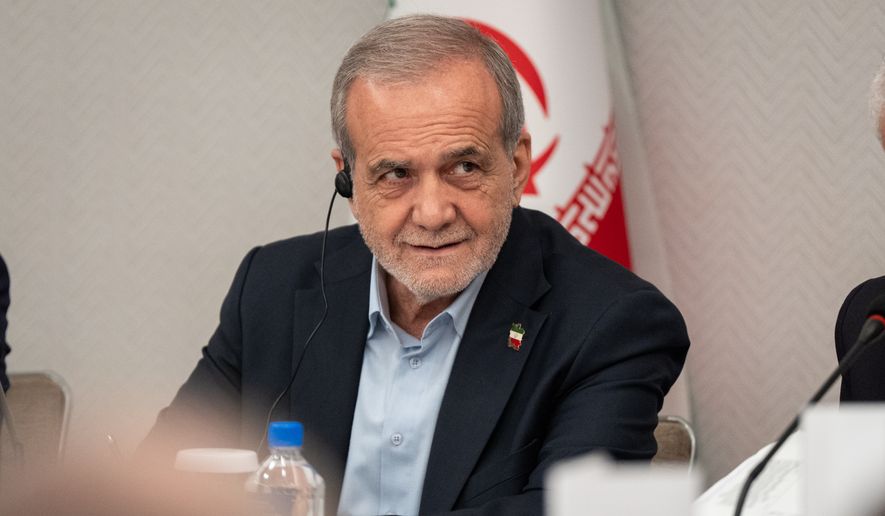

Iranian President Masoud Pezeshkian said Tuesday that Tehran would “immediately reciprocate” if the U.S. adheres to its commitments under the defunct Islamabad memorandum of understanding to end the war.
Speaking at the Shanghai Cooperation Organization Summit in Kyrgyzstan, Mr. Pezeshkian said that despite recent flare-ups over control of the Strait of Hormuz, Iran is prepared to enter an era of peace under the terms of the memorandum.
“Unlike the United States, my country has an outstanding record of honoring its international commitments and agreements and has always acted in accordance with the principles of international law,” he said. “Lasting security is achieved not through confrontation but through mutual trust, respect for national sovereignty, noninterference in domestic affairs and cooperation among governments.”
He added that the U.S. adhered to the terms of the agreement only for a few weeks before the pact collapsed in July.
Mr. Pezeshkian stressed that Iran is willing to respond forcefully if the U.S. continues to violate its commitments under the agreement.
He also urged the Shanghai Cooperation Organization, which includes Pakistan, China, Russia and India, to play a more active role in multilateral diplomacy. Mr. Pezeshkian and his foreign minister, Abbas Araghchi, have used the conference to confer with Iran’s key allies China and Russia.
Mr. Pezeshkian said he met with Russian President Vladimir Putin on the sidelines of the conference on Tuesday, where the two worked to “expand mutual cooperation in various fields.”
The U.S. and Iran signed the Pakistani-mediated memorandum in June after weeks of backchannel diplomacy. The agreement mandated a temporary ceasefire, the reopening of the Strait of Hormuz and at least 60 days of direct negotiations between the two countries.
Pakistan has been one of the loudest voices urging a return to the memorandum over the past month, working alongside Qatar to ferry peace proposals between the U.S. and Iran.
Pakistani Prime Minister Shehbaz Sharif told his counterparts Tuesday at SCO that the memorandum “offers the most viable and enduring pathway to lasting peace.”
However, after Iran struck commercial ships attempting to traverse the strait, the U.S. responded with its own strikes, resulting in weeks of retaliatory strikes from both sides. Fighting ended in late July after President Trump called off a round of attacks.
But fighting resumed this week, as the U.S. attempts to increase its leverage over the strait. U.S. Central Command launched attacks Sunday on Larak Island, off Iran’s southern coast, asserting that Tehran was prepared to launch rockets with sea mines attached.
Iran retaliated the next day with attacks on U.S. military assets in Jordan.
Contact the author


Please read our comment policy before commenting.