



The Senate returns to Washington next week with an added obstacle to the already herculean task of passing the SAVE America Act: a narrow three-week window in which to act.
That is all the time the Senate has left in session before the November midterm elections. Even if Republicans had a viable plan to overcome Democrats’ filibuster and pass the bill, it may be too late to force states to implement the measure’s proof of citizenship and photo ID requirements before the Nov. 3 election.
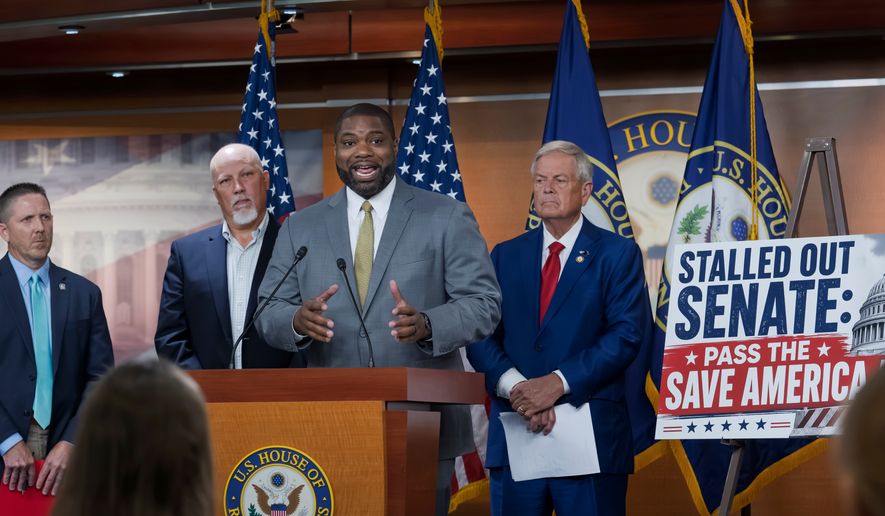
“It’s an exercise on ‘28 now,” said Texas GOP Rep. Chip Roy, a lead sponsor of the bill.
People were interested in these podcasts
President Trump is keeping pressure on Congress to get the bill passed, but he too is looking beyond this year’s election.
“One way or the other, before or after the Nov. 3 election, we will pass the SAVE America Act. We will make mandatory photo ID and proof of citizenship,” Mr. Trump said in a speech Wednesday to the GOP convention in Dallas.
The House-passed version of the election bill is written to take effect upon the date of enactment, specifying that anyone applying to register to vote on or after that date must show proof of citizenship.
Voters would also be required to show photo identification at the polls.
“The closer you get to the election, the more difficult it is to get this implemented,” Hans von Spakovsky, senior legal fellow at Advancing American Freedom, told The Washington Times. “So if [the Senate] wanted to get it done, they would need to do it really as soon as they got back.”
Mr. von Spakovsky, who previously served on the Federal Election Commission, said there is not enough time for states to vet the citizenship status of everyone who is already registered to vote, but they could still implement a proof of citizenship requirement for new registrations that come in before Election Day.
He said 24 states allow same-day voter registration, while the other states have various deadlines on when voters must register but none greater than 30 days before the election.
The requirement for voters to show photo ID when casting a ballot would be the easiest to implement, according to Mr. von Spakovsky and Cleta Mitchell, senior legal fellow at the Conservative Partnership Institute and founder of the Election Integrity Network.
“That is not a problem,” Ms. Mitchell told The Times, noting that 36 states already have some form of voter ID requirement.
However, some states allow student IDs, bank statements, utility bills and other forms of ID that the SAVE America Act would not.
Mr. von Spakovsky said all states would need to do is inform voters of the change and distribute a one-page instruction to election workers on the types of IDs that are acceptable.
Not all election experts are convinced that any pieces of the SAVE America Act could be implemented for the 2026 midterms.
“There’s just no way to pass the bill and implement it nationwide and deal with the litigation before Election Day,” said Don Palmer, senior legal fellow for election integrity at the Heritage Foundation.
He said one thing that theoretically could be implemented is a requirement for states to check their voter rolls for noncitizens using the Department of Homeland Security’s Systematic Alien Verification for Entitlements, or SAVE, database.
“But that’s also tied up in litigation right now,” Mr. Palmer said.
The SAVE system was created to check whether an immigrant was eligible to receive government welfare.
The Trump administration had encouraged states to use SAVE to check their voter rolls for noncitizens, but that use was blocked by a district court ruling in June that said it violated federal privacy laws.
The U.S. Circuit Court of Appeals upheld the lower court’s ruling, so on Tuesday the Trump administration asked the Supreme Court to weigh in.
Republicans’ election integrity bill gives states other options for checking voters’ citizenship status, such as using the Social Security Number Verification Service, that would also invite legal challenges.
Mr. von Spakovsky said even if states are allowed to use SAVE to run citizenship checks, they cannot just immediately remove noncitizens from the rolls.
“You have to investigate each case individually to ensure that information is correct and accurate before you delete them, and that is going to take quite a bit of time,” he said.
Ms. Mitchell said legal fights are part of SAVE America Act opponents’ plan “to run out the clock,” but she is committed to seeing the measure enacted regardless of what election it takes effect.
“We’re not stopping,” she said. “I started working on this in January of 2024, and we are going to keep working on this until we get something done that gets the noncitizens off the voter rolls, and we make sure that we have a proper voter ID, and that we don’t let anybody register to vote who hasn’t proven that they’re eligible.”
Contact the author


Please read our comment policy before commenting.