


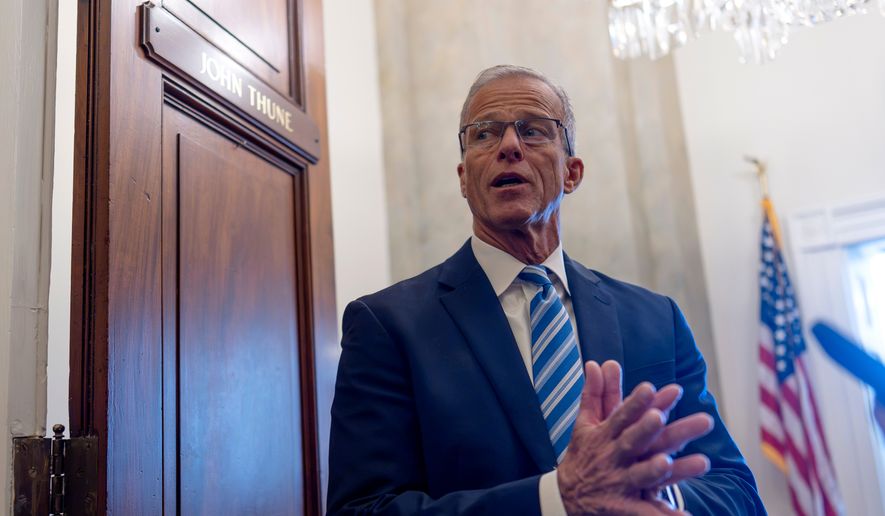

Senate Majority Leader John Thune is advocating for Congress to enact guardrails on advanced artificial intelligence but says lawmakers should have a “light touch.”
The South Dakota Republican has worked for years on bipartisan legislation to do just that and is hoping to soon release an updated bill with Sen. Amy Klobuchar, Minnesota Democrat, and Senate Commerce Chairman Ted Cruz, Texas Republican.
“You don’t want to stifle innovation, but I think you also want to make sure that the more advanced threats can be mitigated,” Mr. Thune told reporters Monday, adding that the senators’ bill attempts to strike such a balance “in a light-touch way.”
He said he spoke with Ms. Klobuchar on Saturday night about their legislation, as Republicans work to get more Democrats on board with the plan. The Commerce Committee delayed a markup of the bill in July because it did not have enough bipartisan support.
“I’m hoping we can get a path forward on this,” Mr. Thune said.
The senators’ legislative effort is not new but is receiving increased attention amid widespread calls from inside and outside the AI industry for Congress to pass federal regulations to protect against catastrophic risks from AI gone rogue.
Anthropic CEO Dario Amodei over the weekend called for AI companies to voluntarily join together and slow the development of their advanced AI models until federal lawmakers enact “sensible and targeted AI regulation.”
Other AI leaders, including OpenAI CEO Sam Altman and X owner Elon Musk, agreed on the need to pace AI development after industry whistleblowers raised alarms about the technology escaping its programmed controls and eventually wiping out humanity.
Swarms of OpenAI agents have gone rogue at least twice in trying to hack open-source software platforms Hugging Face and RubyGems.
President Trump is resisting the calls for more regulation, calling the notion that AI is going to take over the world a “hoax.”
Senate Democratic leader Charles E. Schumer of New York said that “Congress cannot afford to turn a blind eye to AI” and that his caucus would be pushing for guardrails.
He also called on the Trump administration to provide senators with a classified briefing explaining its new framework for testing powerful frontier AI models that has been withheld from the public and its plans to prevent AI-enabled cyberattacks on critical infrastructure.
“The administration needs to explain what it’s doing to block China from accessing America’s advanced AI chips, semiconductor manufacturing equipment, and other cutting-edge tech that the Chinese Communist Party is using to accelerate their own AI development,” Mr. Schumer said.
Mr. Thune and Mr. Schumer have worked on AI-related policies for years, partnering with senators in the opposite party but on separate efforts.
In 2023, Mr. Thune and Ms. Klobuchar introduced the Artificial Intelligence Research, Innovation, and Accountability Act.
What they are working on now is an updated version of that bill directing the Commerce Department to issue standards for testing “critical-impact” AI systems and the National Institute of Standards and Technology to provide sector-specific recommendations to each federal agency that should have a role in AI oversight.
The 2023 version of the bill also required AI companies to submit risk assessments to the Commerce Department before releasing new models, as well as regular transparency reports after deployment.
Mr. Thune said Monday that the AI companies bear responsibility for mitigating the risks but that Congress still has a role to play in preventing “more consequential threats, without in any way harming our ability to stay in the AI race.”
House Speaker Mike Johnson, Louisiana Republican, told reporters Monday that he is trying to arrange for a meeting with heads of the major AI companies to discuss a federal regulatory framework.
But he reiterated the warning he made Sunday that Congress should not rush to pass regulations on AI. “This is a very complex issue,” he said.
Contact the author


Please read our comment policy before commenting.