


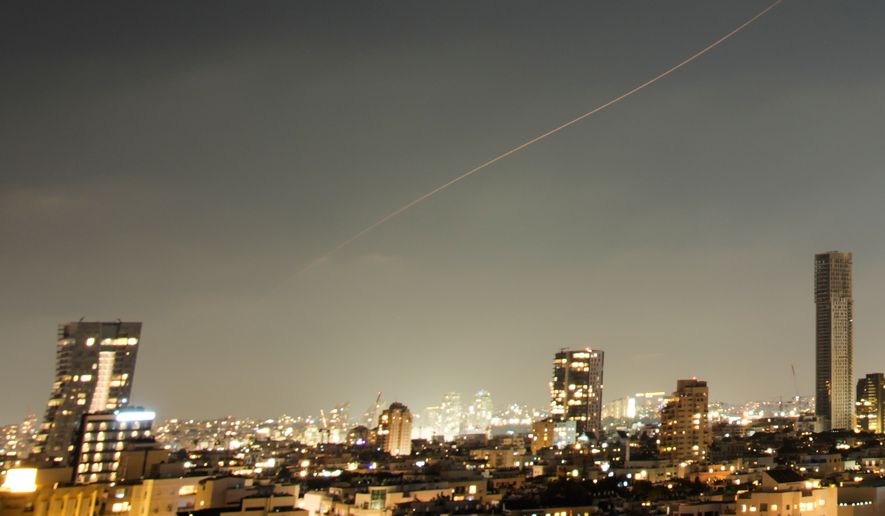

Iranian missile and drone attacks on U.S. outposts in the Middle East have damaged or destroyed hundreds of buildings and dozens of American combat aircraft since the start of the war against Tehran, according to a major new report from the Pentagon’s inspector general.
The study, one of the most comprehensive looks at the conflict’s overall costs, is likely to fuel more criticism of the war and add fresh political pressure to the Trump administration and congressional Republicans ahead of the midterm elections.
In its mandatory report delivered to Congress and released publicly on Monday, the Defense Department watchdog estimated that Operation Epic Fury — the official name of the war that began in late February — has cost $33.4 billion as of June 29. Of that amount, $22.3 billion went to procuring critical munitions, such as missile interceptors, whose stockpiles have been depleted by the conflict. Another $3.7 billion has gone to replace lost U.S. military equipment, the report says.
Those numbers have likely soared even higher in recent months. For example, Iran’s Islamic Revolutionary Guard Corps claimed to have shot down an advanced MQ-9 Reaper drone over the Strait of Hormuz on Tuesday.
That report could not be immediately confirmed, but the Pentagon inspector general’s report said Iran had destroyed as many as 30 MQ-9 Reaper drones throughout the conflict.
Democrats seized on the study to criticize the war and President Trump’s handling of it.
SEE ALSO: Iran flatly rejects peace talks with U.S. as Yemen war threatens global oil supply
Rep. Adam Smith, Washington Democrat and the ranking member of the House Armed Services Committee, said tens of billions of taxpayer dollars are being wasted on Operation Epic Fury while the costs of gas, utilities and groceries at home continue to climb.
“It has been six months since Trump unilaterally launched his catastrophic war of choice against Iran, and so far, he has failed to achieve any of his administration’s constantly changing strategic objectives,” Mr. Smith said in a statement. “Trump’s war has put extreme stress on our military’s munitions and platforms.”
The U.S. launched the war Feb. 28 in an effort to cripple Iran’s military, destroy its ability to build new missiles and drones, crush its nuclear program and end the regime’s support for terrorist groups such as Hamas and Hezbollah.
More than six months later, the government in Tehran is still standing, and its military is still able to target the U.S., its allies and commercial ships transiting the Strait of Hormuz off the Iranian coast, including ships transporting oil out of the Persian Gulf. Iran’s chokehold on that strategic waterway has led to a major global spike in oil prices.
Munitions stockpiles running low
The inspector general’s report will also be viewed as more evidence that the Iran war is putting America’s ordnance stockpile at risk, especially critical weapons such as missile interceptors.
SEE ALSO: Bessent cites progress in cutting off Tehran’s financial lifelines
Although the Pentagon has begun implementing “mitigation strategies,” the U.S. defense industrial base requires significant lead time to expand production capacity, the report stated.
“The most persistent bottlenecks remain in the production of solid rocket motors, the availability of high-grade explosives and propellants, and the recruitment of skilled manufacturing labor,” the report said.
Solid rocket motors are critical components of missiles.
The inspectors noted that U.S. ordnance expenditure during Epic Fury has resulted in “strategic inventory shortfalls” and revealed bottlenecks in the munitions resupply industrial base.
The White House has repeatedly pushed back against concerns about the rapid depletion of U.S. ammunition. On Sept. 4, Mr. Trump said on Truth Social that the U.S. has “virtually unlimited amounts of Mid to High Grade Ammunition, far more than we could ever use for this, or any other War.”
Mr. Trump said the U.S. was producing munitions at “levels never seen before.”
“We are stockpiling and preparing for any contingency that could happen,” he said. “We are taking them for ourselves, the U.S.A., rather than selling them to others, but the sales to allies will soon again begin.”
However, defense industry sources have repeatedly told The Washington Times that the nation’s munitions stockpiles are dipping to levels not seen in years.
The Pentagon said it is working to streamline procurement processes and production lead times and to stockpile materials, components and selected munitions to mitigate the munitions constraints and respond rapidly to a contingency, according to the report.
In a separate report, the Congressional Budget Office estimated that the cost to replace the U.S. munitions expended during the war is $21.7 billion: $7.3 billion for land-attack cruise missiles, $13.1 billion for missile defense interceptors and $1.2 billion for other munitions.
“Replacing those munitions has been the greatest single component of the costs incurred by [the Department of Defense] during the conflict,” the CBO said in its report released Tuesday.
The CBO figures assessed the costs only through the end of August.
The human cost
Personnel costs were also high. More than 50,000 U.S. service members were deployed through the U.S. Central Command area of responsibility in support of the operation.
From Feb. 28 through June 30, seven U.S. military personnel were killed in action, while seven others were killed in nonhostile events during combat operations. Four others were killed in action in July. During the same period, 417 service members were wounded.
Fatal incidents detailed in the report include six U.S. service members killed on March 1, when an Iranian attack drone struck a U.S. tactical operations center at Port Shuaiba in Kuwait. Separately, a March 12 crash of a KC-135 Stratotanker killed six Air Force personnel.
At the height of the conflict, the U.S. sent more than a dozen fighter squadrons, destroyers and air defense batteries to the region. Also deployed were Terminal High Altitude Area Defense ballistic missile defense batteries, High Mobility Artillery Rocket Systems and elements of the Army’s 82nd Airborne Division.
The Pentagon inspectors said the volume and financial cost of U.S.-used ammunition during Epic Fury illustrate the magnitude of the threat posed by Tehran.
“Iran has the largest armed forces in the region and spent decades of intense focus developing and expanding its own domestic defense industry,” the report stated. “Iran has also focused heavily on passive defense measures to protect its military capabilities, including extensive underground facilities, dispersal of munitions inventories, concealment and deception to mask equipment, and mobile launch platforms.”
The Pentagon investigators also detailed the U.S. military aircraft that were destroyed or heavily damaged in the conflict, including F-15E and F-35 fighters, KC-135 refueling aircraft, combat helicopters such as the AH-64 and the MH-60, and drones such as the MQ-4C Triton and the MQ-9 Reaper. The Pentagon report said as many as 30 Reapers have been destroyed in the fighting.
Iran’s ability to target U.S. facilities in the Middle East has sparked new Pentagon initiatives to guard American personnel, buildings and equipment.
Gen. Ken Wilsbach, the Air Force chief of staff, on Monday announced a “point defense weapons system” meant to protect key U.S. installations in wartime theaters, including sites in the Middle East that Iranian drones and missiles have aggressively targeted.
“For decades, American air and space power has often operated from a position of sanctuary. Those days are over,” Gen. Wilsbach said during a keynote speech at the Air, Space and Cyber conference in National Harbor, Maryland. “We can no longer treat point defense as a side hustle. We must make it a core function of air and space power.”
The general offered few specific details on the initiative but said it will combine “kinetic and non-kinetic capabilities to secure our air bases.” He also announced the establishment of an Air Force career field in which airmen will focus directly on “point defense.”
Contact the author


Please read our comment policy before commenting.