


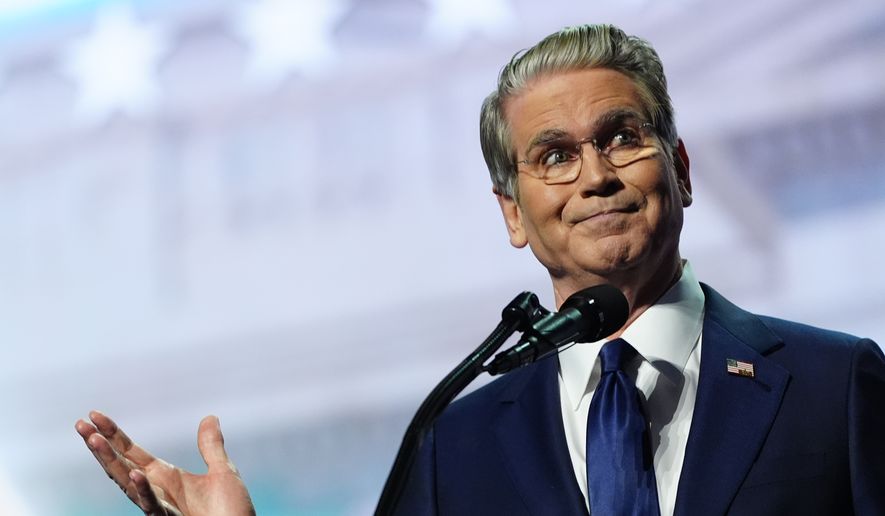

Treasury Secretary Scott Bessent said Tuesday he plans to meet with Chinese Vice Premier He Lifeng over the weekend to discuss economic pressure on Iran and set the table for Chinese President Xi Jinping’s visit to Washington.
Mr. Bessent teased the talks during testimony to the House Financial Services Committee about administration efforts to squeeze Iran and make sure other countries do not send the Islamic regime a financial lifeline during its war with the U.S.
“We have had some very good private discussions, and I look forward to those continuing this weekend when I meet my Chinese counterpart,” Mr. Bessent said. “I’m sure it will continue during President Xi’s state visit.”
Mr. Xi is scheduled to visit the White House on Sept. 24.
Beijing has been a strategic partner to Tehran historically, so President Trump is trying to thwart Chinese assistance for Iran as the U.S. wages war to keep nuclear weapons out of Iranian hands.
Mr. Bessent said the administration made progress with the United Arab Emirates, a key U.S. partner in the Middle East.
“They’ve announced that they have cut off financial transactions and trade with Iran,” the secretary said of the Emiratis.
Two weeks ago, he said, the Treasury sanctioned a branch of an Egyptian bank in Dubai that had transferred more than $1.8 billion to Iran since 2025.
“Our message has been, and it has been heard, that we know who you are, you know who you are — stop,” Mr. Bessent said.
Mr. Trump is relying on economic pressure to bring Iran to heel and force it to meet his terms for ending the war and preventing Tehran from getting a nuclear weapon.
The U.S., working with Israel, launched airstrikes against Iran on Feb. 28, killing top Iranian leaders and decimating the regime’s military infrastructure.
Iran retaliated by closing the Strait of Hormuz, a vital oil chokepoint, resulting in higher energy prices and cycles of violence, diplomacy and economic pressure.
Iran-backed Houthis recently attacked Saudi Arabian energy depots and pipelines, further constraining oil supplies.
Mr. Bessent said Iran is lashing out because its economy is in deep trouble.
“We have seen the currency collapse, we have seen inflation through the roof,” he said. “In a country with the third-highest energy resources in the world, they now have three- to four-hour gas lines because they have to import their fuel.”
“I believe that this violent outburst that we are seeing from them is the result of a wounded and cornered animal,” Mr. Bessent said.
Contact the author


Please read our comment policy before commenting.