


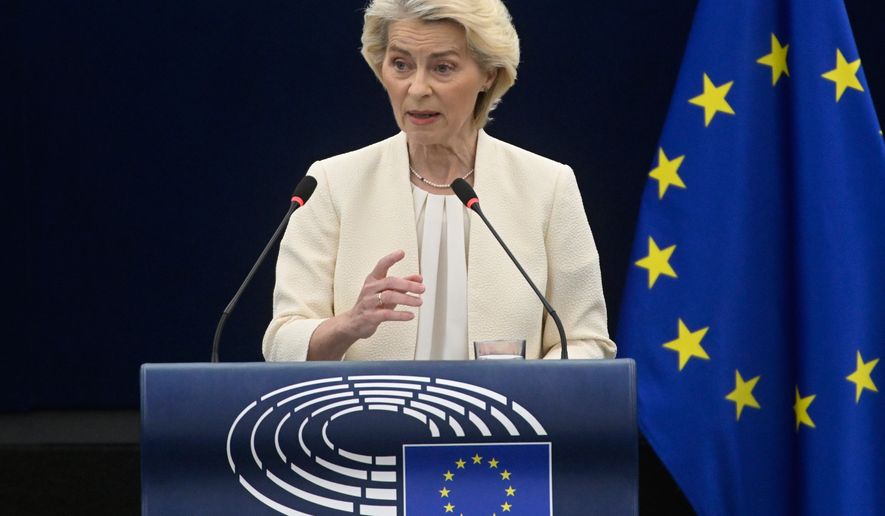

BRUSSELS — European Commission President Ursula von der Leyen on Wednesday set out her priorities for the European Union in the next year, including closer ties with Canada, protection for children online, climate change and Russia’s war on Ukraine.
Canadian Prime Minister Mark Carney was the special guest as von der Leyen spent well over an hour setting out her vision for the world’s largest trading bloc in her State of the European Union speech to the European Parliament in Strasbourg, France.
The speech also touched on the future of artificial intelligence, several worrying drone incidents on EU territory, conflict across the Middle East and international trade tensions.
Last year, she said Europe must stake out its independence as the U.S. continued to impose tariffs on nations and the Trump administration in the U.S. criticized the bloc’s migration policies, warning of “civilizational erasure.”
“Europe is in a fight,” von der Leyen said. “A fight for our values and our democracies.”
A political spectacle to showcase European ambition
The event has become an annual ritual modeled on the State of the Union addresses to Congress by U.S. presidents, but it was not broadcast widely and few of the European Union’s 450 million citizens across 27 member countries were expected to tune in.
It’s a carefully crafted communications exercise in front of often applauding lawmakers that is appreciated most by EU insiders. Von der Leyen concluded with what has become her rallying cry: “Long Live Europe.”
Routinely, the themes of the address are aspirational. They touch on von der Leyen’s hopes and plans for the commission - the EU’s increasingly powerful executive branch – over the coming year but often lack detail, as was the case on Wednesday. Critics say the commission’s work is opaque.
Ahead of the event, Eric Maurice, an analyst at the European Policy Centre think tank, warned against her using the speech “to placate political groups” or “to raise the Commission President’s profile and extend the Commission’s political and institutional domain.”
“The EU is facing the crumbling of all the premises on which it was built. The rules-based order with benevolent free-trade and U.S. friendship and support is disappearing,” Maurice said.
An institution’s rising power and influence
The commission proposes laws used across the 27 countries and watches to ensure that those already in place are not being broken. It negotiates trade on behalf of all its members and is Europe’s top antitrust investigator.
At its helm stands von der Leyen, the 67-year-old former German defense minister, who has become a prominent figure at summits with leaders around the world, despite being a political appointee who hasn’t been elected to Europe’s top post.
Von der Leyen is hard to ignore. She has accumulated influence over seven years in office by securing vaccines during the COVID-19 pandemic, managing the energy crisis sparked by Russia’s invasion and rallying support to Ukraine through the war.
She also seems to have the begrudging respect of U.S. President Donald Trump. She, her chief of cabinet, and her trade commissioners have labored to limit the damage caused by Trump’s tariff war to the European economy.
But the Trump administration has also been riled by the commission’s crackdown on Big Tech companies, many of them in the United States, over their perceived flouting of Europe’s data regulations.

Please read our comment policy before commenting.