


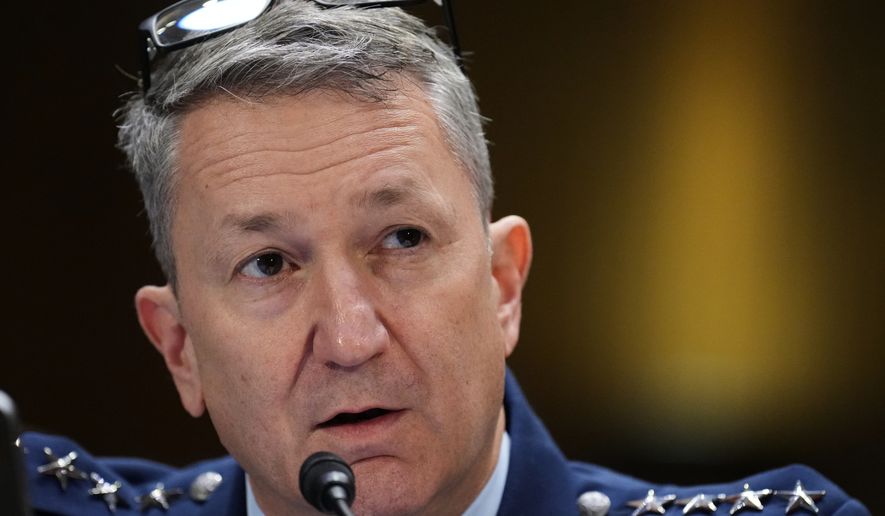

The U.S. must be ready to fight and win 21st-century battles on or around the moon, the chairman of the Joint Chiefs of Staff said in a major speech Wednesday, as the once-futuristic idea of warfare in space edges closer to reality.
Gen. Dan Caine made the comments at a major defense industry conference just two days after U.S. officials confirmed for the first time that the military had weapons in orbit. Maintaining unmatched space superiority is a top military priority, Gen. Caine said, as adversaries such as China and Russia make massive investments in space weapons and other capabilities that can threaten American satellites.
“Our task, my friends, is to adapt right now, so the joint force is prepared to fight, endure and win in global contested environments, from the seabed to cislunar space,” said Gen. Caine, referring to the area of space stretching from Earth to the orbit of the moon.
“Our United States Space Force must provide unrivaled space superiority and sustain the associated networks, domain awareness, data advantage that the joint force needs to win in space both now and in the future,” he told an audience at the Air and Space Forces Association’s Air, Space and Cyber Conference at National Harbor in Maryland.
Gen. Caine warned that in future combat, U.S. forces will be “hunted” by AI-powered drones, a nod to how rapidly technology is changing the fundamentals of warfare.
Dominating the space domain — home to satellites crucial to the military’s ability to communicate and operate around the globe — has been a central priority for the Space Force since its establishment as an independent military service in 2019.
In recent weeks, however, key officials have begun to speak about actual kinetic warfare in space in unprecedented terms, suggesting that attacks on satellites or the exchange of fire in orbit may be closer than thought.
On Monday, Air Force Secretary Troy Meink revealed that the U.S. had weapons in orbit.
“The United States now has on-orbit space-control weapons capable of defending the joint force against hostile adversary action,” Mr. Meink said during his keynote address at the conference.
Mr. Meink’s announcement appeared designed to signal to China and Russia that the United States is now openly engaged, at a potentially kinetic level, in the growing great-power military competition in space. Both adversaries have made major strides in their own space capabilities in recent years, including Moscow’s pursuit of anti-satellite weapons and Beijing’s investment in space weapons that U.S. defense analysts say are designed to destroy or disrupt American satellites.
“For over a decade, we’ve been talking about the fact, and we’ve expressed concern that the Chinese and the Russians, and especially others [are] developing weapons for space,” Mr. Meink said. “We are focused on making sure we can protect ourselves and operate in that environment, as we’ve done for decades.”
The U.S. Space Force plays a central role in fielding America’s space-based weapons and protecting satellites that facilitate military communications, logistics, GPS and targeting on Earth.
The Trump administration has requested a budget of more than $71 billion for the Space Force in fiscal 2027, more than doubling fiscal year 2026 spending.
Gen. Caine sketched out a future in which America’s adversaries are working together.
“Our adversaries may be geographically distributed and dispersed, but they’re increasingly connected. They share technology, intelligence, weapons and economic support,” he said. “They’re studying our battlefields in the past and our battlefields currently. They’re adapting quickly and seeking new ways to challenge our advantages.”
He cited AI and advanced cyber capabilities as changing the pace of modern warfare.
“AI is here now, and it’s already changing the way militaries see, sense, decide and act,” he said. “Across the joint force, we’re putting AI to work every single day to move faster and to make better decisions.”
Russia’s invasion of Ukraine in February 2022 triggered an evolution in combat operations. First-person-view drones with AI-enabled computer vision can strike targets on a heavily contested battlefield even when GPS is not available.
U.S. troops operating on those future battlefields will face rapidly evolving threats, Gen. Caine said.
“We have to assume from now on that our forces will be hunted by autonomous systems, jammed across the spectrum and tracked in real time,” he said.
Contact the author



Please read our comment policy before commenting.