



OPINION:
Desperate Iranians are offering their kidneys to the highest bidders, and their bank deposits are evaporating.
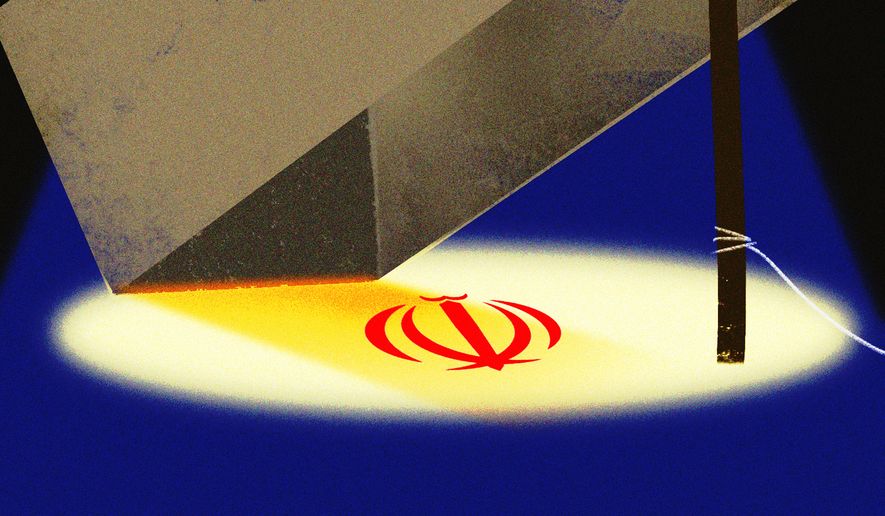
The Islamic Revolutionary Guard Corps-led regime is facing its hardest economic challenge ever: a full blockade of its oil exports, the country’s only moneymaker.
Washington’s toughest sanctions push yet faces one stubborn problem: Every time the U.S. closes one door, Tehran opens another.
People were interested in these podcasts
Late last month, Treasury Secretary Scott Bessent announced a wave of sanctions called “economic asphyxiation.” He dubbed the campaign Operation Economic Outcast, an “economic D-Day” meant to force Iran’s remaining trade partners to choose between America and Iran.
In a single day, nearly 60 targets were hit. They were Iran’s five lifelines: digital assets, technology, gold, aviation and shipping.
A U.S. naval blockade launched in April drove Iran’s oil exports toward zero by May, down from roughly 2.1 million barrels a day in February.
The International Monetary Fund expects Iran’s economy to shrink more than 6% this year, with inflation near 69%, and the rial has lost about half its value in the past year alone. This is not a country shrugging off sanctions.
Still, “D-Day” is the wrong image. What Iran has built over nearly five decades is a maze of smaller escape routes that together keep just enough money moving to avoid collapse, even as the wider economy craters. That is what the U.S. needs to destroy.
Where China comes in
This is where Iran’s story becomes China’s story. For years, most of the oil Iran managed to sell went to China — not to the state oil giants, which stopped touching Iranian crude long ago, but to small, independent refineries, many in Shandong province.
The oil arrived relabeled as Malaysian or “unspecified Middle Eastern” crude, swapped ship-to-ship off the coasts of Malaysia and Singapore, and paid for through small Chinese banks and Hong Kong shell firms settling in yuan.
The U.S. must target a shadow fleet of roughly 300 tankers that continue to operate even after new loadings ceased, drawing on oil stockpiled offshore before the blockade tightened. The oil reserve is nearly gone. Floating storage has fallen to roughly 80 million barrels, and Iran’s central bank governor said last month that exports are effectively zero.
China is likely to fight hard for Iran anyway. When Washington sanctioned one of these refineries in April, the Chinese Commerce Ministry issued a formal order blocking the U.S. designations, calling them illegal. That is a government pushing back, not a company hiding money.
Beijing is testing how far U.S. financial power can extend into another country’s banks and how much resistance Washington will absorb in enforcing it.
That is why the summit later this month between President Trump and Chinese leader Xi Jinping matters. A successful visit, one that eases U.S.-China friction over trade and technology, could make Beijing more willing to rein in its refiners and banks. A visit that goes badly could push China toward open defiance of U.S. sanctions on Iran.
Iran sanctions are no longer just an Iran problem. They are now a test of whether Washington and Beijing can compete without fighting in every corner of the map — and the odds of that are probably not good.
Closing the land routes
China is the biggest obstacle to sanctions success, but not the only one. Iran also moves goods overland, and those routes deserve more attention.
The amount that slips through Turkey’s Kapikoy-Razi crossing is unknown, as it is unclear whether Iran has increased imports through the corridor since the blockade began. However, this is exactly the kind of gap that stays open as long as sanctions target individual violators rather than making Turkish banks treat Iran as too risky to touch.
Iran also runs goods through Armenia and across the Caspian into Russia. These corridors sit uncomfortably close to a U.S.-backed transit route in the same region.
As China leans harder on overland routes, freight trains on the Xi’an-Tehran line — through Kazakhstan and Turkmenistan — have jumped from once a week to every three or four days, with new corridors now under discussion.
None of these routes moves as much money as the China oil trade did. Together, they are the seams holding Iran’s economy together. Closing them takes the same tools that worked on China’s refiners: making banks and governments in Ankara, Yerevan, Islamabad, Ashgabat and Dushanbe more afraid of losing U.S. financial access than of losing Iranian business.
Iran is not the brittle, isolated state that “maximum pressure” assumed back in February. It has spent decades learning to navigate isolation, and its people are bearing the cost in empty shelves and a crumbling currency.
Whether Mr. Bessent’s campaign changes Tehran’s calculus depends on whether Washington — and a working relationship with Beijing — can close the seams where that pressure leaks out.
• Ariel Cohen is a senior fellow at the Atlantic Council’s Eurasia Center and managing director of the Energy, Growth and Security Program at the International Tax and Investment Center.

Please read our comment policy before commenting.