


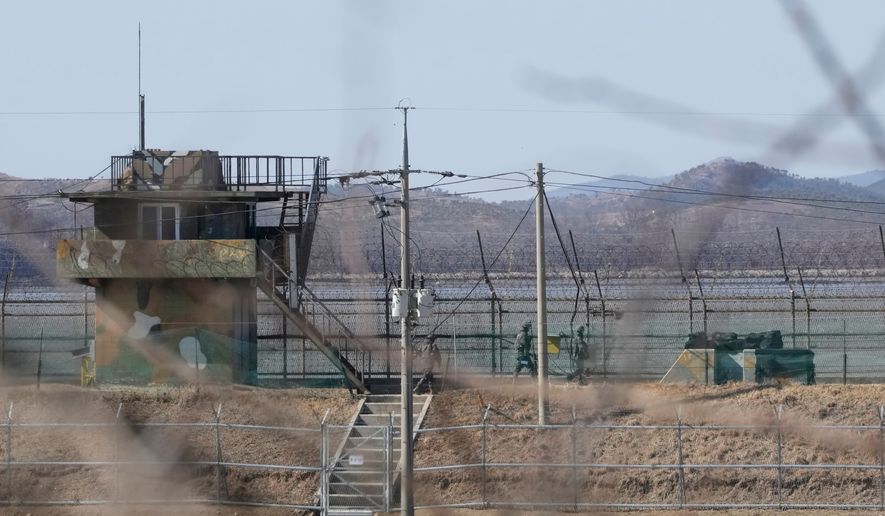

SEOUL, South Korea — A so-far unexplained explosion that wounded three South Korean soldiers in the Demilitarized Zone on Monday adds timely weight to Seoul’s resistance to U.S. pressure to deploy military assets to the Middle East.
The ever-present risk represented by its threatening neighbor is often cited by South Koreans as reason to turn down risky overseas deployments or regional contingencies — such as a defense of regional fellow democracy Taiwan against a potential Chinese assault.
But despite Monday’s DMZ drama, South Korea still looks vulnerable to building U.S. pressure to deploy assets to the conflict-struck Strait of Hormuz.
Other U.S. allies, including NATO members, Australia and even pacifist neighbor Japan, have astutely hedged against Washington’s demands.
South Korea has not.
Defense vs. deployment
Three South Korean soldiers were injured in an explosion just south of the Military Demarcation Line, or MDL — the de facto inter-Korean border that runs through the center of the tense DMZ. According to South Korea’s Joint Chiefs of Staff, the exact cause of the explosion is unknown. Two men with serious wounds were evacuated by helicopter.
If the detonation was caused by a mine, it could have been laid by either side. Though infantry routinely patrol through the DMZ on known trails, the landscape is strewn with mines. While mines are buried under topsoil, they can shift position due to, for example, rainstorms or mudslides. Officials noted that recent torrential rains had caused terrain changes.
The last time South Korean soldiers were seriously injured in a kinetic incident in the DMZ was in 2015, when two were wounded by a landmine. That incident was blamed on North Korea, which uses wooden-box mines, resistant to metal-detection devices.
The DMZ incident came one day after North Korea conducted a test-firing of two short-range ballistic missiles in the Sea of Japan.
Sunday’s splashdowns were the latest in a spate of ballistic and tactical missile tests by Pyongyang. Some believe the tests are designed to express the regime’s dissatisfaction with trilateral Japan-South Korea-U.S. aerial-maritime drills, which were held off the southwest coast earlier this month.
The recent events provide clear evidence of the threat South Korea confronts over its northern frontier. Some consider that threat good reason not to dispatch assets off-peninsula.
“South Korea is still at war with North Korea, whether the U.S. wants to admit it or not,” Yang Uk, a defense expert at the Asan Institute, a Seoul think tank, told The Washington Times. “It is saying its allies should take care of conventional deterrence — and we are doing that.”
“South Korea is geographically next to North Korea, and Korean citizens are focused on the security of the Korean Peninsula,” Jang Ji-hyang, director of Asan’s Center for Regional Studies, said in a separate briefing to Seoul-based foreign correspondents Monday. “That can be some excuse for the Korean government’s cautious stance.”
However, South Korea has conducted significant off-peninsula deployments in the recent past.
They include a division of troops to northern Iraq during the U.S.-led occupation of the country, and an ongoing rotation of warships and naval commandos to multinational anti-piracy operations in the Gulf of Aden.
“I believe Korean citizens and the government are too focused on the security of the Korean peninsula,” Ms. Jang said.
America’s uneasy allies
President Trump did not canvas allies when U.S. forces teamed up with Israel in an aerial campaign against Iran in February.
However, since Iranian forces expanded the conflict into the Strait of Hormuz, he has repeatedly expressed frustration that allies have not helped U.S. units to force open the strategic waterway.
Japan and South Korea, despite heavy national reliance upon Gulf oil imports — and despite flagged vessels of both nations being struck by Iranian projectiles in the Gulf — have so far resisted Washington’s entreaties to assist.
That leaves the two Asian powerhouses, which both boast powerful militaries, vulnerable to Mr. Trump’s indignation. Elsewhere, U.S. allies in NATO — frequently the target of his ire — and even Australia have aided Gulf states, albeit without joining the offensive Israeli-U.S. campaign against Iran.
London has permitted the U.S. Air Force to use bases on its soil and in the Indian Ocean. It has deployed fighter jets to defend Qatari airspace, and ground air-defense units to Bahrain, Kuwait and Qatar.
Paris sent a carrier strike group to the Arabian Sea, and doubled the number of its fighter jets operating from Abu Dhabi.
Italy deployed fighter jets to Kuwait and Saudi, as well as reconnaissance drones and air-defense radars to Kuwait.
Canberra dispatched airborne early warning and control aircraft to UAE, and supplied the Emirates with air-to-air missiles.
Seoul and Tokyo have not sent assets, though South Korean-built air-defense missiles, sold to UAE, have proven their worth in combat.
Tokyo, meanwhile, has covered its back on two fronts: political and economic.
In March, Japanese Prime Minister Sanae Takiachi told Mr. Trump that she cannot send assets to the combat zone due to the pacifist clause in Japan’s constitution, Article 9. However, she was being economical with the truth.
Paul Midford, an American expert on Japanese foreign policy at Meiji Gakuin University, noted that in Diet deliberations that led to constitutional reinterpretations in 2014-2015, the Strait of Hormuz was specifically mentioned as a geography where “collective self-defense” might be exercised.
Mr. Midford guessed that Mr. Trump — who accepted Ms. Takaichi’s excuse — was improperly briefed on the constitutional issue.
Economically, Tokyo is also ameliorating Washington.
Japan, which customarily runs multibillion-dollar annual trade surpluses with America, pledged a $550 billion investment package into the U.S. That pledge has so far reached approximately 20% implementation, with Stateside investments being made in an oil export terminal, modular nuclear reactors and natural gas facilities.
Korea has no such constitutional escape clause. Like Japan, Korea boasts an export-based industrial structure and runs annual multi-billion-dollar trade surpluses with the U.S. and has also pledged to invest in America — to the tune of $350 billion.
But amid disputes over profit returns and subjects of investment, the pledge remains stalled.
An announcement on the first tranche had been widely anticipated last Friday, after South Korean Foreign Minister Cho Hyun held talks with U.S. Secretary of State Marco Rubio in Washington. Nothing was forthcoming.
On the defense front, leaks to media earlier this month suggested Seoul could send maritime reconnaissance aircraft, logistics vessels or clearance divers to the Middle East.
Nothing happened, and Seoul’s relations with Washington look conflicted at the highest level.
President Lee Jae-myung, who has been suffering a drop in his approval ratings, said in a televised press conference on Friday that “There will be no troop deployments that participate in or intervene in war.”
But on Saturday — apparently stung by headlines suggesting that Seoul was denying Washington — the presidential Blue House issued a clarification.
“President Lee did not reject President Trump’s request for cooperation on Middle East affairs concerning South Korea at the [Friday] press conference,” it stated.
“The government has been reviewing practical ways to contribute … in close communication with the United States and the international community … under the principled stance of not becoming involved in war or combat,” it continued.
The waffle reflects South Korea’s core national focus in recent decades. The democratic middle power has built up massive commercial-industrial muscle, but has been reluctant to step into the international political arena.
The Asan Institute’s Ms. Jang recognizes how unpopular any involvement in the Middle Eastern conflict would be. However, she urged South Koreans to think broadly, particularly as the CRINK — the unofficial authoritarian grouping of China, Russia, Iran and North Korea — is heavily concentrated in its neighborhood.
“We need to widen our scope: All blocs including the Middle East, Europe and Northeast Asia are closely interconnected,” she said. “The CRINK is solidifying alignments, so democratic countries have to strengthen their solidarity and we have to consider our national status on the global stage.”
Contact the author


Please read our comment policy before commenting.