


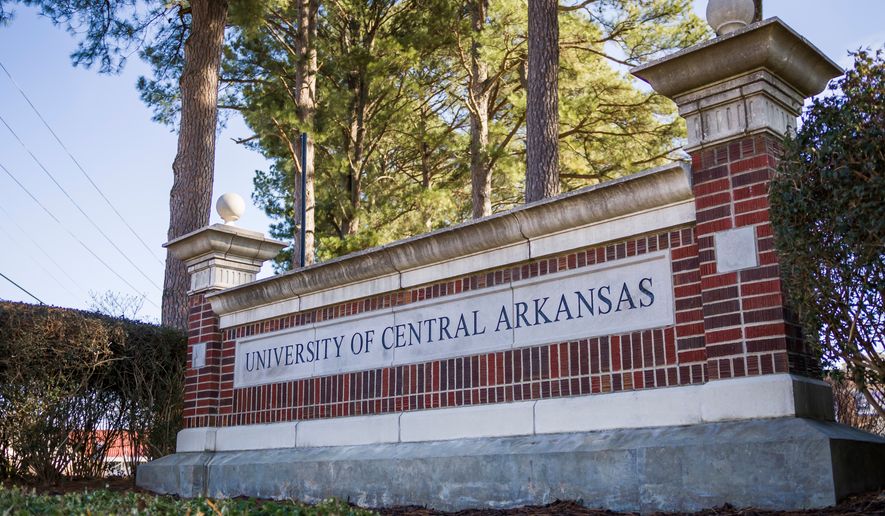

The Department of Education has found that 10 scholarships at the University of Central Arkansas illegally favored women and racial minorities.
University President Houston Davis agreed in a signed resolution obtained by The Washington Times to end “any sex- or race-based preferences or limitations” in the eligibility requirements that violated federal civil rights guidelines for publicly funded institutions.
Mr. Davis also committed to two years of monitoring by the Education Department’s Office for Civil Rights — a stricter requirement than past settlements that relied on the word of administrators at other schools to end similar practices.
People were interested in these podcasts
“This is the Trump effect in action,” Education Department spokeswoman Ellen Keast said in an emailed statement.
“We are pleased to see the University of Central Arkansas coming into compliance with federal law, upholding the law and the universal truth that all students should be judged on their merit and hard work, not their sex or the color of their skin,” Ms. Keast added.
President Trump has rolled back the Biden administration’s special consideration for “historically underserved” women, Blacks and Latinos at universities receiving public funds.
The University of Central Arkansas in Conway has traditionally been the state’s leading teacher training program.
University spokeswoman Tiffany L. Head said the school previously revised eligibility guidelines for eight of the privately funded scholarships to comply with Trump administration guidelines. She pledged not to distribute awards from the remaining two programs until they are also changed.
“Many scholarships had already been modified, but in some cases, older documentation still appeared online while system updates were finalized,” Ms. Head said in an email.
She added that the school regularly reviews scholarship guidelines to ensure “full compliance with state and federal regulations” and “an environment free from discrimination.”
As of Thursday, some scholarships on the university website continued to name women and minorities as their intended recipients.
“For full-time female African-American students who are residents of Faulkner County (Arkansas) and majoring within the College of Arts, Humanities, and Social Sciences,” reads a description for the Faydean Dunevant Scholarship at the School of Communications.
“The recipient shall be an active member of their church with preference given to a student involved in the church’s music program,” it adds. “Selection shall be based on financial need and cumulative GPA of 3.0 or above.”
William Jacobson, a Cornell University law professor who founded the Equal Protection Project to support colorblind civil rights policies, filed the complaint on Oct. 28.
He said the university’s public-facing guidelines for all 10 scholarships remained discriminatory at the time, as many schools either ignored Mr. Trump’s policies or disguised their compliance.
“This new resolution does away with administrators playing whack-a-mole with programs by forcing the university to confess any race-based or sex-based sins,” Mr. Jacobson said in a phone call. “We hope it will be a model for the Department of Education moving forward.”
Jennifer Brooks, a supervisory attorney in the Education Department’s Office for Civil Rights, told Mr. Jacobson in an Aug. 28 letter sharing the resolution that the University of Central Arkansas made no effort to “assert a legal justification for the manner in which the scholarships are administered, offered, or promoted.”
Launched in February 2023, the Equal Protection Project has received dozens of resolution letters confirming that schools it filed complaints against agreed to discontinue race-based scholarships or change their eligibility standards.
That includes Missouri State University, the University of Wisconsin-Madison and eight campuses in the California State University system.
’Surprisingly common’
Since Mr. Trump returned to office, watchdogs say many more schools have hidden donor-funded scholarship programs and guidelines on password-protected websites open only to students.
Others have changed scholarship names to disguise eligibility requirements, or stopped posting any public information about them at all.
“Race and sex discrimination in the award of scholarships — much of it completely out in the open — is surprisingly common,” said Gail Heriot, a senior fellow at the Manhattan Institute and former independent member of the U.S. Commission on Civil Rights.
“Some universities seem to think anything goes,” she added. “They are learning that isn’t true.”
Omekongo Dibinga, a professor of intercultural communications affiliated with American University’s Antiracist Research and Policy Center, said the Central Arkansas resolution reflects a broader gutting of civil rights laws intended to help people historically excluded from higher education by racism.
“The Trump administration has created a template for dismantling any civil rights and gender rights programs that do not benefit White, cisgendered, allegedly Christian men,” Mr. Dibinga said. “It’s disgraceful.”
Contact the author


Please read our comment policy before commenting.