


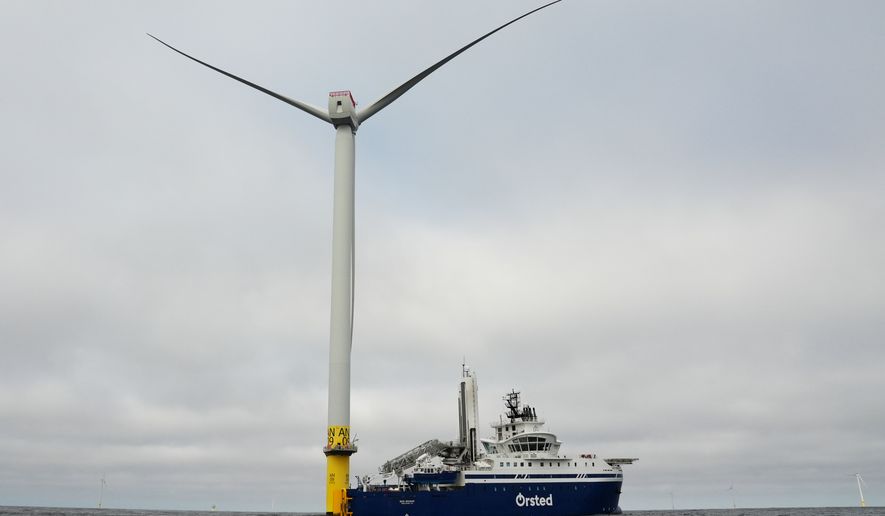

An expedition team this week identified the wreck of the Mistress, a fishing vessel that sank next to a wind farm off the Rhode Island coast on Jan. 1, 2019, taking with it the captain and his nephew.
The discovery of the trawler and the remains of the two fishermen prompted demands for a federal investigation into whether the wind farm operator, Orsted, discovered the wreck years ago and kept it quiet.
The Mistress wreck also has revived calls to examine the safety risks associated with offshore wind turbines that, when positioned closely together, can make it virtually impossible for the U.S. Coast Guard to conduct nighttime rescues of distressed vessels, particularly in stormy weather.
People were interested in these podcasts
The exact cause of the Mistress’ sinking has not been determined.
No evidence shows that the ship might have struck the easternmost turbine of the Block Island Wind Farm, where a private diving crew recently identified the sunken boat, but the turbines forced the Coast Guard to abandon its rescue attempt in the early morning hours of Jan. 1, 2019. The Mistress had taken on water during a sudden storm, and the captain issued a mayday call.
“They had a helicopter there, and they had to let it go,” said John Ansay, whose son, John Ansay Jr. went down with the Mistress two days after his 31st birthday.
Mr. Ansay wants the Coast Guard to reopen the investigation into the missing vessel so that the bones discovered at the wreck can be retrieved and positively identified.
Mr. Ansay wants to bring his son home and learn how Orsted workers missed the wreck while conducting extensive underwater maintenance on the easternmost turbine in early 2019. The Mistress is resting 50 feet away from the base of the turbine, where Orsted began maintenance in April 2019.
An environmental group suing to block Orsted wind farms and other offshore wind projects is convinced Orsted discovered the location of the wreck next to one of its turbines long ago but did not report it.
“They had a maintenance barge, and they were working on it, and they had divers on it,” said Ben Riggs, a retired Navy captain, aviator and leader in the environmental group Green Oceans. “For them not to know that’s where it went down is very hard to believe.”
Green Oceans is a Rhode Island-based nonprofit that opposes utility-scale offshore wind energy projects. It has filed several lawsuits against the Interior Department to stop offshore wind projects, among them Orsted’s.
Mr. Riggs said Orsted was motivated to conceal the location of the wreck.
The Block Island Wind Farm, made up of just five turbines, was the nation’s first commercial offshore wind farm. Its success was critical for paving the way for billions of dollars in additional wind projects on the Eastern Seaboard, now partially built or in the planning phase.
“Obviously, it’s bad for business, particularly this so-called demonstration offshore wind farm, the first of its kind in the U.S., to have the public know that this is something that happened, and was inevitable, and would happen again,” Mr. Riggs said.
Representatives of Orsted have not responded to inquiries from The Washington Times.
The Trump administration opposes offshore wind and has moved to halt new projects. It recently pledged nearly $4 billion in lease buybacks to encourage companies to abandon plans for offshore wind farms.
Democratic-led states are pushing forward with the projects and sued the administration this month over the lease buyback scheme. They argue that offshore wind provides critically needed power to the electrical grid and reduces reliance on fossil fuels that contribute to pollution and climate change.
Critics say the dangers to fishing vessels, helicopters and airplanes in proximity to offshore wind projects are well known to state and federal officials.
In a report after the failed attempt to rescue the crew of the Mistress, the Coast Guard cited the Block Island wind turbines as one of several hazards that forced it to turn back.
The Coast Guard said low visibility, winds and rough seas also contributed to the aborted mission.
The ship went down in a storm with winds blowing at 40 knots and low visibility.
The Coast Guard’s heavy-duty helicopters and highly trained crew routinely perform rescues in so-called heavy weather, said Bonnie Brady, policy director for the New England Fishermen’s Stewardship Association and former director of the Long Island Commercial Fishing Association.
“That’s what they do,” Ms. Brady said.
She blames the Coast Guard’s failed rescue on the wind turbines, which cast “ghost images” on radar and generate unpredictable wind shifts that endanger hovering aircraft, particularly in inclement weather with low visibility.
The Block Island turbines are positioned in proximity to each other, with only about a half-mile of space between them. The nearly 600-foot-tall turbines are not stationary. The 290-foot-long blades swivel and pitch according to the direction of the wind.
“We told them this was a dangerous thing,” said Ms. Brady, referring to commercial fishermen’s opposition to the wind farms. “We told them that search and rescue wouldn’t work. And it’s not just search and rescue for us commercial fishermen. Anybody on the water, whether you’re a pilot boat, whether you’re a tugboat, whether you’re a sailing boat with your family, or whether you’re a tanker, it doesn’t matter. You get in there, they can’t come and get you, and that should have never, ever happened.”
Ms. Brady’s organization obtained the Coast Guard’s incident investigation report on the aborted mission the night the Mistress sank and provided it to The Times. The report repeatedly mentions the wind farm as a hazard to the rescuers.
The Coast Guard said it deployed an MH-60T Jayhawk to the sinking vessel from Air Station Cape Cod after receiving the distress call.
Typically, the aircraft search for survivors and lower equipment and a rescue swimmer to recover them, and they can perform this task in severe weather and rough seas.
However, the Jayhawk aborted the mission to help the Mistress, the incident report said, “due to weather and hazards in the area (I.E. Wind Farm).”
The Coast Guard launched a second helicopter after visibility improved, but it did not find the Mistress or any survivors.
The captain’s son, who was thrown into the rigging as the ship turned on its side, escaped on a raft and was picked up that night by another fishing vessel that responded to the distress call. He was the lone survivor of the three men aboard the Mistress.
Mr. Riggs, a retired Navy captain and aviator, said the winds, the darkness and the sinking vessel’s proximity to the wind farm left the Coast Guard without any choice but to abandon the mission.
“You’re talking about the most difficult environment you could possibly have to enter with a helicopter, and in addition to that, you have the blades changing position, and you don’t want to get hit by a blade that’s going 200 miles an hour,” he said.
The FBI, Justice Department and Interior Department are investigating whether Orsted concealed knowledge of the wreck’s location, said Mr. Riggs and people familiar with the investigation.
The Times reached out to all three departments.
“It’s a bigger issue than just the Mistress, but the Mistress is an example of what we’ve been warning about for a long time,” Mr. Riggs said.
Contact the author


Please read our comment policy before commenting.