


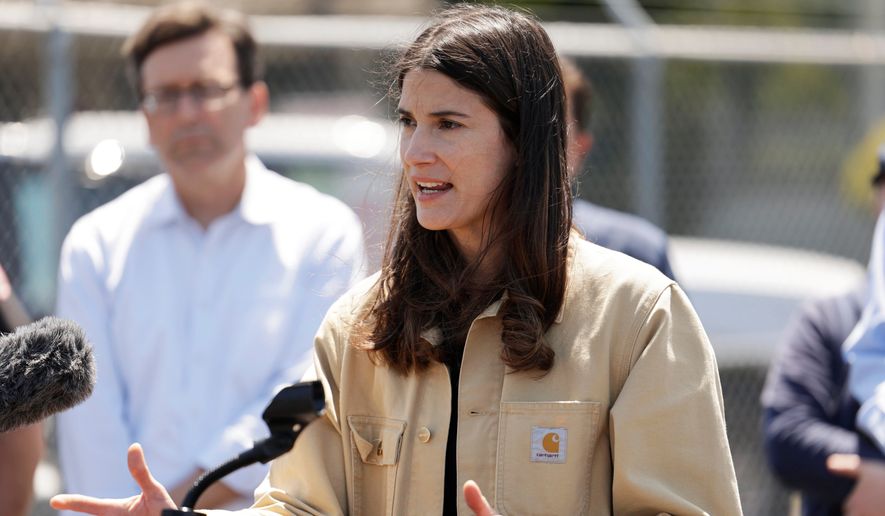

Rep. Marie Gluesenkamp Perez wants lawmakers to be able to include images in the text of their bills, figuring it could help illustrate or simplify some of the trickier things lawmakers are trying to do in their legislation.
She sees it as a way to modernize the format of bills, which has not changed much over the past 200 years.
“Have you ever thought that it’s really weird you can’t add pictures to laws?” the Washington Democrat posted to social media. “I see so many laws that would be clearer and more logical if we could just include a map or a blueprint.”
People were interested in these podcasts
There is no bar to including images, and House procedures even say it has happened on “rare” occasions. One 1986 measure, for example, included an image of a warning label.
There is no standard process for including images, so lawmakers do not do so.
Ms. Gluesenkamp Perez said the time has come, calling it a way of democratizing bill-writing.
“For too long, our laws have been written for ’staffer bros’ with bow ties who will issue guidance on how to follow them from cubicles on Pennsylvania Avenue,” she wrote in a July letter to the top Republican and Democrat in each chamber. “We should be able to draft legislation that speaks to all Americans, regardless of how they learn or the profession they work in, from visual learners and foremen to lawyers and policy experts.”
Gerlinde Berger-Walliser, an associate professor of business law at the University of Connecticut who studies contract visualization and legal design, said that formally including illustrations in bills would be “revolutionary.”
She said it would need rules to make them useful rather than harmful.
The danger is that pictures or graphics could add uncertainty, such as how much weight a judge hearing a case challenging a law with images in it would give to the image.
Ms. Berger-Walliser, though, said that would not be anything new.
“Well, my argument would be, well, words are also uncertain. Most lawsuits are about the interpretation of words,” she said. “So it really depends on how you use it.”
She did say there would need to be guidelines for deciding which takes priority when a bill’s words and images clash.
Kevin Kosar, a senior fellow at the American Enterprise Institute who studies Congress, said laws are not written in plain English, which means they are not always easily accessible for the layman.
He said illustrations can transmit meaning, but there might be trade-offs.
“And if somebody drops a picture inside a bill, are they dropping a thousand words in the bill? What are those thousand words? Are we just to guess at them? What are the odds that the reasonable observer can agree upon what those thousand words are?” he said.
Ms. Berger-Walliser said other nations allow images in their legislation. She named Australia as one.
In the U.S., some judges include images in their rulings to illustrate or expand on their points.
That even goes for the Supreme Court.
Justice Clarence Thomas’ majority opinion in 2024 in Garland v. Cargill, which found that “bump stock” additions to firearms do not qualify as machine guns, used six diagrams to illustrate the difference between the two firing mechanisms.
A 2013 study in the Chicago-Kent Law Review, which examined the use of images in high court rulings from 1997 to 2009, concluded that they worked best when accompanied by an explanation of why they were included and the point the justices thought they illustrated.
Even the Code of Federal Regulations, the compendium of rules issued by executive branch agencies that has the force of law, allows images.
Ms. Gluesenkamp Perez, in her letter to House and Senate leaders, noted that the House has, through an appropriations bill, directed the chamber’s clerk to assess the feasibility of adding illustrations to bills.
The clerk was told to move ahead with an implementation plan if the idea is feasible.
It is not clear where that study stands, but the congresswoman said it shows an appetite for action.
“That bipartisan directive demonstrates a recognition that the current process can be improved and provides a strong foundation for implementing a permanent, standardized approach,” she wrote in a July letter.
None of the four congressional party leaders responded to a request for comment.
Contact the author


Please read our comment policy before commenting.