


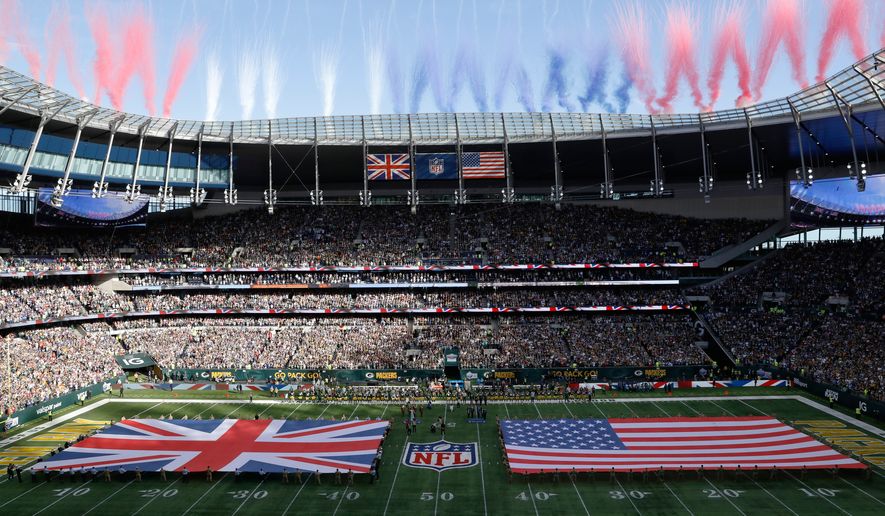

Pro football is no longer contained to Sundays, Mondays and Thursdays.
With the NFL’s opener between the Seattle Seahawks and New England Patriots set for Wednesday night — and games on Thanksgiving Eve, Black Friday and Christmas Day — the league’s quest for cultural dominance features games on six days of the week this season.
The slippery slope began with Monday night games in 1970. Sunday night matchups followed, as did Thursday nights. The midweek games once reserved for Thanksgiving became commonplace during the latter half of the season before becoming a season-long affair in 2012.
This season is different.
The NFL has ditched its usual Thursday debut, which almost always features the defending Super Bowl champions, in favor of a Wednesday game.
It’s a scheduling quirk this year. The league wanted to keep its Week 1 international game on a Friday, as it had the past two years. But due to a late Labor Day, the NFL is barred from broadcasting a matchup on Friday under the Sports Broadcasting Act of 1961.
Instead, the international opener — the league’s first in Australia — was moved to Thursday. The traditional debut retreated to Wednesday for just the second time in league history.
The NFL began the 2012 season on a Wednesday to avoid a broadcast conflict with the Democratic National Convention.
“Not the first time a Wednesday has been used for the opening game, but obviously it’s not common,” NBC’s Mike Tirico, who will broadcast Wednesday’s opener, said on a conference call. “But if the data comes back and the league sees that everyone is interested and is watching on a Wednesday, I would not be surprised to see different days of the week show up going forward.”
“The schedule is going to have to be more flexible as we go along,” said Cris Collinsworth, Tirico’s broadcast partner.
The opener isn’t the only Wednesday game on the calendar, either.
The Los Angeles Rams will host the Green Bay Packers on the night before Thanksgiving. It will be a first-of-its-kind effort for the NFL, which expanded its footprint on Thanksgiving weekend with an inaugural Black Friday game in 2023.
“I do think if you look at the growth of Thanksgiving specifically, and that holiday, and how core football, and food, and family, and bringing all that together, that the growth of Thanksgiving over the last handful of years has just been tremendous,” Hans Schroeder, the NFL’s executive vice president of media distribution, said on a recent call with reporters.
The added Thanksgiving Eve game didn’t surprise sports management professionals who have been closely watching the NFL’s continued expansion throughout the calendar. The day before the holiday represented a hole in the market, lacking any preexisting traditions.
“The night before Thanksgiving, a lot of people come in and they’re reuniting, but it’s good to have a game on in the background for everybody to rally around,” said Lisa Delpy Neirotti, the director of George Washington University’s graduate sports management program. “They know it’s a popular night for families to get together, so they’re just taking advantage of that and filling it in with football.”
Even so, Wednesday nights aren’t the new Monday nights for the NFL, at least not yet.
Schroeder insists that Netflix’s Thanksgiving Eve presentation will be a one-off. The NFL media executive compared the effort to the Black Friday and Christmas festivities, staples on the NFL’s yearly calendar, not its weekly one.
“I don’t think we’re looking at Wednesday night football. I think we looked at the opportunity to make Thanksgiving Eve a really special one,” he said before referring to the Christmas plans, which continue with a triple-header on a Friday this season. “Those are more of the exceptions than the rules. And we’ll continue to look at those selectively.”
Most of the NFL’s off-day experiments have offered promising, if unflashy, results. The first attempt at Black Friday games drew below-average results for their respective season, with 9.6 million viewers in 2023, 13.5 million spectators in 2024 and an audience of 15.3 million last year.
But those matchups aired on Prime Video, which featured a smaller audience base than traditional TV networks or a streaming powerhouse like Netflix.
The newly prioritized Christmas Day broadcasts aired on a Friday in 2020 and a Wednesday in 2024. Those games beat the average regular-season matchup, with 23 million fans watching on Fox and NFL Network in 2020 and 24 million viewers for a pair of Netflix broadcasts two years ago.
Those numbers could keep growing as fans learn to expect these matchups on different days and on varying platforms.
“Fans are creatures of habit, but they can and will adjust,” Delpy Neirotti said. “But how far can you stretch this schedule across all days? I think they’re hitting the capacity, but they’re going to find gaps. ’Where can we put another game and make it special to get more revenue?’”
For now, Friday and Saturday nights early in the season are safe.
The Sports Broadcasting Act of 1961 gave the NFL an antitrust exemption to collectively negotiate media rights, with the understanding that the league’s broadcast would not clash with Friday night’s high school games or Saturday’s college matchups.
Every other day of the week is fair game. The NFL already has a stranglehold on Sundays, Mondays and Thursdays, with dominant viewership numbers.
“I do think the cadence of Thursday, Sunday, Monday on a regular basis feels right for the fans at home in general,” Tirico said, noting that Wednesday “adds possibilities” for the schedule makers. “I think the NFL is such an entertainment powerhouse that people will adjust their lives and schedules for the right matchup and the right game.”
Tuesday is technically open — it’s the only day of the week without an NFL game this year — but it may be a bridge too far. In the past, the league touched Tuesday only due to COVID complications in recent years.
Players and fans need time to breathe between games. The fantasy football ecosystem treasures the short break for roster adjustments.
“I think Tuesdays are only going to be used if a holiday falls on it,” Delpy Neirotti said, circling Christmas Day in 2029. “You need to be a little bit careful about not oversaturating weekdays and making weekends special where everybody sets that aside for football.”
Oversaturation has never been an issue for the NFL in the past. Most new broadcasting efforts — even those met with initial dismay, like streaming exclusive playoff games — fetch a stellar return on investment for the league and its broadcast partners.
The U.S. is a football-hungry nation. If there’s a limit to that appetite, it hasn’t appeared yet.
“You can put it on every night of the week for me,” Collinsworth said. “I’ll be just fine.”
Contact the author


Please read our comment policy before commenting.