



A version of this story appeared in the daily Threat Status newsletter from The Washington Times. Click here to receive Threat Status delivered directly to your inbox each weekday.
NEWS AND ANALYSIS:
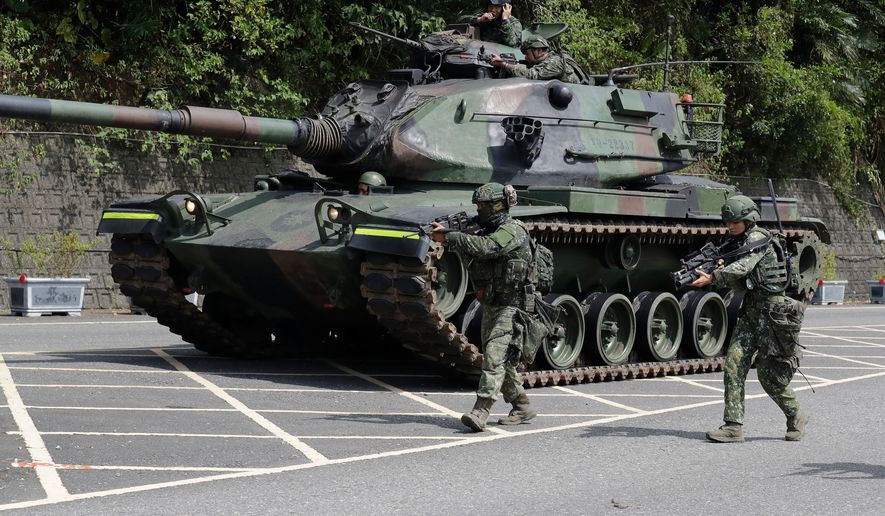
Taiwan’s military is applying lessons on modern warfare from regional conflicts and adopting asymmetric warfare tools to prevent a war with China, America’s senior diplomat in Taipei said Wednesday.
Ambassador Raymond Greene, director of the official American Institute in Taiwan, also said a war with China over Taiwan would have a greater impact on the world economy than World War II. The upcoming U.S. visit of Chinese President Xi Jinping will seek to lower the risk of a conflict, he said.
The Xi visit scheduled for Sept. 24 will seek to promote strategic stability and “avoid misunderstandings and miscalculations,” Mr. Greene said.
People were interested in these podcasts
“As we all know, the threats Taiwan faces continue to grow in scale and sophistication,” Mr. Greene said in rare public remarks to a defense conference in Taipei.
Taiwan’s lessons learned from the wars in Ukraine and the Middle East highlight the changing nature of warfare. The conflicts are helping both the U.S. and its Taiwan ally prevent a similar outbreak of hostilities in the Pacific, he said.
“Taiwan can and is employing lessons from these conflicts, especially the concepts of asymmetry, employment of new technologies, and war fighting on a transparent battlefield,” Mr. Greene said.
The island democracy’s key advantage is a favorable geography — the 90-mile-wide Taiwan Strait that acts as a buffer with the mainland.
“To deter conflict, Taiwan doesn’t need to demonstrate that it could win a war outright,” he said. “It simply needs to convince an adversary that it would struggle to successfully land a large ground force in heavily urbanized, mountainous terrain and sustain it across 90 miles of open, turbulent waters. It is hard to imagine a more difficult and complicated operation, even for a combat-experienced military force.”
China has vowed to annex Taiwan, which Beijing claims is a breakaway province. The U.S. is committed to helping defend the island with defensive military equipment under the 1979 Taiwan Relations Act.
Mr. Xi has ordered the Chinese Communist Party’s military, the People’s Liberation Army, to be ready to use force against Taiwan by next year, although U.S. military leaders say the date is not a deadline for war.
Over the past several years, the PLA has sharply stepped up provocative and large-scale military operations around Taiwan along with increased propaganda and information warfare efforts in a bid to coerce Taiwan into submitting to Beijing’s demands.
Mr. Greene said asymmetric warfare represents the key for Taiwan in applying military ingenuity and rapid adaptation.
Key weapons systems that will allow a less powerful Taiwan to counter China’s more powerful army include drone weapons, greater mission command and control and increased societal resilience, he said.
Taiwan’s advanced manufacturing capabilities will boost its drones along with battle-tested U.S. systems such as Anduril’s Altius and Shield AI’s V-BAT aerial drones, he said.
Underwater drones and AI-enabled swarming technologies will also strengthen Taiwan’s defenses, he said.
Taiwan’s defense will apply a system-of-systems defense by fusing conventional and drone systems with advanced command, control and intelligence capabilities, he said.
To counter Chinese information operations targeting the island, Taiwan also needs to prepare for new and sophisticated propaganda that will seek to sow division and undermine democracy, he said.
The administration of Taiwan President Lai Ching-te was also praised by Mr. Greene for boosting defense spending to 5% of GDP by 2030, a key demand of the Trump administration.
“In the wake of Russia’s full-scale invasion of Ukraine and facing unprecedented provocations across the Taiwan Strait later that same year, Taipei has moved decisively to bolster its defense,” Mr. Greene said.
“This isn’t incremental change; it is a fundamental shift in how seriously Taiwan approaches its own defense, and it deserves real recognition.”
In Beijing, a spokesman for the Taiwan Affairs Office of the State Council was asked about Taiwan and said “peaceful” unification and adoption of China’s one-country, two-systems formula is the best solution.
One country, two systems calls for keeping a democratic system under mainland annexation.
The formula was promised for Hong Kong but ultimately replaced with Chinese Communist Party rule.
“The reunification of the motherland is an unstoppable historical trend,” said Chen Binhua, the spokesperson, at a news briefing Wednesday.
First nuclear-capable B-52s deploy to Australia
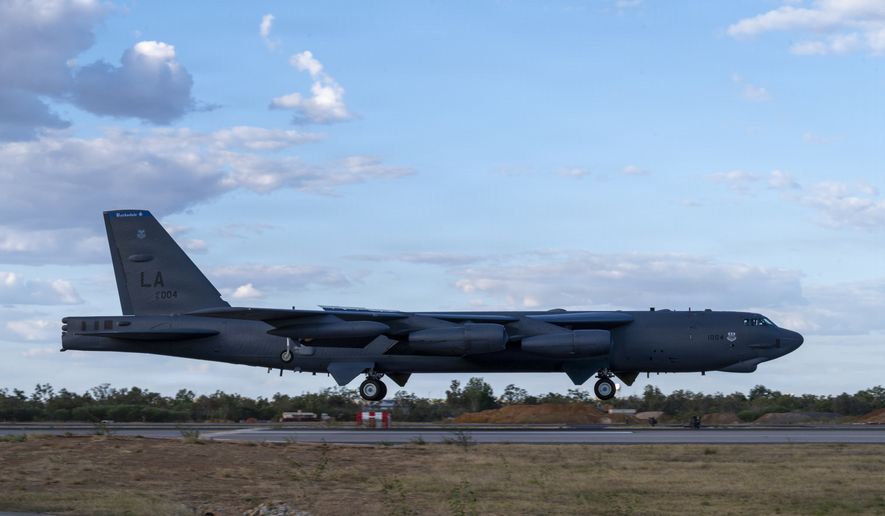
A task force of nuclear-capable B-52 bombers has deployed for the first time to Australia in a show of regional force located to the south of China.
The bombers arrived last week at an upgraded Royal Australian Air Force Base Tindal. Local reports called it a new era in Australia’s military alliance with the U.S.
A Pacific Air Forces spokesman confirmed to Inside the Ring that the bomber task force is underway Down Under.
“These missions demonstrate seamless interoperability with our partners and bolster regional security across the region,” the spokesman said. “To preserve operational security, we will not discuss specific details regarding future operations.”
The exact number of the strategic bombers from the 2nd Bomber Wing at Barksdale Air Force Base, Louisiana, was not disclosed. Most task forces include up to six B-52s.
An Air Force photo of the deployment stated in a caption that the bombers arrived Sept. 1. “Operating from RAAF Base Tindal marks our ability to project, sustain, and regenerate decisive airpower across an expanding extended network,” the caption stated.
The long-range bombers can deliver nuclear bombs or conventional precision-guided weapons.
The Tindal base has been upgraded with new hangars and ramps for the bombers. It is located in northern Australia about 200 miles south of the northernmost coastal city of Darwin and about 2,000 miles from the tense South China Sea.
The base also hosts Australian F-35 stealth jets and MQ-4C Triton surveillance drones.
China has increased tensions in the region with new military construction in the sea on disputed islands claimed by Vietnam and the Philippines.
What’s more, China’s military in July conducted a short-notice test firing of a submarine-launched ballistic missile that traveled some 4,000 miles into the South Pacific.
The bomber deployment coincided with Australian Defense Minister Richard Marles saying, after a meeting in Washington with Defense Secretary Pete Hegseth, that the U.S. military presence in his country will expand further.
Currently, U.S. Marines are based in Darwin and a submarine rotational force was set up near Perth, with about 1,000 Navy personnel set to deploy in support of Virginia-class submarine deployments.
“Since we’ve come to government, you can see a through-line of growing American force in Australia, and we think that’s really important in terms of providing deterrence in the Indo-Pacific, providing for stability and peace in the Indo-Pacific,” Mr. Marles said.
“And that’s very much in Australia’s national interest.”
Ford hit for using Chinese EV tech
Transportation Secretary Sean Duffy on Tuesday criticized the Ford Motor Company for what he said is undermining American security with continued use of Chinese electric vehicle (EV) technology.
In a letter sent to Ford CEO James Farley, Mr. Duffy said Ford’s use of licensed technology from Chinese battery maker Contemporary Amperex Technology Co. Ltd. (CATL) at its BlueOval Battery Park facility in Marshall, Michigan, undermines U.S. auto manufacturing integrity, furthers supply chain insecurity and is an unsafe reliance on foreign technology.
“DOT remains deeply alarmed by Ford’s continued reliance on licensed technology from Chinese battery manufacturer CATL,” Mr. Duffy said.
Additionally, Ford’s joint venture with the Zhejiang Geely Holding Group in Spain is helping a strategic adversary secure a vital foothold in Western markets, he said.
Ford is also engaged in talks with China’s multinational manufacturer BYD for hybrid vehicle components that “could lead to further embedding subsidized foreign technology into Ford’s core supply chains,” Mr. Duffy said.
The company has proposed a framework for facilitating Chinese joint ventures in the U.S., and its delay in returning the manufacture of Lincoln Nautilus cars to the U.S. until 2030, “leaves an unacceptable, multi-year window of reliance on Chinese manufacturing while depriving skilled American workers of vital manufacturing jobs,” Mr. Duffy said.
“When a company intentionally chooses to deepen operational dependencies on strategic competitors, it fails to act as the reliable partner the American public and this DOT require,” he said, adding that enriching foreign adversaries “is not a sustainable strategy for the United States.”
“Ford must demonstrate a level of corporate citizenship that prioritizes the long-term resilience and technological sovereignty of the United States automotive ecosystem over short-term arrangements or questionable foreign alliances,” he said.
CATL is listed as a Chinese military company by the Pentagon.
In response to the letter, Ford said that it was a “wrongheaded attempt to capture headlines” at the company’s expense.
Ford will continue to import Chinese batteries and invest in American battery production.
“The CATL arrangement is a limited technology-licensing and services agreement, not a joint venture or foreign-owned manufacturing operation. Ford owns the plant, controls the operation and employs the workforce,” the company said in a statement.
Under President Biden’s anti-oil policies, Ford sought to get out front of other carmakers by electrifying its most popular vehicle, the F-150 pickup truck.
Biden officials pushed Ford to build the EV version of the F-150, known as the Lightning, hoping it would win over “work truck men” to back its green agenda.
The Lightning, however, proved to be a business disaster, and most truckers disliked it.
The company canceled production of the Lightning and lost $19.5 billion on the truck, the online newsletter Carbuzz reported.
• Contact Bill Gertz on X @BillGertz.
Contact the author


Please read our comment policy before commenting.