


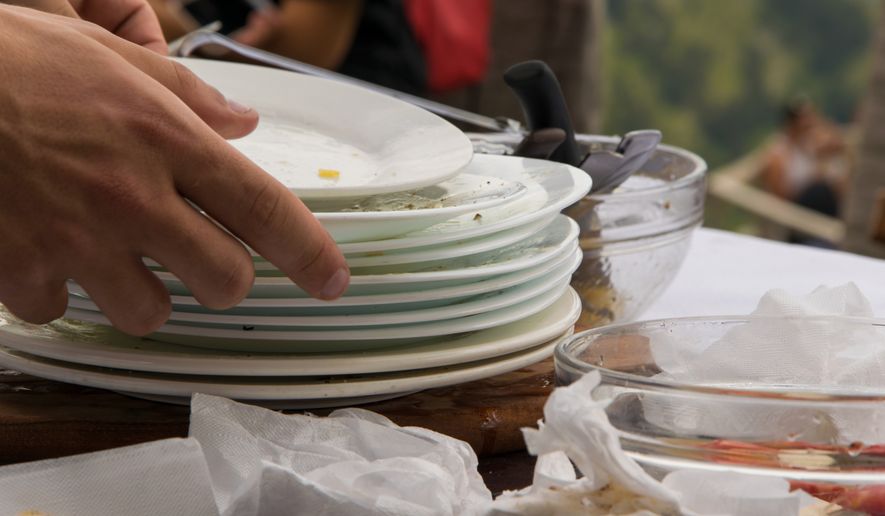

Watch the end of a meal in any busy restaurant and you will see the split. Some tables stack the plates, gather the glasses, and hand the pile over. Others get up and leave everything exactly where it fell.
Neither is rude. Nobody asked. That is precisely what makes it interesting to psychologists: behavior that nobody requires is the kind that tells you something.
The Behavior Has a Name
People were interested in these podcasts
Researchers call this prosocial behavior. It’s a voluntary action intended to benefit another person, with no obligation and no expectation of return.
Most of it is unremarkable. People help their families, their friends, their colleagues, and the reasons are easy to explain. The category narrows sharply when the beneficiary is a stranger you will never see again, who is being paid to do the thing you are helping with, and who has not asked.
Stacking plates sits squarely in that narrow category. So does holding a stroller on the stairs, carrying a neighbor’s groceries, returning a shopping cart from the parking lot, or even giving blood. The common thread is that none of them buy you anything.
The Finding That Complicates the Story
The intuitive explanation is that helpers were raised by helpers, and simply copied what they saw. That is partly true, and it is not where the research starts.
In a 2006 study, German researchers Felix Warneken and Michael Tomasello set up a series of situations in which an adult stranger visibly struggled with a task. In one scenario, the stranger dropped a clothespin out of reach. In another, they fumbled with a cupboard while holding a stack of books. Then the scientists watched what toddlers did.
Children of 18 months helped. Repeatedly, across varied scenarios, without being asked and without being rewarded. Warneken’s own reaction to the results was that these were children still in diapers who could barely speak.
Follow-up work pushed it earlier still, to around 14 months, and added a detail that upends the usual assumptions about encouragement. In a study of 20-month-olds, toddlers who were given a material reward for helping subsequently helped less than those who had received praise or nothing at all. Rewarding the behavior did not reinforce it. It corroded it.
The conclusion the researchers drew is that the motivation to help is intrinsic and present very early, and that what determines whether a child helps is the other person’s unmet goal, not any benefit to themselves.
So Why Do Most Adults Stop?
If nearly every toddler does this, the adult variation needs a different explanation than “some people were raised well.”
Part of the answer is threshold. Helping requires noticing that someone has a goal they cannot complete, and adults filter enormously. A server clearing tables reads as scenery to most diners, not as a person with an armful of plates and a problem.
Part of it is script. Restaurants come with a strong sense of assigned roles, and plenty of people read plate-stacking as stepping outside their lane, or worry it will read as fussy or as a critique of the service. That hesitation is real, and it is not the same thing as indifference.
And part is what the empathy researchers spent careers on. Martin Hoffman, the NYU psychologist whose 2000 book Empathy and Moral Development remains a foundational text in the field, spent decades arguing that empathic response develops in stages, from raw distress at another person’s discomfort in infancy toward something more deliberate and principled in adulthood. Whether it keeps developing depends heavily on what happens in between.
What It Actually Signals
So the plates do mean something, but not what the folk version says.
Stacking them does not make you a better person than the table that did not. What it indicates is narrower and more specific: that in a room designed to make service invisible, you registered the person doing it as a person with a task.
That is a habit of attention more than a moral trait. And it is the same habit that shows up in a hundred other places where someone is quietly doing work nobody is watching.
Worth remembering, though, that the toddler in the high chair at the next table would probably have helped too. Nobody had to teach her.
This article was constructed with the assistance of artificial intelligence and published by a member of The Washington Times' AI News Desk team. The contents of this report are based solely on The Washington Times' original reporting, wire services, and/or other sources cited within the report. For more information, please read our AI policy or contact Steve Fink, Director of Artificial Intelligence, at sfink@washingtontimes.com
The Washington Times AI Ethics Newsroom Committee can be reached at aispotlight@washingtontimes.com.

Please read our comment policy before commenting.