


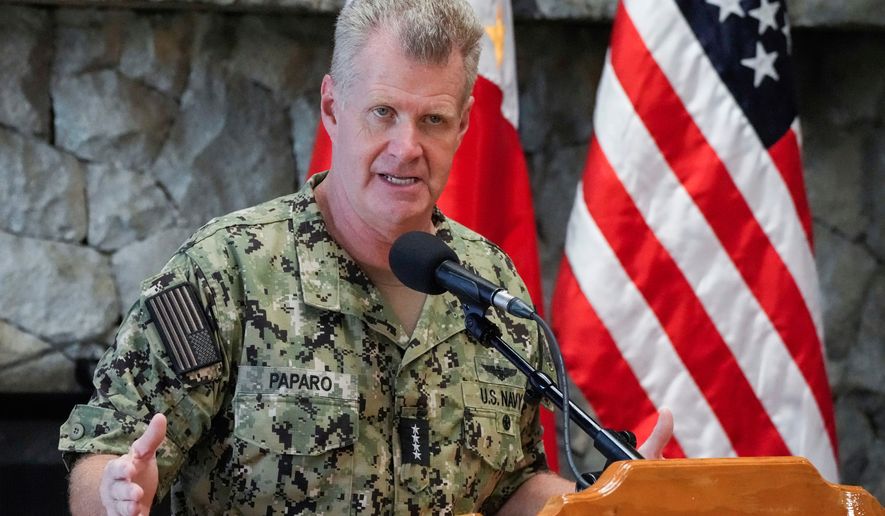

KUALA LUMPUR, Malaysia — The head of U.S. Pacific Command said Monday that coercive actions by China and other actors are challenging regional stability, warning the United States will not allow any nation to dominate the Indo-Pacific.
Admiral Samuel Paparo said some actors were using “false claims of legitimacy” to justify intimidation and coercion.
“That’s not the rule of law. That’s the rule by law. That distinction between law as a tool of order versus law as a weapon of raw power, is the defining fault line of our time,” he said via video link at a regional security conference in Malaysia organized by the U.S. Pacific Command.
Paparo’s remarks come as tensions remain high in the South China Sea, where China’s expansive maritime claims overlap with those of several Southeast Asian nations. The Philippines has been at the center of a series of confrontations with China, particularly around a disputed shoal, where Chinese and Philippine vessels have repeatedly faced off.
Manila has accused Beijing of dangerous maneuvers, water cannon attacks and attempts to block Philippine resupply missions. China has rejected those accusations and maintains its territorial claims in the disputed waterway.
The United States has said it does not take sides in competing sovereignty claims but supports freedom of navigation, international law and the ability of states to operate in accordance with their rights.
Paparo emphasized that freedom of the seas, maritime security and open commerce are key to regional stability, saying peaceful resolution of disputes and respect for the sovereignty of all nations are essential to preserving the Indo-Pacific order.
“The United States is clear-eyed about the complex security environment in this region. Our posture and our intent are well defined. The United States is deterring China through strength, not through confrontation,” Paparo said. “We will not let any nation dominate this region or sweep away the hard-fought sovereign rights of independent states.”
The U.S. Indo-Pacific commander said the region remains the world’s geopolitical and economic center of gravity, with growing instability and security challenges making cooperation among allies and partners increasingly important.
Earlier at the conference, Philippine Defense Secretary Gilberto Teodoro vowed his country will continue to resist and “push back” against the threat from China.
Teodoro told reporters later that the Philippines’ concerns extend beyond China’s activities in the South China Sea, pointing to Beijing’s actions in other areas, including a recent ballistic missile launch into the Pacific Ocean, as evidence of its expanding reach and growing military presence.
“China is everywhere … this is a matter of concern,” he said.
Talks between the Association of Southeast Asian Nations and China for a code of conduct to govern behavior in the South China Sea and help ease tensions have progressed significantly, ASEAN Secretary-General Kao Kim Hourn said on the sidelines of the conference.
“The pace has picked up dramatically and I think we are much closer to finalizing the code of conduct,” Kao said. “I have full confidence that we will get it done within this year.”

Please read our comment policy before commenting.