


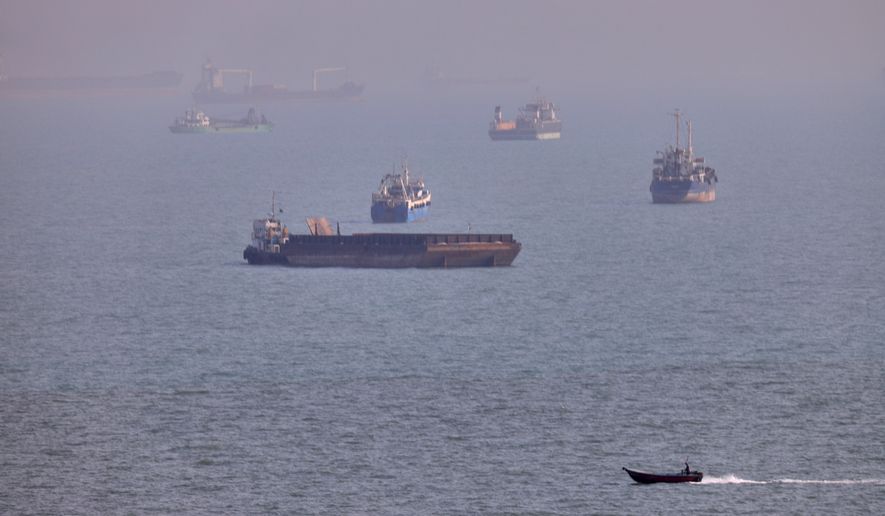

Iran launched retaliatory strikes Monday in the Middle East after the U.S. military attacked an Iranian-held island in the Strait of Hormuz over the weekend, marking the countries’ first kinetic exchange since July.
Iran’s Islamic Revolutionary Guard Corps announced it launched missiles and drones at the King Hussein and Al Azraq air bases overnight, causing “heavy damage” to infrastructure, maintenance facilities and enemy fighter jet positions.
Al Azraq, known officially as Muwaffaq Salti Air Base, hosts the U.S. Air Force’s 332nd Air Expeditionary Wing, while King Hussein Air Base focuses on more specialized units.
The Jordanian military contradicted Iran’s claims, asserting that its forces intercepted eight ballistic missiles before they could threaten any infrastructure or troops.
The United Arab Emirates Ministry of Defense also reported intercepting a drone launched from Iran attempting to enter its airspace. The interception caused no damage or casualties, according to the ministry.
Iranian military officials had claimed to have launched ballistic missiles at the Al Minhad Air Base, which the UAE denied. The air base also hosts U.S. forces.
The Iranian attacks were in apparent retaliation for a U.S. assault on Larak Island, an Iran-controlled islet southeast of Qeshm in the Strait of Hormuz. U.S. officials launched the strikes Sunday, asserting that Iran was preparing to fire rockets carrying sea mines into the strait.
The U.S. attack was the first official kinetic action announced by U.S. Central Command since late July. The attack targeted dozens of IRGC-affiliated locations in Iran.
CENTCOM announced last week that the U.S. successfully de-mined the Strait of Hormuz, paving the way for the safe transit of commercial ships. Other reports said the U.S. had begun ramping up efforts to guide tankers through the strait via Omani waters, indicating that Iran was losing its leverage over the waterway.
Iran closed the Strait of Hormuz in March, and the waterway has seen a sharp reduction in commercial traffic ever since. Brent crude oil was trading at about $91 a barrel Monday morning, compared to $87 on July 31.
Shortly after the July attack, President Trump publicly called off a round of airstrikes, citing positive steps toward diplomacy. Most of August was dominated by U.S. officials insisting there would be no further kinetic action amid the Trump administration’s economic pressure campaign.
The pressure campaign, which includes an expansion of secondary sanctions on Iran’s trading partners and a comprehensive naval blockade, is aimed at either collapsing the Iranian economy or forcing Tehran back to the negotiating table.
Contact the author


Please read our comment policy before commenting.