


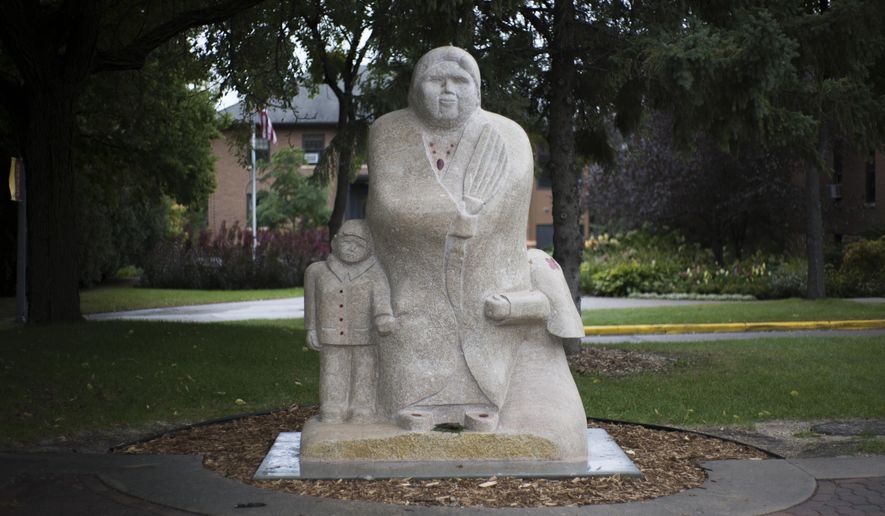

A land acknowledgment meant to open the Michigan Democratic Party’s state nominating convention on a note of unity instead turned into an awkward public correction session.
Portia Roberson, vice chair of the state party, began the Saturday program at the Lansing Center by reciting a tribute to the Anishinaabe, Three Fires Confederacy. She stumbled over the pronunciation, prompting several audience members to shout the correct wording back at her. She asked one attendee to stand where she was in the crowd and coach her through it, then mispronounced a second tribal name — Potawatomi — moments later, drawing a fresh round of corrections.
“This time I rushed it, and I didn’t rehearse. I apologize,” Ms. Roberson said before leaving the stage.
Land acknowledgments — statements recognizing that an event’s location was historically inhabited by Native American tribes — have become common at party conventions, universities and museums. The practice has also drawn conservative mockery as performative, including at former President Barack Obama’s presidential center in Chicago, where a permanent Indigenous land display sits on parkland the Obama Foundation leased from the city under a 99-year agreement for a one-time $10 payment.
The stumble came against the backdrop of a convention the party had branded around the theme of “unity” — a message tested by internal divisions well before Saturday. Michigan Attorney General Dana Nessel, who is Jewish, skipped the event over antisemitism concerns after pro-Palestinian activists shouted down pro-Israel speakers at an earlier party gathering. Senate nominee Abdul El-Sayed, a left-wing critic of Israel’s military campaign in Gaza, also fielded questions from reporters about his ties to controversial streamer Hasan Piker, brushing off the scrutiny: “I don’t want to have a conversation about a Twitch streamer in California.”
Despite the friction, the convention drew several of the party’s marquee 2026 candidates. Secretary of State Jocelyn Benson, the Democratic nominee for governor, addressed the crowd alongside Michigan Senate Majority Leader Winnie Brinks, Ms. Benson’s running mate for lieutenant governor. Ms. Brinks used her remarks to target Rep. John James, the Michigan Republican running for governor, tying him to President Trump. Lt. Gov. Garlin Gilchrist, running for secretary of state, pledged to shield Michiganders’ voter data from federal requests.
This is the second Michigan Democratic convention this year to generate unwanted headlines. State Sen. Sylvia Santana led an April gathering dispute over the party’s down-ballot nominating process, filing a 53-page complaint alleging roughly 200 people voted remotely in violation of convention rules, more than 300 voters weren’t on the master voter list, and hundreds of others shared registration numbers with at least one other voter. Ms. Nessel and losing candidates, including Oakland County Prosecutor Karen McDonald, backed Ms. Santana’s call for an independent audit; the state party said the dispute would go through its formal appeals process.
This article was constructed with the assistance of artificial intelligence and published by a member of The Washington Times' AI News Desk team. The contents of this report are based solely on The Washington Times' original reporting, wire services, and/or other sources cited within the report. For more information, please read our AI policy or contact Steve Fink, Director of Artificial Intelligence, at sfink@washingtontimes.com
The Washington Times AI Ethics Newsroom Committee can be reached at aispotlight@washingtontimes.com.

Please read our comment policy before commenting.