


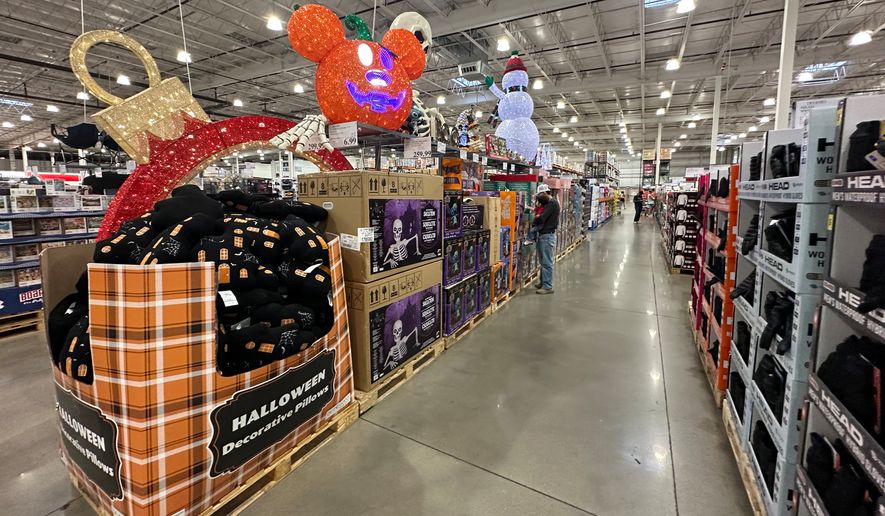

Aspiring ghouls and goblins may feel an unearthly chill as they budget for Halloween festivities, industry analysts say.
The Halloween & Costume Association says Trump administration tariffs on Chinese plastics and textiles have raised the price of a bargain-basement children’s witch costume to as much as $60, up from $39.99 in 2025 and $19.99 in 2024.
Costume suppliers have started importing materials from nations with lower tariffs, such as India and Vietnam, according to the trade group, which represents more than 30 retailers and manufacturers. However, prices have continued to rise as importers absorb higher duties.
People were interested in these podcasts
“The tariffs have really hit the Halloween industry hard,” Michele Boylstein, the Halloween & Costume Association’s executive director, said Wednesday. “A lot of companies laid off people and cut costs last year to adjust, but the tariffs change so often that it’s hard to keep up with it.”
The National Retail Federation projects that U.S. spending on Halloween will surge to a record $13.5 billion. Unadjusted for inflation, that is up from $13.4 billion in 2025, the previous high point.
That includes expected increases in consumers splurging on candy, decorations, costumes and greeting cards as spending per person jumps 69 cents to $115.14.
Retail experts note that this 0.6% increase in spending over last year trails the broader 3.4% annual inflation rate, meaning the average person will spend $3.10 less on Halloween this year.
“Consumers may just be paying more for the same amount of Halloween goods,” said Tom Arnold, a finance professor at the University of Richmond.
He noted that 39% of adults responding to the National Retail Federation’s annual poll intended to shop at discount stores this year, as more retailers sell products as early as July in “Summerween” promotions.
Inflation accounts for part of the spending increase. Rising production costs have also driven up prices for haunted houses, candy and decorations since 2025.
The National Confectioners Association, a candy industry trade group, estimates that spending on Halloween chocolate and sweets will increase from $3.9 billion to $4.1 billion this year.
“Americans are continuing to navigate higher costs across their household budgets, but demand for chocolate and candy is resilient,” said association spokesperson Carly Schildhaus.
The latest figures from the Bureau of Labor Statistics show that candy prices rose 8.1% in August 2026 from the year before. That means the average $50 candy run in 2025 will cost $54 this year.
Chocolate has long been the season’s top seller, with Reese’s peanut butter cups leading the pack.
Allison Kleinfelter, a vice president at The Hershey Co., said the chocolate giant has adapted to consumers seeking earlier discounts for a Halloween binge that “now spans nearly a third of the year.”
“More broadly, we’re seeing people prioritize affordable experiences that create happiness, connection and anticipation,” Ms. Kleinfelter said. “We call it ’Treatonomics.’”
Sugar and cocoa prices have jumped in recent years because of poor crops and rising labor, manufacturing and shipping costs.
Retail consultant Jackie Swanson, a managing partner at Gartner Consulting, estimated that 49% of families now purchase discounted Halloween candy as early as September, up from 34% a decade ago.
She noted that rising production costs in recent years have also led to higher prices, smaller packages, cheaper product mixes and heavier promotions for non-chocolate candy.
“The biggest takeaway is that Halloween has become surprisingly recession-resistant culturally,” Ms. Swanson said. “Consumers may comparison-shop for candy, reuse last year’s skeleton and start buying two months early to spread out the expense. They are finding ways to preserve the fun.”
Tracy Beach, founder of the haunted house directory website FrightFind.com, said wage hikes, increased construction costs and higher gas prices have also jacked up haunted house ticket prices by 10% to 15% since last year.
“Everything just costs more,” Mr. Beach said. “You should expect to get less for your money.”
On Sunday, U.S. Trade Representative Jamieson Greer announced that China had agreed to reciprocal tariff cuts on roughly $60 billion of nonsensitive goods, including toys and decorations.
It remains unclear how quickly the cuts will affect Halloween prices.
“The Trump administration has consistently maintained that foreign exporters who rely on access to the U.S. economy will ultimately bear the cost of tariffs, not American consumers,” White House spokesman Kush Desai said Wednesday in a statement. “Last year, as President Trump increased America’s average tariff rate by nearly sevenfold, inflation cooled and real incomes increased.”
Contact the author


Please read our comment policy before commenting.