



OPINION:
If a suspected terrorist and his attorneys have their way, the U.S. could give prisoner-of-war status to a man who reportedly coordinated nearly 20 murderous attacks in Europe and North America. The administration must not grant it.
In May, Mohammad Baqer Saad Dawood al-Saadi, 33, was extradited from Turkey to the U.S. and initially charged with six terrorism-related counts connected to his role as an operative for the terrorist group Kata’ib Hezbollah and Iran’s Islamic Revolutionary Guard Corps.
Later that month, he was indicted by a grand jury on eight counts — two more than the original complaint.
According to the Justice Department, in the span of just three months this year, al-Saadi “planned, coordinated, and claimed responsibility for at least 18 terrorist attacks in Europe,” including eight in Britain and two in Canada — all in the name of Harakat Ashab al-Yamin al-Islamiya, characterized by the FBI as a Kata’ib Hezbollah front.
The attacks include the bombing of Bank of New York Mellon in Amsterdam, an act of arson in a synagogue in North Macedonia, an attempt to set off improvised explosives at the Bank of America in Paris and the stabbing of two Jewish men in London.
In August, al-Saadi’s attorneys filed a motion in the Southern District of New York demanding that the dual Iranian-Iraqi national be given protection under the Third Geneva Convention. Why? “Because the United States is involved in an international armed conflict in the Middle East, and because the pleadings drafted by the government allege that Mr. Al-Saadi is a commander in one of the adversary militias or militaries,” according to the filing.
Failure to grant al-Saadi prisoner-of-war status “would violate the United States’ obligations after it initiates a war.”
Not so, and the U.S. should not allow it.
First, non-state actors (such as terrorists) are generally not afforded prisoner-of-war status. Second, the Geneva Conventions — treaties adopted after World War II to protect combatants — “are primarily designed to cover instances of interstate conflict,” Washington-based national security lawyer Crispin Smith, an expert in state-sponsored terrorist groups, told The Washington Times.
“That means [that] to qualify as a lawful combatant entitled to POW status, an individual needs to be identifiably part of the military of one of the state parties to a given conflict,” Mr. Smith said. “Therefore, for al-Saadi to claim POW status, he would need to be claiming that he is a member of the armed forces of one of the state parties to a conflict — here, presumably … Iran’s IRGC.”
If al-Saadi is determined to be a member of the IRGC, he would still have violated the laws of war — which expressly prohibit the targeting of civilians — because all of the terrorist attacks he reportedly plotted targeted civilians or civilian buildings.
This is not the first time that accused terrorists have tried to use the laws and values they so despise to their advantage.
Attorneys for prisoners at Guantanamo Bay attempted to argue that their clients were due POW protections under the Geneva Conventions. The U.S. rejected the demands, saying that in order to be considered prisoners of war, the individuals had to have been lawful combatants.
The evidence that al-Saadi was anything but a lawful combatant is plentiful and damning. He reportedly posted videos after several of the attacks, claiming responsibility on behalf of the Kata’ib Hezbollah front and showing a superimposed target (and the words “THE TARGET”) on at least one image of a building that was hit.
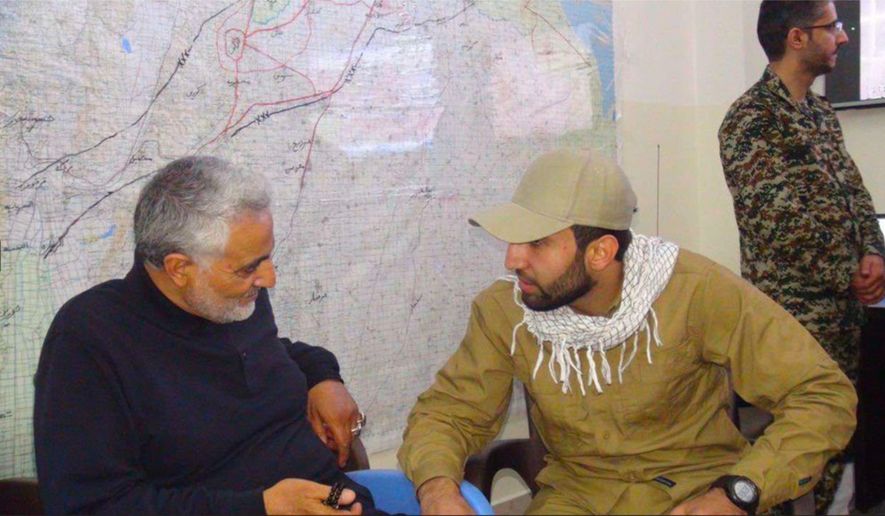
He also reportedly posted to social media photos of himself laughing and/or in deep discussion with longtime IRGC commander Qassem Soleimani, a terrorist eliminated by the U.S. in 2020 and responsible for the deaths of hundreds of Americans.
The U.S. should not let its commitment to the rule of law and international treaties be misused against it. If it does, given the ongoing war with Iran, it is likely that we will only see more such individuals (and their American attorneys) claiming the same as al-Saadi.
Let us not hand them a prepackaged legal strategy by granting al-Saadi’s outrageous demand for prisoner-of-war status.

Please read our comment policy before commenting.