


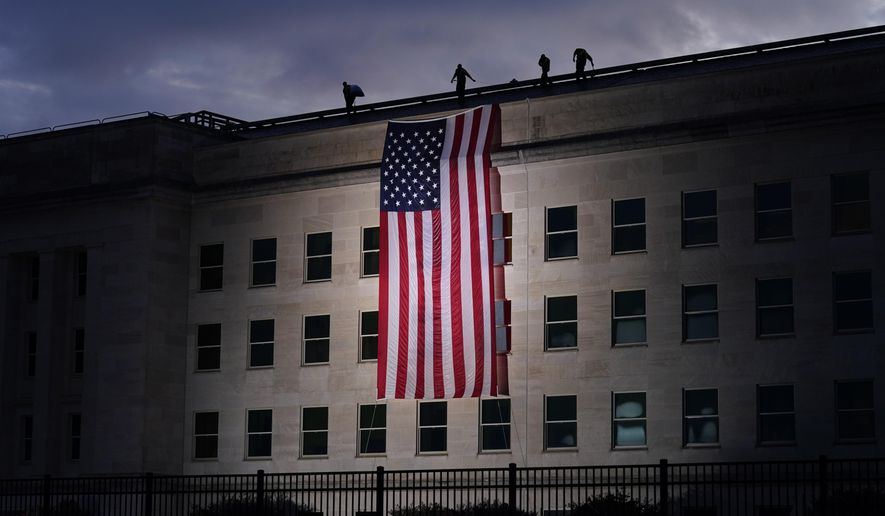

None of today’s K-12 students was alive during the 9/11 terror attacks 25 years ago — and analysts say schools are stumbling over how to teach why they happened.
Officials at the Jack Miller Center, a Philadelphia-based foundation dedicated to teaching American principles, expect many U.S. history classes to address 9/11 as a foreign policy topic at the end of the year — but only if teachers go that far in their textbooks.
Some schools will hold a moment of silence on the anniversary of the attacks, which killed 2,977 victims and 19 hijackers who crashed airliners into the World Trade Center, the Pentagon and a field near Shanksville, Pennsylvania. Others have nothing planned.
“Every state, school and classroom is different in how it approaches 9/11,” said Lauren Altobelli, the center’s executive director of civics initiatives.
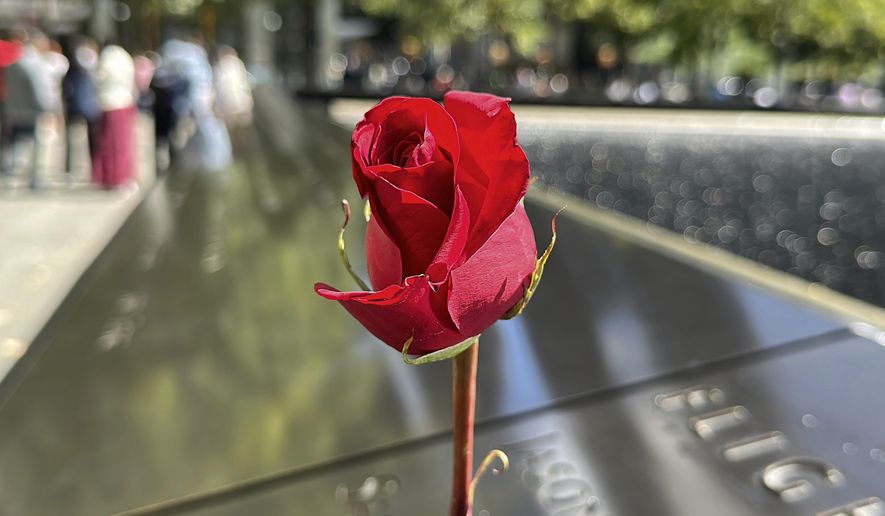
She noted that some states, including Florida and Maryland, have released detailed standards requiring teachers to tell students the facts about what happened. Others, such as Massachusetts and Washington, have no guidelines.
Maryland State Board of Education spokeswoman Cherie Duvall-Jones said its High School U.S. History Framework includes explicit “instruction on domestic and foreign terrorism, September 11 and the War on Terror.”
But she said the actual content of those lessons can vary.
“Local school systems determine the curriculum used to meet those standards,” Ms. Duvall-Jones said. “As September 11 has become more historically distant, instruction has shifted from helping students understand a current event to helping them analyze a historical event.”
The Associated Press recently counted at least 40 states expecting or encouraging public schools to address 9/11. That includes 25 with laws requiring instruction and 13 with optional teaching standards. Some other states, including Pennsylvania, require a moment of silence on the anniversary but do not mandate classroom instruction.
School systems holding memorials for the victims of the attacks this year include D.C. Public Schools and Red Bud Community Unit School District 132, which serves two southern Illinois counties.
The D.C. school system will continue its tradition of honoring three teachers and three students who died on American Airlines Flight 77 — which terrorists crashed into the Pentagon — in social media posts and a moment of silence over school intercoms.
“Leckie Education Campus and Ketcham Elementary School both maintain tributes to those lost, including photographs, murals and plaques,” a D.C. Public Schools spokesperson said. “Leckie Education Campus houses a permanent memorial garden where students, staff, families, and neighbors can gather in peace and reflection.”
U.S. history books from scholastic publishers such as Kids Discover and Houghton Mifflin Harcourt all cover the when, who and how of the 9/11 attacks for classes that get to the unit. The only thing they omit is why.
“An examination of high school history textbooks shows a fair examination of 9/11 events,” said Donald Critchlow, a U.S. historian and director of Arizona State University’s Center for American Institutions. “What is missing in most is a full discussion of radical Islamic ideology, other than a few of them mentioning that Osama bin Laden and al Qaeda were anti-Western and anti-Israel.”
He said public schools are anxious to avoid any appearance of stoking irrational fears of Muslims — despite his belief that such discussions could provide “a better understanding for students about America’s involvement, right or wrong, in Iran today.”
Many more schools, districts and state education boards have said little or nothing about the 25th anniversary of one of the deadliest terror attacks in world history. Some Republicans say that’s worrisome.
“While decisions about classroom instruction belong to states and local communities, we should never lose sight of the importance of preserving our nation’s history, honoring the victims and heroes of 9/11 and ensuring that future generations understand the lasting impact of that day and their responsibilities to be good stewards of the freedoms entrusted to us,” said Rep. Tim Walberg, Michigan Republican and chair of the House Education and Workforce Committee.
Tim Goeglein, a former adviser to President George W. Bush who was in the White House on the day of the attacks, said patriotism about the anniversary has fallen out of fashion among young people more interested in socialism and opposing the U.S. war in Iran.
“I would not be surprised if 9/11 is treated as just another day, much like Memorial Day has become more about BBQs and the first day of summer than as a day to give tribute to the men and women who made the ultimate sacrifice for our nation and freedoms,” said Mr. Goeglein, a vice president at Focus on the Family, a conservative evangelical group.
He urged schools to treat 9/11 as an unprovoked attack that united the nation, similar to the Japanese attack on Pearl Harbor in 1941.
Education is primarily a state and local responsibility under the U.S. Constitution. Rep. Mike Lawler, a New York Republican, introduced a nonbinding resolution last year that would urge all 50 states to teach the events and lessons of 9/11. The bill is stalled in committee.
A Department of Education official noted that there is no federally mandated curriculum for teaching 9/11 in K-12 social studies classes. However, she encouraged public schools to adopt a patriotic stance for the 25th anniversary.
“We cannot expect our children to defend American freedom if they don’t learn about it,” said Savannah Newhouse, an Education Department press secretary.
“Americans collectively owe it to the first responders who ran up those stairs, to the loved ones who never came home and to the everyday citizens who stood together in unity to ensure the next generation never forgets,” she added.
Many analysts still expect public school lessons and memorials to be muted this year, as teachers seek to avoid stoking Jewish-Muslim tensions.
“Teachers generally don’t court controversy in their relationship with students, and even the most self-dealing wannabe leftist martyr is going to pick a different cause to virtue-signal about,” said Mike Davis, an American history professor at Lees-McRae College, a Presbyterian campus in North Carolina.
Curricular resources
Conservatives argue that the attacks cannot be explained without discussing the hatred of fundamentalist Islamist extremists for the freedoms that women, minorities and varied religions enjoy in America.
Several red states, including Utah and Florida, have approved the media platform PragerU to offer supplemental history resources to their teachers. Its videos and parents’ guide on 9/11 ask students in grades 6-12 to reflect on the attacks and America’s war on terror as a battle of good versus evil.
“Generations are growing up without learning why the towers fell or why it mattered they fell here, in a free country, on free people,” said Marissa Streit, PragerU’s CEO. “What we’re observing isn’t [about] whether schools mention September 11, but whether they still call what happened evil.”
Other resources available to teachers covering the 25th anniversary encourage a more critical tone.
The Morningside Center for Teaching Social Responsibility’s social-emotional learning guide instructs teachers to help students understand “why people around the world — including those in Muslim-majority countries — sometimes feel angry at the United States.”
The Council on American-Islamic Relations recently removed a link from its back-to-school guide that included a copy of al Qaeda leader Osama bin Laden’s 2002 “Letter to the American People,” which said that U.S. support for Israel prompted the attacks.
Co-designed by the council’s New Jersey chapter and the advocacy group Teaching While Muslim, the linked lesson plans also described the hijackers as “a group self-identifying as al Qaeda hailing from the mountains of Afghanistan.”
The council removed the link a day after it published the guide, following viral internet protests.
Edward Ahmed Mitchell, the council’s national deputy director, said it deemed the materials inappropriate for younger students, and emphasized that the guide largely advises teachers “what not to do.”
“Don’t ask your Muslim students to explain 9/11 or Islam’s view on terrorism,” Mr. Mitchell said in a phone call. ”Every year around the anniversary, we get complaints from some students who face bigotry from peers bullying them or teachers singling them out, as if they had something to do with the attacks.”
The National September 11 Memorial and Museum’s digital lesson plans for different grades focus on primary sources, including archival videos of the attacks.
Located at Ground Zero in Manhattan, the nonprofit launched a “Never Forget” campaign in June that aims to “reach a new generation of visitors and learners by opening a landmark exhibition featuring stories of 9/11-inspired service, teaching 20 million students and training 100,000 professionals.”
Jonathan Butcher, an education analyst at the conservative Heritage Foundation, praised the museum’s approach.
“Students must be taught the horrors of that day, how terrorists tried to take our freedoms and the resolve of the brave men and women who put their lives on the line on that day and in the months and years that followed to defend the U.S.,” Mr. Butcher said.
The nonprofit media platform Homeland Security Today’s “America After 9/11” guide uses firsthand accounts from policymakers to explain how 9/11 led Congress to create the Department of Homeland Security and expand nationwide surveillance, cybersecurity and airport safety infrastructure.
Some survivors of the September 2001 attacks have urged schools to teach 9/11 as an unprovoked act of terrorism, which federal statutes define as violence calculated to intimidate civilians or coerce government action.
“It was 19 terrorists, full of hatred for America and what this country stood for, attacking innocent people,” said Sujo John, an Indian immigrant who survived the World Trade Center’s collapse by running down 81 floors of stairs. “What more do you want? It’s important to talk about that threat because another 9/11 could happen if we don’t.”
No national organization tracks how schools teach 9/11 and what materials instructors use.
Paul Whitten, an Afghanistan combat veteran and historian who leads military staff rides and tours across Middle Tennessee, said it’s gotten increasingly hard to make young people care about it.
“What I am increasingly seeing is kids and even adults not having any real knowledge of 9/11, and I’ve had to learn how to make the story of 9/11 land,” Mr. Whitten said.
Competing narratives
Education experts disagree on whether schools should teach a unified explanation of 9/11.
“Instead of imposing a singular interpretation of 9/11, teachers should share contrasting curricula and ask their students to make sense of the differences,” said Jonathan Zimmerman, an education history professor at the University of Pennsylvania. “That’s precisely the skill you need to be an effective democratic citizen: thinking for yourself.”
A 2011 Education Week report found that 9/11 received little or no attention in social studies classrooms during its 10th anniversary. Researchers cited crowded curricula, teachers feeling ill-prepared and concern about politically charged discussions as factors.
Jeanne Allen, a former Reagan Education Department official, noted that a 2022 report found that “descriptions of the attacks were exceedingly brief and textbooks struggled to place 9/11 into a coherent historical context.”
“Research has repeatedly found 9/11 treatment lacking,” said Ms. Allen, CEO of the Center for Education Reform.
Her center’s Why America program points teachers to the National Archives, National Constitution Center, Bill of Rights Institute, iCivics Primary Source Sets and Constituting America as key resources to change that.
Officials at Young America’s Foundation, a national network of conservative students, blamed violent rhetoric against Israel for making teachers “increasingly hesitant” to discuss 9/11.
“Students deserve to know what happened on September 11, 2001,” said Rob Tandy, the foundation’s media coordinator. “And they deserve an honest discussion about the radical Muslim ideology that motivated the attack.”
Contact the author


Please read our comment policy before commenting.