


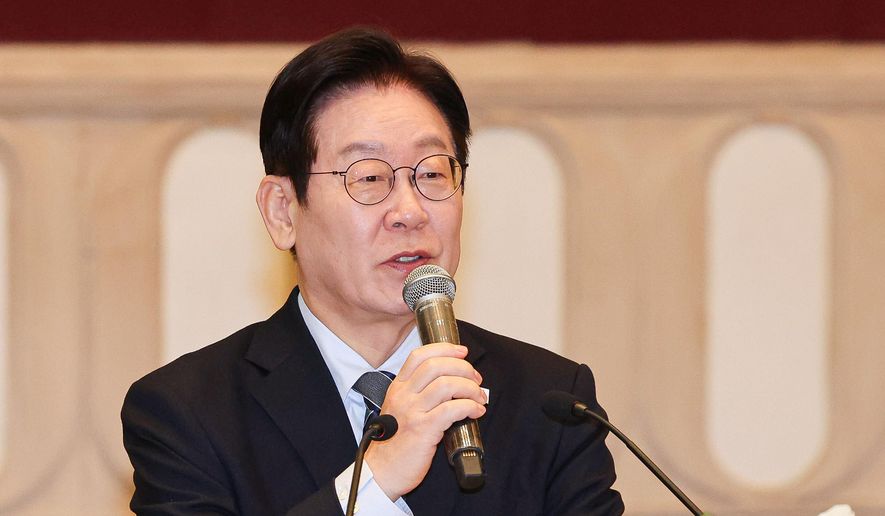

SEOUL, South Korea — South Korean President Lee Jae-myung on Wednesday urged the swift integration of the nation’s armed forces academies in order to dilute the risk of army-led coups.
Since its founding in 1948, South Korea has suffered two coups led by generals, in 1961 and 1980. The generals-turned-presidents ruled the country for a total of 29 years before democratic governance won out in 1987.
“How many military coups has South Korea experienced so far? Weren’t all of them carried out by the Army, and weren’t they done by graduates of the Military Academy?” Mr. Lee said Wednesday during a briefing by officials of the defense, foreign and unification ministries, according to local news reports.
“The Military Academy … has never been held accountable,” he said. “Couldn’t they do it again in the future?”
The president noted that integrating the military academies, a plan that has been dismissed within the Ministry of National Defense, could reduce that possibility.
“Is it acceptable to cultivate the military separately by branch, allow a specific branch to overwhelmingly control the military for a very long time, occasionally stage coups to divide the nation, and bear no responsibility?” Mr. Lee asked.
Army-led coups had looked like distant history for South Korean millennials before then-President Yoon Suk Yeol declared martial law in December 2024 and deployed commandos to democratic institutions.
The attempt fizzled within hours; Yoon was impeached. He is now serving a life sentence for treason.
Still, Mr. Lee’s comments sparked pushback from a prominent former general who told The Washington Times that integrating the military academies would reduce the quality of officers and insisted that the behavior of current-generation officers prove the measure unnecessary.
“I am shocked at what he said,” retired Lt. Gen. Chun In-bum said of Mr. Lee’s remarks. “It is almost beyond my comprehension.”
Mr. Chun commanded troops against North Korean infiltrators, served in Afghanistan and led the crack Special Warfare Command. Since retiring, he has undertaken fellowships at European and U.S. think tanks.
“Until now, the reasoning [to integrate the academies] was to enhance jointness and to alleviate falling demographic issues,” he told The Times.
Korea’s armed forces, like most, struggles to conduct effective joint-service operations and suffers a recruitment shortfall linked to dwindling births.
But Mr. Lee’s stated motivation for an integrated tri-school academy seemed off-base to Mr. Chun.
“The underlying reason might have been this concern for future military [coup] action,” the retired general said. “But it has already been proven that the Korea military, especially the new generation, will not follow unlawful orders.”
In December 2024, Korea’s top-tier military units — the 707th Special Mission Battalion, the 1st Airborne Brigade and operatives of the Defense Counterintelligence Command — were engaged in imposing martial law. They deployed to the National Assembly and the National Election Commission.
However, they carried out their missions half-heartedly when confronted by fast-acting lawmakers and furious citizens. The crack troops — trained in martial arts and marksmanship — did not open fire, and there were no reports of any demonstrators even being punched or kicked.
That is a stark difference from 1980, when airborne special forces were deployed to suppress pro-democracy protests in the southwestern city of Gwangju. The “black berets” opened fire, and more than 200 civilians were killed.
“The officer corps, including one-stars, two-stars and colonels, did not obey orders,” Mr. Chun said of the 2024 incident. “They were not openly resisting but were hesitant throughout the whole process, so I cannot agree that the Korea Military Academy is a breeding ground for coup artists.”
Mr. Lee replaced all of South Korea’s four-star generals three months after taking office in June 2025. His comments on Wednesday suggest he remains suspicious of army elites.
Coup plotters or military pros?
Six academies churn out leaders for the country’s 550,000-strong armed forces, which remain largely conscript-based.
The three major ones are: The four-year Korea Military Academy for army officers, roughly equivalent to the U.S. Military Academy at West Point, New York; the Korea Naval Academy, for navy and marine officers; and the Korea Air Force Academy.
In addition, the Korea Army Academy at Yeoncheon is a “transfer” academy for students with non-military majors that is roughly equivalent to Britain’s Royal Military Academy Sandhurst.
The Korea Armed Forces Nursing Academy produces military nurses, while the Korea National Defense University is a graduate school for professional, high-flying officers.
The Korea Military Academy is the problem, according to Mr. Lee. Also known as Hwarang-dae — named for a corps of warrior youths in ancient Korea — it was founded in 1946, after World War II ended three decades of Japanese colonial rule over the peninsula.
Many early KMA instructors and students had experience in Japan’s imperial forces, a fact that would besmirch the reputations of some of the nation’s Korean War-era officers in the 1950s.
The generation of generals who came to prominence in the 1960s and thereafter gained notoriety for different reasons.
Two putsches that installed military generals as presidents — in 1961 and in 1980 — were led by graduates of the KMA, backed by cabals from the academy as core co-conspirators.
The two generals-turned-presidents oversaw significant economic growth that turned Korea from economic zero to industrial hero and birthed a middle class.
But they also suppressed democratic institutions and practices. The forces they used ranged from massed riot police formations to army special forces to secret police units who oversaw a secret network of detention and torture centers.
Only in 1987, after people-power protests rocked the nation, did South Korea achieve full “one person, one vote” democracy.
Like the country’s three top educational institutions — Seoul National University, Korea University and Yonsei University — the Korea Military Academy is based in northeastern Seoul.
A Korean proverb states: “A horse should go to Jeju [the top breeding ground for stallions], but a young man should go to Seoul” — the ideal location for ambitious youth.
Mr. Chun warned that the army cadet corps will lose elite candidates if an integrated academy moves them to the south-central provincial city of Daejeon, per early plans.
“By moving the ’tri-school’ to Daejeon, everyone knows it will degrade the quality of students,” he told The Times.
He also scoffed at the concept that a new joint-services academy would improve cross-service operational abilities.
“If you have seen concept drawing of the new academy the Ministry of National Defense has proposed has three distinct sectors,” Mr. Chun said. “Put the three schools together and still divide them? It does not add up.”
Contact the author


Please read our comment policy before commenting.