


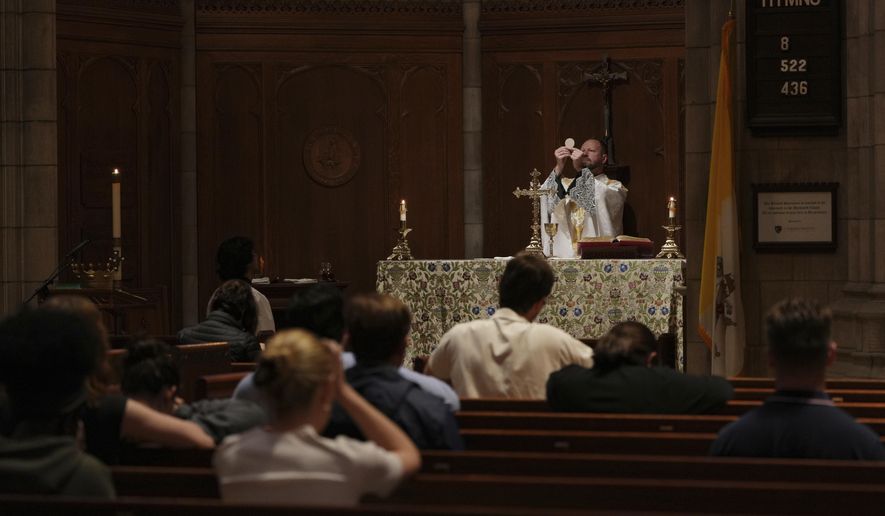

College chaplaincies led a surge in the number of Americans converting to Catholicism during the 2025-2026 academic year, outperforming traditional parishes, a new report finds.
Hallow, a Catholic prayer and meditation app with more than 15 million registered users, found in a representative survey of 59 universities that the number of people seeking baptism and confirmation through campus ministries jumped 87.6% from the 2024-2025 term.
By comparison, Hallow reported in March that 140 of the nation’s 175 dioceses experienced a 38% annual surge in conversions through the Order of Christian Initiation of Adults program during the recent Easter season.
“Our team began hearing stories from folks on the ground who were seeing fuller crowds at Mass, greater attendance at OCIA meetings and just a general resurgence of Catholic faith on campus,” Alex Jones, Hallow’s CEO and co-founder, said Monday in a statement. “We wanted to explore this and quantify the anecdotal evidence that people were sharing.”
Hallow reported that Texas A&M University led the increase among campuses, rising from 121 to 204 converts. Arizona State University jumped from 32 to 137 converts over the period, while the University of Illinois at Urbana-Champaign grew from 47 to 141. The University of Oklahoma placed fourth, growing from 65 to 125 converts.
“This surge is apparent in attendance at daily Newman Center Masses, which are nearly standing room only, and in my classes where I see more and more young men wearing crosses,” Donald Critchlow, a U.S. historian and director of Arizona State University’s Center for American Institutions, said in an email.
Mr. Critchlow described the trend as “a rejection of left-wing secular narcissistic culture.”
The Rev. Gabriel Mosher, a Dominican priest who leads the St. Catherine of Siena Catholic Newman Center at the University of Utah, told Hallow that young men have tripled Mass attendance at the Salt Lake City campus since he arrived four years ago.
Hallow found that participation in adult conversion programs at the average campus more than doubled from the 2024-2025 to 2025-2026 school years.
Several Catholic leaders and researchers said the church’s liturgy, community and intellectual tradition have appealed to young people struggling to find marriage partners and form families in the wake of the COVID-19 pandemic.
“A growing number of college students, especially young men, are turning to the Catholic Church for spiritual sustenance, real community and moral clarity in an age that too often lacks all three,” said Brad Wilcox, a University of Virginia sociologist who studies marriage trends. “Many of them are driven, in part, by online influencers and conservative Catholic writers and thinkers who inspire them to give the Catholic Church a chance.”
Officials at St. Thomas Aquinas University Parish said the number of people entering the Catholic Church through the University of Virginia campus in Charlottesville grew from 32 in 2024 to 64 in 2025 and to 94 this year. Another 64 have already signed up for next Easter season.
“We’re beginning classes for 2027, and it’s looking big again,” said the Rev. Joseph Hagan, a Dominican priest and chaplain serving University of Virginia students.
Others, however, warned against exaggerating Hallow’s findings.
Christian Smith, a sociologist emeritus at the University of Notre Dame, noted that increases “in the hundreds” are nothing compared with the 30 million Americans ages 18 to 24 nationwide.
According to the Hallow report, Notre Dame reported an increase from 52 converts in 2024-2025 to 76 in 2025-2026.
“Percentage changes can look impressive, but the magnitude of the actual numbers themselves is less than minuscule,” Mr. Smith said in an email. “The upticks now are itty-bitty, so the question is whether they will continue to grow into something significant.”
Conversion trends
Georgetown University’s Center for Applied Research in the Apostolate estimates that the number of Catholic converts dropped steadily from 173,674 people in 2000 to 70,796 in 2020.
Since then, the tally has increased from 74,972 in 2021 to 90,157 in 2024 — surpassing the pre-pandemic high of 89,339 converts in 2019.
The Rev. Thomas Gaunt, a Jesuit priest and executive director of the center, noted that many of the collegiate converts reported to Hallow could be people born to Catholic parents who never raised them in the faith.
“So, the numbers look good and encouraging, but a single year or two of data do not make a trend,” Father Gaunt said in an email. “There is a need to have clear data on whether they were ’not baptized’ or grew up unengaged with the church that they are now discovering.”
Nationally, the Catholic Church has grown in the South and West for several decades while shrinking in the Midwest and Northeast.
In Texas, the Diocese of Fort Worth has become one of the fastest-growing Catholic communities in the country, driven in part by a large influx of believers.
“We, too, are seeing an increase in campus engagements and conversions, but these results are not outpacing engagements and conversions at our parishes,” said Jason Whitehead, the diocese’s director of catechesis.
Tricia Bruce, a Catholic sociologist affiliated with multiple institutions, said adult converts often “get missed in wide-scale trends” because they make up just 8% of the nation’s roughly 74 million Catholics.
“It’s unlikely that the growth in conversions, however notable, will be enough to offset longer-scale dips in Catholic affiliation, Mass attendance and participation in sacraments like baptism,” Ms. Bruce said in an email. “But many parishes and campuses are experiencing meaningful growth. Through that lens, contemporary Catholicism in the U.S. is very much alive and well.”
Gender shifts
Several researchers noted that men have become more likely than women since the 2010s to identify as religious and conservative, challenging long-standing trends.
Gallup reported in April that 42% of men ages 18 to 29 described religion as “very important” to their lives in 2024 and 2025, up from 28% in 2022 and 2023. That was higher than the 30% of women who said the same, and was the first time in 25 years of polling that men outpaced women on the question.
“Male-only spaces have been effectively feminized in a way the Catholic Church has resisted,” said political scientist Shaun Rieley, director of educational programs and teaching fellow at Hillsdale College’s Allan P. Kirby, Jr. Center for Constitutional Studies and Citizenship in Washington.
In 2015, Mr. Rieley converted from evangelical Christianity to Catholicism while working on his doctorate at the Catholic University of America. He said this choice helped pull his wife, who had been raised Catholic, back into the church.
“Part of the appeal to men is the traditional architecture and the unapologetic male priesthood that’s increasingly hard to find in Protestantism,” Mr. Rieley said in a phone call. “College is a place where you get to read good books, contemplate the sources of Western civilization and consider the claims that the Catholic Church best maintains the unapologetic Christian tradition.”
Roughly 19% of the nation’s population is Catholic, a share that has been relatively stable since 2014. At the same time, immigration has helped offset tens of millions of American Catholics who leave the faith after growing up in it.
The primary reason people cite for converting to Catholicism remains their desire to marry or find a spouse.
Paul O’Reilly, president of Thomas Aquinas College in Santa Paula, California, where 5% of its 400 students are non-Catholic, estimated that up to 30% of his students marry each other right after graduation.
“When you have a strong chaplaincy and a robust course of studies, it forms young people,” Mr. O’Reilly said. “But there’s also the example of our faculty, who are mostly married and have families, and who host students in their homes.”
Contact the author


Please read our comment policy before commenting.