



Saudi Arabia’s announcement of a coalition of predominantly Muslim nations to fight the “disease” of Islamist terrorism drew an optimistic response from Washington on Tuesday despite uncertainty over the alliance’s true focus and goals.
Although analysts say the partnership of 34 nations may be a ploy to rally Sunni Muslim powers against Riyadh’s main rival, the Shiite powerhouse of Iran, the Obama administration expressed hope that the development will focus more on bolstering the U.S.-led fight against the Islamic State group.
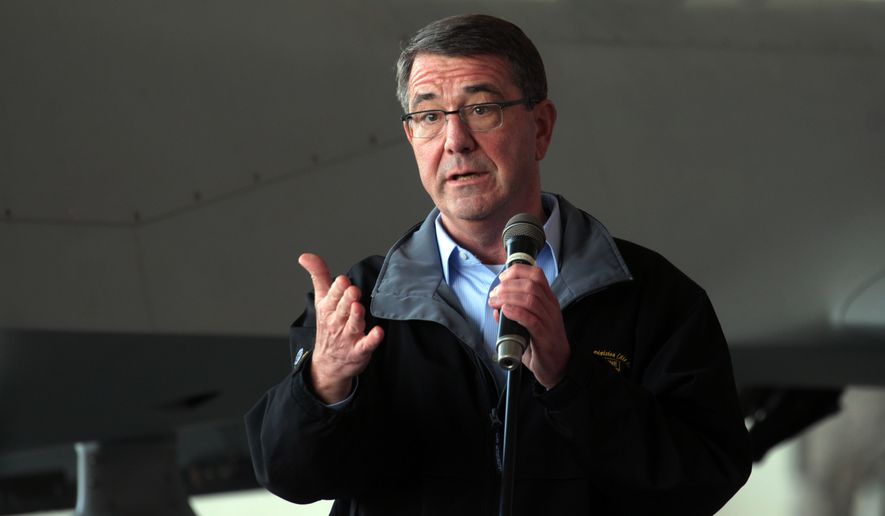
With the administration having struggled to keep Arab powers involved in the fight against the Salafist terrorist group — also known as ISIS, ISIL and Daesh — Defense Secretary Ashton Carter said the Saudi announcement could result in “greater involvement in the campaign to combat ISIL by Sunni-Arab countries.”
But Mr. Carter, who made his remarks during a visit with U.S. troops in Turkey, also gave the appearance of being caught off guard by the emergence of the coalition, suggesting that the Obama administration had little to do with its creation and could have limited influence over its mission.
“We look forward to learning more about what Saudi Arabia has in mind in terms of this coalition,” he said. “But in general, at least it appears that it’s very much aligned with something that we have been urging for quite some time … [for] Saudi Arabia and other states to be more active in the campaign to defeat ISIL.
“That is what I would want to talk to my Saudi counterpart about,” the defense secretary said. “And, I hope that that’s the kind of thing that they have in mind. But I look forward to learning more.”
The Saudi Press Agency on Tuesday said 34 nations had agreed to form an “Islamic military alliance” to fight terrorism with a joint operations center based in the kingdom, but the coalition does not include Shiite-majority Iran or Iraq, and it’s not clear exactly how it would function.
Saudi Deputy Crown Prince and Defense Minister Mohammed bin Salman told a news conference in Riyadh that the coalition would develop mechanisms for working with other countries and international bodies to support counterterrorism efforts.
He also said their efforts would not be limited to countering the Islamic State.
“Currently, every Muslim country is fighting terrorism individually,” the Saudi defense minister said. “So coordinating efforts is very important.”
“Today, there are a number of countries that suffer from terrorism, for example Daesh in Syria and Iraq; terrorism in Sinai, terrorism in Yemen, terrorism in Libya, terrorism in Mali, terrorism in Nigeria, terrorism in Pakistan, terrorism in Afghanistan, and this requires a very strong effort to fight,” he said, according to CNN. “This announcement comes from the Islamic world’s vigilance in fighting this disease so it can be a partner, as a group of countries, in the fight against this disease.”
’Best response’ to terror-Islam link
The counterterrorism coalition includes nations with large and established armies such as Pakistan, Turkey and Egypt, as well as war-torn countries such as Libya and Yemen. African nations that have suffered militant attacks, such as Mali, Chad, Somalia and Nigeria, are also members.
Saudi Foreign Minister Adel al-Jubeir told reporters in Paris that members could request assistance from the coalition, which would address the requests “on a case-by-case basis.”
“There is no limit in terms of where the assistance would be provided or to whom it would be provided,” he said.
Prime Minister Ahmet Davutoglu of Turkey, the only NATO member in the coalition, called it the “best response to those who are trying to associate terror and Islam.”
“We believe that this effort by Muslim countries is a step in the right direction,” he said.
Several smaller nations were named in the coalition, including the archipelago of the Maldives and the Gulf Arab island nation of Bahrain, which is home to the U.S. Navy’s 5th Fleet.
Other Gulf Arab countries such as Kuwait, Qatar and the United Arab Emirates also were named, although notably absent was Oman. In recent years, the tiny Gulf state that neighbors Saudi Arabia has maintained a neutral role as a mediator in regional conflicts and served as a conduit from the Gulf Arabs to Iran.
The coalition has formed as Washington and its European allies try to ramp up their military campaigns against the Islamic State, but also as the Obama administration struggles to keep Arab militaries involved in the U.S.-led coalition of some 64 nations that have vowed to fight the terrorist group, which is based in Syria and Iraq and has a growing number of “provinces” from North Africa to Asia.
U.S. officials acknowledged during recent interviews with The Washington Times that Saudi Arabia’s air force had not flown a mission against the Islamic State in nearly three months, that Jordan stopped flying sorties against the extremists in August and that the United Arab Emirates stopped in March.
A top former Obama administration official who helped build the U.S.-led coalition last year said Persian Gulf Arab powers made a strategic gamble months ago to focus their military resources on a war against Houthi rebels seen as Iranian proxies in Yemen — wagering that the U.S. and the European Union would lead the fight against the Islamic State.
It remains to be seen how Tuesday’s announcement may change that calculus.
Riyadh-Tehran proxy war
At the White House, administration spokesman Josh Earnest offered only a broad-stroke response to the Saudi announcement, asserting that the “Saudis went to great lengths to also make it clear that this is not a substitute or a replacement for the 65-member anti-ISIL coalition that was built and is being led by the United States of America.”
Mr. al-Jubier, meanwhile, said Saudi Arabia and other Gulf Arab states are discussing sending special forces to Syria as part of the U.S.-led coalition.
“There are discussions, countries that are currently part of the coalition [like] Saudi Arabia, the [United Arab] Emirates, Qatar and Bahrain about sending in some special forces into Syria, and those discussions are ongoing,” he said.
But there were questions over the extent to which the Saudi-led alliance is intended to present a unified front against the Islamic State or will be more focused on countering Iran’s influence in the region.
The absence from the coalition of Iran, as well as Syria and Iraq — both of whose governments are seen to be aligned with Tehran — only fueled such questions. The timing of Riyadh’s announcement also prompted speculation because it came on the same day a cease-fire went into effect between Saudi-led military forces and Iranian-backed rebels in Yemen.
“The Riyadh-Tehran proxy war definitely has something to do about it,” said Cenk Sidar, who heads the Washington-based research and strategic advisory firm Sidar Global Advisors. “Saudi Arabia has long been trying to increase its influence in the region.
“Riyadh’s move to establish an ’Islamic military coalition’ just as a cease-fire is coming into effect in Yemen — while only vaguely specifying where and how the new coalition will fight against terrorism — does not indicate any clear message in the direction that the Western world would ask for,” Mr. Sidar said.
“Just last week, we saw the Iran-Saudi power game playing out during OPEC meetings,” he said. “We could read the Saudis’ move now as being designed to demonstrate Riyadh’s power in the region.”
Firas Abi Ali, senior Middle East analyst at the London-based consulting firm IHS Country Risk, described Riyadh’s announcement as “an attempt at broadening the net of countries supporting Saudi Arabia, potentially as it prepares de-escalation in Yemen,” according to a report by Al Jazeera.
⦁ This article is based in part on wire service reports.
Contact the author


Please read our comment policy before commenting.