'Your papers, please' must never be heard in America

President Obama said Friday that reports of Syria using chemical weapons "is a game changer" for dealing with the regime, but he cautioned that the U.S. won't take action quickly.

Jordan has signed off on a plan for Israel to fly military drones of its airspace to Syria in order to keep abreast of the civil war and whether government forces use chemical weapons.
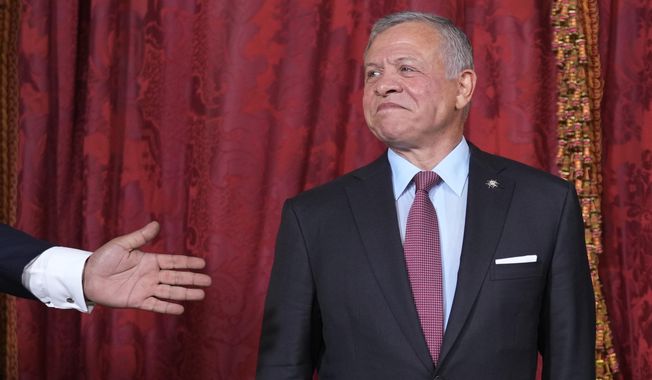
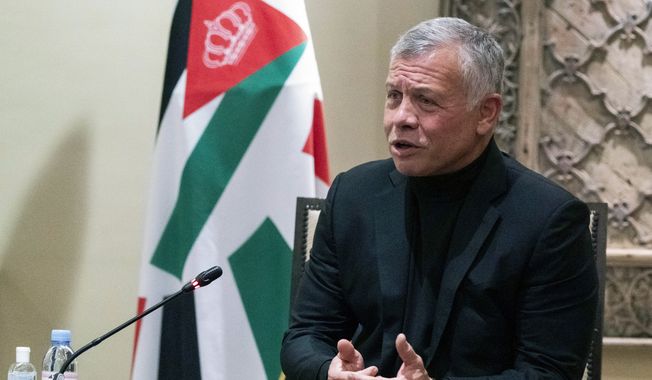
At his recent news conference with President Obama, King Abdullah II of Jordan was asked whether he would consider closing Jordan's border to refugees from Syria ("Obama pledges $200M to Jordan for Syrian refugees," Web, Friday). "How are you going to turn back women, children?" Abdullah answered, "This is something we just can't do. It's not the Jordanian way." The king's sentiment is noble, and his open arms for more than 300,000 refugees is laudable. But the Jordanian border is not open to all refugees fleeing Syria.

President Obama met with King Abdullah II and his son, Crown Prince Hussein bin Abdullah, in Jordan Friday and afterward immediately announced he would seek $200 million in additional U.S. aid to help care for Syrian refugees flooding into the country.

Islamists and other government critics won about a quarter of the seats in Jordan's newly empowered parliament, according to initial results released Thursday, a surprisingly strong showing despite a boycott by the country's most powerful opposition group.

Jordan's King Abdullah II is touting Wednesday's parliamentary elections as the centerpiece of political reforms aimed at addressing the simmering discontent in his realm.

On the seventh day of his Holy Land tour, Sen. Rand Paul continued to walk a fine line between expressing support for Israel while avoiding the impression that his support for the Jewish state is uncritical and self-serving.

Jordan's King Abdullah II paid a rare visit to the West Bank on Thursday in a show of support for Palestinian President Mahmoud Abbas' successful bid for U.N. recognition of a Palestinian state.

Frantic efforts to reach a cease-fire in the 7-day-old Israel-Gaza conflict appeared stalled late Tuesday, after negotiators throughout the day confidently predicted an imminent truce and Secretary of State Hillary Rodham Clinton rushed to Israel to appeal for peace.

It's usually a few younger protesters who break out in the chant — startling and almost unheard of in this country where the monarchy has always been almost sacrosanct — "Down, down with the king."

Jordan, a key U.S. ally in the Middle East, was rocked Wednesday by a second day of protests that uncharacteristically targeted the king after the government raised fuel prices in a desperate act to reduce a massive budget deficit.

A radical Islamist cleric described by prosecutors as a key al Qaeda operative in Europe was freed from prison Tuesday after a court ruled he cannot be deported from Britain to Jordan to face terrorism charges.
Israel has lifted a ban on Palestinian travel between the Jordan Valley and the rest of the West Bank that an Israeli rights group says had made lives of local residents miserable.

For Jordan's King Abdullah II, preventing the Arab world's wave of uprisings from washing into his country has been an exercise in careful calibration — easing his absolute grip on power just enough to defuse protests.
An airstrike Wednesday killed 15 al Qaeda-linked militants in their training camp in the country's south, Yemeni military officials said. The airstrike resembled earlier U.S. drone attacks, but the U.S. did not comment.
"It is our duty to protect citizens, but at the same time, we have to open our doors to our Syrian brothers, and I'm very optimistic that the situation is moving in the right direction," King Abdullah II said at a Cabinet session.
"Police are still searching for 30 more people," he said without elaborating.