'Your papers, please' must never be heard in America

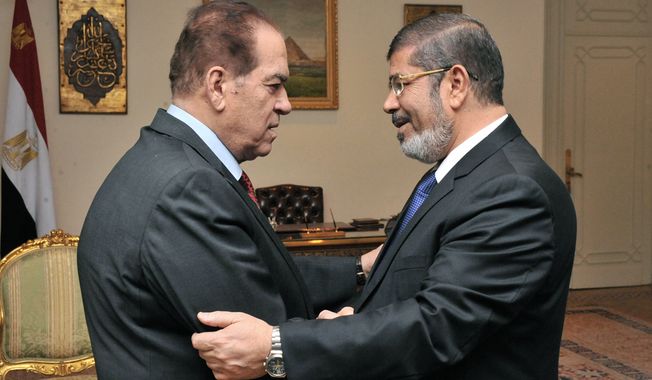
Egypt's military signaled its acquiescence Monday to the president's surprise decision to retire the defense minister and chief of staff and seize back powers that the nation's top generals grabbed from his office.

Egypt's Islamist president ordered the retirement of the defense minister and chief of staff on Sunday and canceled the military-declared constitutional amendments that granted the top generals wide powers previously reserved for the head of state.

Egypt's Islamist president ordered the retirement of the defense minister and chief of staff on Sunday and canceled the military-declared constitutional amendments that granted the top generals wide powers previously reserved for the head of state.

The power struggle that has pitted Egypt's first democratically elected president against his country's courts and military has drifted into murky legal waters, leaving analysts, officials and ordinary Egyptians scratching their heads over the question: who has the law on their side?

What does it mean that Mohammed Morsi is the president of Egypt? The American consensus is that Egypt has been lost. However, the election was not just symbolic, but illusory. Egypt's future remains very much in play.

The Arab Spring is over; the Egyptian Revolution has begun. Egypt's new president Mohammed Morsi issued a decree Sunday reconvening the country's recently dissolved parliament. Egypt's Supreme Constitutional Court disagreed, saying its finding that the parliamentary election was unconstitutional was final.

Egypt's highest court insisted Monday that its ruling that led to the dissolution of the Islamist-dominated parliament was final and binding, setting up a showdown with the country's newly elected president.

Egypt's president on Sunday ordered the Islamist-dominated parliament to reconvene in defiance of a military decree dissolving the legislature last month on the basis of a ruling by the country's top court, the state news agency reported.

Islamist Mohammed Morsi became Egypt's first freely elected president on Saturday, launching his four-year term with a potentially dangerous quest to wrest back from the military the full authority of his office.

The election of Egypt's first Islamist president poses a challenge for the Obama administration, which is grappling with the reality of embracing a leader whose worldview often has been at odds with Washington.
An Egyptian court suspended on Tuesday a government decision allowing military police and intelligence agents to arrest civilians, a setback for the country's military rulers after the decree drew an outcry from opponents who accused them of trying to impose martial law.

For all their ideological fervor, revolutions in practice tend to be fairly predictable affairs. More often than not, when the initial groundswell of popular discontent recedes, the best-organized and most ideologically cohesive political factions assume power and proceed to run the show according to their own preferences.

An Egyptian court on Tuesday suspended a government decision allowing military police and intelligence to arrest civilians, a setback for the country's military rulers after the decree drew an outcry from opponents who accused them of trying to impose martial law.

Egypt's newly elected president, Mohammed Morsi, says he will be a "leader for all Egyptians." That sounds a lot like the sorts of lies his fellow Muslim Brothers have been telling for months, only to renege on them when they can.

Egyptians celebrated Sunday the election of their country's first freely elected president - Mohammed Morsi of the Muslim Brotherhood, who becomes the first Islamist head of state of the Arab world's most populous nation.