


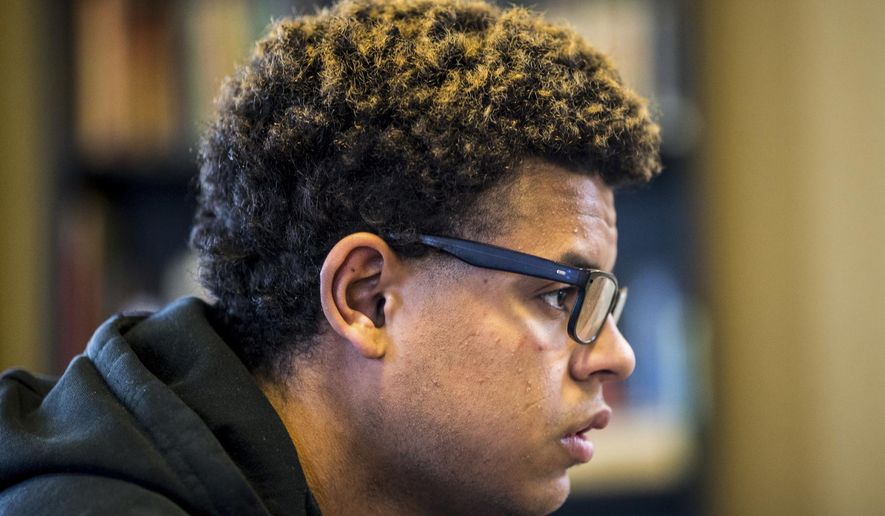

YAKIMA, Wash. (AP) - Each afternoon, Cory Butler heads to Rod’s House - a drop-in center for homeless youth and young adults in downtown Yakima - where he waits to be taken across town to a new overnight winter shelter for young adults.
Butler, 20, said he’s grateful for the shelter at Englewood Christian Church, where he’s been spending nights since it opened more than two weeks ago. He doesn’t fit in at adult shelters.
“There’s a lot of older people who don’t understand the younger generations - the way I dress, the way I talk would upset them sometimes,” said Butler, clad in dark jeans and a black pullover sweater with the top of his dark hair dyed a lighter color.
Yakima’s overall homeless problem is long-standing and quite obvious, but less visible is a rapidly growing population of homeless youths and young adults, such as Butler, with few services to help them. For example, there’s no permanent overnight shelter in Yakima for minors, and placing young adults at facilities with older people could leave them vulnerable to sex trafficking, sexual exploitation and other problems, service providers say.
There is no clear picture of how many homeless teens and young adults there are in Washington state - or in Yakima County - but a 2016 state report estimated more than 13,000 youths ages 12 to 24 were living on the streets statewide. Officials also look to growing numbers of homeless K-12 students not only as a possible clue of how big the problem may be, but also as ground-zero in battling the issue.
The numbers are startling: Over the past decade, the Yakima School District has seen its homeless student population nearly quadruple to just over 5 percent of its students this year.
Officials know those homeless students are at high risk of becoming chronically homeless adults, so state and local agencies are focusing their efforts on homeless youths and young adults in hopes of breaking the cycle and preventing an explosion in chronically homeless people.
That means helping homeless students find stable living situations so they can concentrate on school work, and helping homeless young adults between the ages of 18 and 24 find a place to live so they can get a job and become independent, said Jim Theofelis, executive director of A Way Home Washington, a statewide coalition of service providers and state agencies focused on helping young adults out of homelessness.
“We need to have a system that understands (that) 18-to-24-year-olds are our best, last chance to interrupt the pattern of homelessness,” Theofelis said.
EXTENT OF THE PROBLEM
Determining the number of homeless young adults isn’t easy. Unlike their older counterparts, they are less likely to participate in surveys, such as the annual “Point in Time,” which counts the number of homeless in the state. A lack of associated services focusing on older teens and young adults also makes tracking them difficult, said Josh Jackson, director of Rod’s House. In addition, many have experienced bad situations in foster care, detention centers and other programs and are therefore less likely to seek help, he said.
“It takes time to build trust with a population that wants to stay underground,” Jackson said.
But there are indications homelessness among youths and young adults is on the rise statewide.
The number of homeless students in grades K-12 in the state has nearly doubled over the past 10 years. During the 2008-09 school year, there were 20,780 homeless students in Washington state, but by 2015-16 that number had jumped to 39,671 - 3.7 percent of the more than 1 million students statewide, according to the most recent data from the state Office of the Superintendent of Public Instruction.
It’s worse in the Yakima School District where the rate of homeless students nearly quadrupled over the same time period. The district’s homeless student population was 171 during the 2008-09 school year but grew to 847 by 2015-16, accounting for 5 percent of the district’s 16,200 students, OSPI data shows. Superintendent Jack Irion said he was surprised to see how much homelessness has grown among students.
“That’s a significant population of our students that are homeless,” Irion said. “When you come to school not knowing where you’re going to sleep that night, I think it’s pretty hard to focus on education.”
The situation is similar across Yakima County, where 2,614 homeless K-12 students were counted attending schools across the county during the 2015-16 school year - also 5 percent of the more than 54,290 students countywide.
SOLUTIONS
This year, Yakima has taken a step forward in reaching homeless young adults by establishing its first winter shelter devoted to homeless people ages 18 to 24. The shelter, Butler says, means he has a place to go - a refuge not possible if he had to go to a shelter housing older homeless adults.
Past experiences at those shelters have left the 20-year-old feeling vulnerable, he said.
Last summer, Butler stayed at Camp Hope behind the former Kmart, where he says he was intimidated by others.
A woman there took away a puppy Butler obtained from the nearby Yakima Humane Society after criticizing the way he was caring for the animal, and a man kept telling him he’d be drafted into the military, sent to Iraq and be killed, he said.
Tension grew, Butler said, and the man began threatening to beat him up.
“There definitely was a threat there and that’s why I’m glad I’m at the youth shelter, where we’re all relatively the same age,” he said.
So far, about eight homeless young adults have been using the winter shelter nightly, but Jackson said that number will increase as word gets out.
“This is a group that has been staying outside a lot and they don’t have to stay outside this winter,” he said,
The new statewide focus on homeless youths and young adults is already bringing attention to Yakima and leading to more collaboration among local service providers. For example, Catholic Charities has received $632,000 in state grants and another $304,000 in federal funds specifically to house young adults, said program manager Callie Webster.
Seven young adults have already been housed using the grant money, with five more in the process of being housed. The funding will be allocated over three years, and those housed will eventually begin paying rent. The program aims to help individuals come off of assistance within two years, she said.
“The real hope and goal of this is for a true launch into financial stability and adulthood,” Webster said.
Although the Yakima School District has partnered with area service providers in the past to ensure homeless students receive services, it’s now directed staff to determine the leading causes of homelessness among students and devise a plan to prevent it. One finding is that often poor communication prohibits families from solving conflict, and that results in homelessness, Irion said.
“What are we doing as a community to teach those skills? Because those are teachable,” he said. “We want to address that - that’s why we’re headed down this second path.”
Meanwhile, the state Office of Homeless Youth Prevention and Protection along with A Way Home Washington is embarking on a plan to help funnel grants to local communities in need of services.
And Yakima has caught the state’s attention, said Kim Justice, the agency’s executive director.
“Yakima is a community we’ve been paying a lot of attention to,” she said. “They’ve created a coalition on youth and young adults, they meet regularly and are working to find solutions.”
One such fix may be to establish a host-home program where youths can live with a family without the family being required to obtain a foster-care license, she said.
Another solution may include building shelters, one for minors and another for young adults, she said. But much work would be needed to provide the data needed to define such a project and secure funding.
The state and A Way Home Washington later this year will select eight to 12 communities across the state to help do the work needed to establish more services such as shelters, Theofelis said. Although A Way Home Washington has yet to make a decision, Yakima would be considered, he said.
Despite the challenges, Theofelis and other advocates are confident the problem of teen and young adult homelessness can be solved.
“We do not have to accept this, but we do have to be more thoughtful with more intent about how we address this,” he said. “I really believe we can solve this in Washington state and be a national model.”
___
Information from: Yakima Herald-Republic, http://www.yakimaherald.com

Please read our comment policy before commenting.