



OPINION:
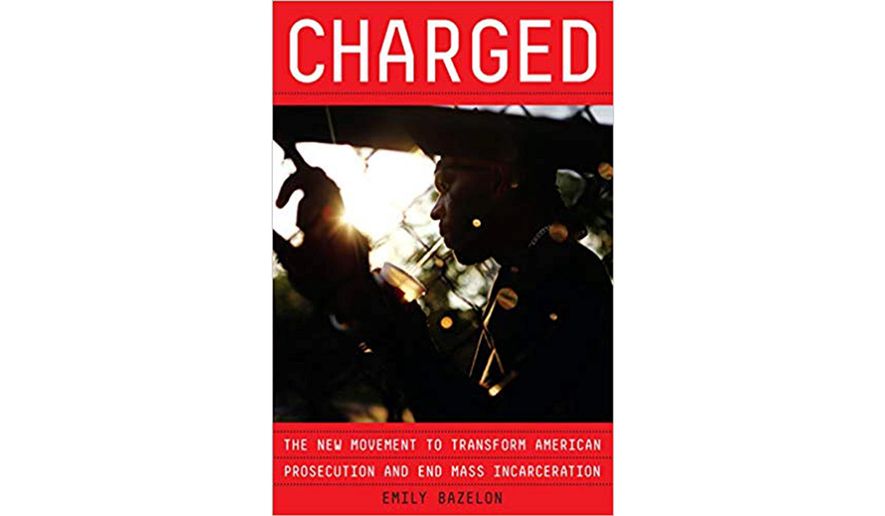
CHARGED: THE NEW MOVEMENT TO TRANSFORM AMERICAN PROSECUTION AND END MASS INCARCERATION
By Emily Bazelon
Random House, $28, 407 pages
Although I’m not sure it delivers on the promise of its subtitle, this is nonetheless a most important book, because it takes a critical look at several important problems that have been swept under the national rug for far too long. Chief among these problems is the overarching, and over-reaching, power of American prosecutors, especially on the statewide level, which has led — directly, says the author — to the problem of mass incarceration.
(For a revelatory look at prosecutorial misbehavior on the federal level, see Rob Cary’s “Not Guilty: The Unlawful Prosecution of U.S. Senator Ted Stevens,” a book [full disclosure] on which I worked.)
Emily Bazelon is a journalist (nine years for Slate, before joining the staff of The New York Times Magazine) with a law degree from Yale who now lectures there. Her previous books include the national best-seller “Sticks and Stones: Defeating the Culture of Bullying” and also “Rediscovering the Power of Character and Empathy.”
If her surname sounds familiar to Washington ears it’s because she’s a grand-daughter of legendary Washington lawyer and judge David Bazelon, also known for being concerned about the rights of criminal defendants. It’s no stretch to say she’s following in his large footsteps.
In “Charged: The New Movement to Transform American Prosecution and End Mass Incarceration,” Ms. Bazelon wastes no time getting to her point. In the introduction, she writes, “This book will show that American prosecutors have breath-taking power, leading to disastrous results for millions of people churning through the criminal justice system and they have used it to put more people in prison, contributing to the scourge of mass incarceration which continues to rip apart poor communities, especially if they are mostly black or brown, and long ago passed the level required for public safety.”
She calls the “unfettered power” of prosecutors “the missing piece for explaining how the number of people incarcerated in the United States has quintupled since the 1980s, to a total of almost 2.2 million,” a total “nine times Germany’s and seven times France’s.”
Hard-line law-and-order readers who take issue with such statements, viewing them as the literary equivalent of “cooking the books,” should be mollified by the author’s reliance, as cited in her footnotes which cite such reliable sources as statistics of the U.S. Department of Justice. (In addition to more than book 300 pages of text, “Charged” has 54 pages of carefully detailed notes, all from recent sources, plus a 20-plus page single-spaced appendix (in smaller type) called “Twenty-One Principles for Twenty-First-Century Prosecutors,” that includes specific recommendations on reducing incarcerations and increasing fairness. No bibliography, but add to that an index.
If all this makes “Charged” sound like a law school textbook, fear not. Emily Bazelon avoids that trap by interspersing two real-life cases that illustrate her main points. The first is that of a black teen from the Brownsville neighborhood in the Bronx, New York, whom she calls Kevin to protect his privacy.
Kevin’s charged with gun possession. He says he was trying to hide it from the police when they raided a friend’s apartment; they say it was his. Years later, having successfully completed a rigorous diversion program, the gun charge is behind him and Kevin can start to get on with his life, but never totally without fear. A somewhat similar situation is illustrated in the case of Noura Jackson who, in 2005, discovered her mother’s dead body in the family home in Memphis. The dead woman had been stabbed 55 times. When they could find no other suspect, the police charged Noura.
Ms. Bazelon writes that the decision to charge Noura Jackson with her mother’s murder was made by an overly-ambitious prosecutor, Amy Weirich, despite the fact that all the evidence against Noura was circumstantial.
Later, when the DNA found in the mother’s bedroom was not a match for Noura’s, the prosecutor simply dismissed it, saying that it didn’t make her even “hesitate” because “Sometimes DNA doesn’t [point to anything].”
Noura is convicted, but eventually the conviction is reversed (because Ms. Weirich asked, in front of the jury, a rhetorical question that the appeals court decided violated the defendant’s Fifth Amendment right against self-incrimination.) By the time she, like Kevin, finally walks free, she has spent 12 years in prison, from ages 18 to 30.
By the book’s end, while I felt the author had shown that a growing number of states were definitely taking steps to reduce mass incarceration, I wasn’t convinced this represented a “movement,” though I hope it does.
In concluding, Ms. Bazelon writes, “The criminal justice system is ungainly and massive, and rerouting it is like turning an ocean liner We have to fix the broken parts [of it]. And we the people have the power, with our votes.”
• John Greenya, a Washington writer and critic, is the author of “Gorsuch: The Judge Who Speaks For Himself” (Simon and Schuster, 2018).

Please read our comment policy before commenting.