



A version of this story appeared in the daily Threat Status newsletter from The Washington Times. Click here to receive Threat Status delivered directly to your inbox each weekday.
A version of this story appeared in the daily Threat Status newsletter from The Washington Times. Click here to receive Threat Status delivered directly to your inbox each weekday.
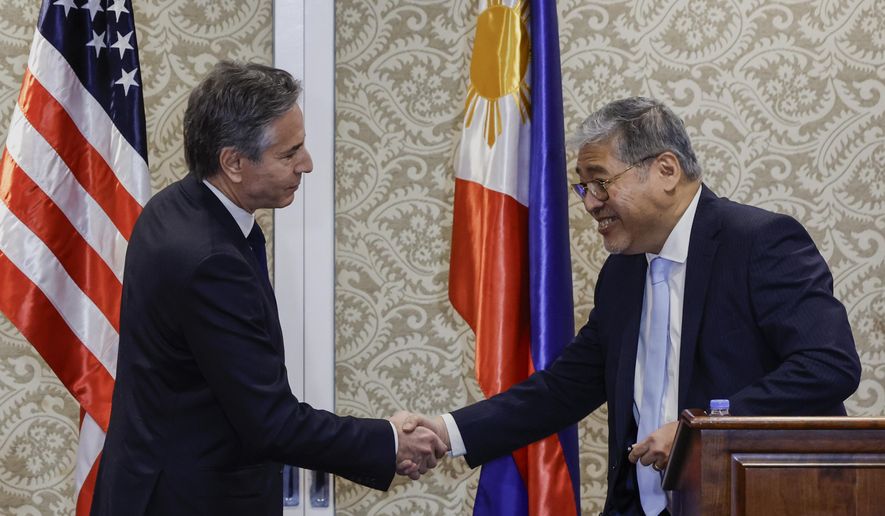
SEOUL, South Korea — Secretary of State Antony Blinken on a visit to the Philippines on Tuesday reaffirmed Washington’s “ironclad” commitment to Manila’s defense in the face of rising friction with China and talked up an upcoming trilateral summit with Japan.
The first-ever joint meeting between the leaders of Japan, the Philippines and the U.S. will take place on April 11. Japanese Prime Minister Fumio Kishida and Philippine President Ferdinand Marcos Jr. will travel to Washington to meet with President Biden, U.S. and Filipino officials said.
“These are three countries that have a shared vision for a free and open Indo-Pacific,” Mr. Blinken told a press conference in Manila Tuesday, “and I think a recognition that when we work together, when we collaborate, when we pool our resources — including in terms of economic cooperation, building critical infrastructure, humanitarian assistance — we are stronger when we do it together and bring together all the complementarities that we have.”
In the background of Mr. Blinken’s discussions with Mr. Marcos and top officials are a series of basing agreements that the Biden administration has negotiated with the Marcos government granting U.S. forces access to strategic posts in the region, notably for any future defense of Taiwan.
Also looming over Mr. Blinken’s trip Tuesday were a series of recent clashes in contested waters west of the Philippines between Philippine and Chinese vessels. Though Mr. Blinken made clear that the U.S. remains committed by treaty to the Philippines’ defense against armed attack, he did not address how Washington will respond to what military analysts call Beijing’s recent “gray-zone” tactics, conducted below the threshold of “armed attack.”
While the Philippines contends with Chinese maneuvers off Second Thomas Shoal in the South China Sea, Japan faces similar issues with Chinese hybrid tactics around the disputed Senkaku Islands in the East China Sea, which China calls the Diaoyu Islands.
Some expect the upcoming trilateral summit to include measures to build up the domestic capacities of Philippine forces — a country with tiny defense expenditures and maritime assets compared to China.
However, both Mr. Blinken and his Philippine counterpart, Enrique Manalo, alluded to a far more ambitious, longer-term project, helping increase the overall economic muscle of the Philippines, a country that ranks behind fellow ASEAN nations such as Singapore, Brunei, Malaysia, Thailand, Indonesia and Vietnam in economic growth rates and per capita income.
Iron-clad alliance — with holes
Noting that its alliance with the Philippines is America’s oldest in the region, Mr. Blinken made clear that Washington has Manila’s back.
“We stand with the Philippines and stand by our ironclad defense commitments, including under our Mutual Defense Treaty,” he told reporters. The U.S. commitment “extends to armed attacks on the Philippine armed forces, public vessels, aircraft — including those of its Coast Guard — anywhere in the South China Sea.”
But China so far had adopted tactics — including blocking Philippine ships from contested areas, rammings, water cannons, even an alleged laser — that fall below the threshold of “armed attack.” Notably, the Chinese vessels engaged in recent incidents are not from the People’s Liberation Army Navy but from China’s Coast Guard, “maritime militia” or from centrally directed fishing fleets.
As a result, U.S. warships have not intervened. Asked by a journalist whether the defense treaty could be expanded to include such hybrid attacks, neither Mr. Blinken nor Mr. Manalo could clarify.
Chinese Foreign Ministry spokesman Lin Jin told a press briefing later in the day that “military cooperation between the United States and the Philippines should not harm China’s sovereignty and maritime rights and interests in the South China Sea, let alone be used to prop up the Philippines’ illegal position,” Reuters reported.
Beijing claims most of the South China Sea in the face of competing claims for islands and shoals from countries such as Brunei, Malaysia, Vietnam and the Philippines. In 2016, an international tribunal ruled in favor of Manila on competing sovereignty claims in the sea, but China has refused to recognize the decision, calling Manila’s claims to waters off the western Philippines “illegal.” The U.S., Mr. Lin said Tuesday, “is not a party to the South China Sea issue and has no right to interfere in the maritime issues between China and the Philippines.”
Mr. Manalo said discussions Tuesday’s talks with Mr. Blinken focused on “many issues including defense and security engagement, … always anchored on the rule of law.”
Building bases, building alliances
As Washington seeks to upgrade security ties between Indo-Pacific democracies, the April trilateral summit follows a path forged last year. In August 2023, Mr. Biden hosted the leaders of Japan and South Korea in a three-way meeting at Camp David.
Mr. Biden, Mr. Marcos and Mr. Kishida “will discuss trilateral cooperation to promote inclusive economic growth and emerging technologies, advance clean-energy supply chains and climate cooperation, and further peace and security in the Indo-Pacific and around the world,” the White House said in a statement Tuesday.
Warming Washington-Manila ties, which Mr. Manalo said are now on “hyper-drive,” contrast sharply with the pro-China tilt of Mr. Marcos’ predecessor, Rodrigo Duterte. The U.S. and the Marcos administration reached a deal last year expanding U.S. rotational basing rights in the country from five to nine bases, including two new sites in the strategic northern Luzon region. North Luzon oversees the strategic Bashi Channel between the Philippines and Taiwan and a U.S. military presence there could make the waterway unpassable for Chinese naval assets seeking to either blockade or surround Taiwan prior to attacking.
Last November, U.S. and Philippines forces began conducting joint naval patrols in the area, and Defense News reported last month that the U.S. has also committed to upgrade the Philippine bases, including an air base in northern Luzon.
Neither Mr. Blinken nor Mr. Manalo addressed speculation that the Pentagon may also help build a port facility on the Philippine islands chain of Batanes, which lies in the Bashi Strait just 125 miles from Taiwan. In February, Philippine Defense Secretary Gilberto Teodoro called for more troops on the islands, which he called the “spearhead of the Philippines.”
Philippine news outlets reported earlier this month that a Navy spokesperson referred to the project as a civilian port that could, nonetheless, be used by armed forces in crises. Earlier, Batanes Governor Marilou Cayco said U.S. military personnel would visit the islands in April to discuss possible port construction.
Beyond military and diplomatic developments, both sides on Tuesday talked up the importance of boosting the Philippines’ economy, which has long lagged behind East Asia’s economic tigers.”
“For many years we have made major investments in the capacity of the Philippines,” said Mr. Blinken, who also referred to a recent trip by a U.S. trade delegation led by Commerce Secretary Gina Raimondo. “Economic strength is perhaps the most important factor in its long-term strength and security.”
Contact the author


Please read our comment policy before commenting.