



A version of this story appeared in the daily Threat Status newsletter from The Washington Times. Click here to receive Threat Status delivered directly to your inbox each weekday.
OPINION:
A version of this story appeared in the daily Threat Status newsletter from The Washington Times. Click here to receive Threat Status delivered directly to your inbox each weekday.
Our nuclear weapons capability is highly compromised and in need of immediate attention, according to a report issued last October by the Strategic Nuclear Posture Committee. The committee is composed of people across the political spectrum who otherwise would probably agree on nothing else.
The report is unsparing in its assessment of how we went from the sole leader of the new world order to playing catch-up to our nuclear rivals in a generation. All three legs of our triad have reached the ends of their life span, as has the command and control network that makes them function. The Nuclear Security Enterprise, owned and operated by the Department of Energy’s National Nuclear Security Administration, is at or beyond its capability to reliably meet operational demands for uranium, plutonium, lithium, tritium, high explosives and non-nuclear components.
People were interested in these podcasts
While the U.S. and Russia have parity with respect to strategic nuclear weapons, the imbalance in nonstrategic — tactical — nuclear weapons, which are not subject to any treaty, is immense. At the moment, the Russians enjoy at least a 10-to-1 advantage over the United States in these nuclear weapons.
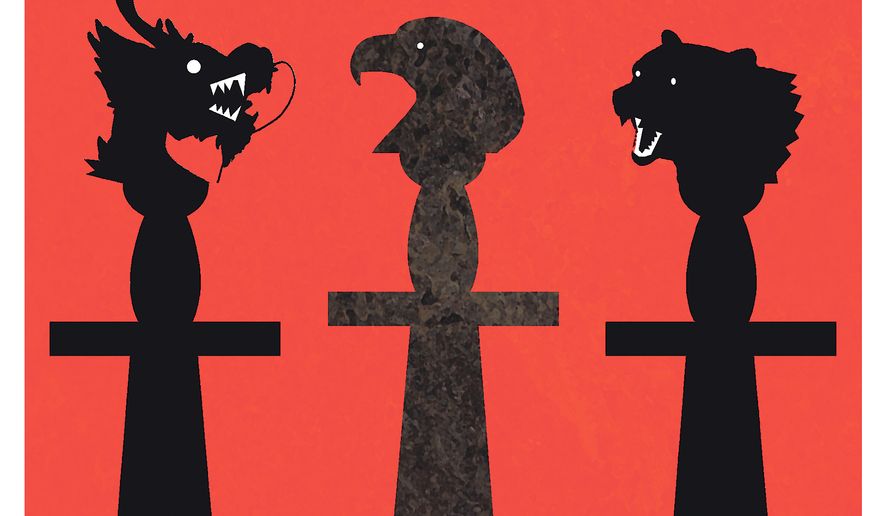
China is in the middle of a massive nuclear buildup, which has been described as “breathtaking” by the former commander of the U.S. Strategic Command. The buildup is expected to bring China to parity with the U.S. and Russia in about a decade. While the U.S. is just now embarking on its nuclear modernization efforts, China and Russia are completing their programs. We have never faced the prospect of two peer or near-peer nuclear rivals and do not yet have the analytical and intellectual bases to address the emergent nuclear tripolarity.
How did we get here? In the course of 30 years, we went from what Francis Fukuyama labeled the end of history — where the world would coalesce around a new liberal global world order of Pax Americana — to one in which the U.S. and our partners are on the wrong side of an existential game of nuclear chess with Russia and China.
We have failed on two fundamental fronts.
First, we failed to understand our enemies. For Russia, we believed that it would join, not challenge, the emerging liberalized world order. While the West had always understood that the Russian capability for paranoia was unbounded, we acted as if the Russian character would change overnight and that Russia would become a trusted partner in the new world order. The inflection point for the Russians was the U.S.-NATO bombing of Serbia in 1999. Russia recognized that it could not keep pace with NATO airpower. It decided to double down on its nuclear arsenal as its security guarantor.
With respect to China, the U.S. and other nations welcomed China into the liberal economic order by admitting it into the World Trade Organization in 2001. By enabling the Chinese export-focused economy, the U.S. and the West believed that China would evolve into a liberal economic state with its new wealth. But we somehow forgot that China is a totalitarian state whose economy and military support not Chinese citizens, but the Chinese Communist Party. Along with this fact, we also forgot that the Chinese Communist Party keeps to its 100-year plan to expunge capitalism from the world.
Second, we wanted to believe the narrative. We wanted an end of history. We wanted a stable, liberal, globalized world order. We wanted Russia and China to reform. We wanted them to be partners. Accordingly, we saw what we wanted to see and failed to see what was right in front of us. Given where we are, we need to abide by this admonition, which is carved into a pillar at the National Archives: “Eternal vigilance is the price of liberty.”
• David S. Jonas is a partner at Fluet in Tysons, Virginia. He served as general counsel of the National Nuclear Security Administration and teaches at Georgetown and George Washington University law schools. Patrick Rhoads leads the nuclear research efforts at the National Strategic Research Institute. These are the opinions of the authors and not necessarily those of any organization with which they have been or are now affiliated.

Please read our comment policy before commenting.